
Spatial AI observability traces how a location-aware system moves from a request to an authorized place, a geographic calculation, a ranked result, a map action, and a host outcome. Model latency and token counts can show that a call finished. Those two numbers cannot show that the place was eligible or that the customer finished the job. The useful record is the decision path, kept small enough to explain the result without copying private location data.
The sections below separate system telemetry from the geographic decision, name what to trace, and mark what should stay out of the log. Related reading includes Spatial AI Accuracy Evaluation and An Enterprise Spatial AI Pilot. A healthy service graph can still hide a wrong place.
Spatial AI observability essentials
- Trace the decision: Authorization, retrieval, place identity, geography, eligibility, ranking, tools, and the host outcome are separate spans.
- Keep IDs, not copies: Place, route, policy, model, and action identifiers explain more than pasted prompts.
- Minimize content: Secrets, raw private records, and precise location stay out of the telemetry store by default.
- Count the removals: A result total is incomplete without the reason each candidate left the set.
- Share a failure vocabulary: Offline cases and production incidents should use the same categories.
What Is Spatial AI Observability?
A customer can ask which store on the way home still has an item and will be open on arrival. The answer depends on identity, current inventory, hours, a route, eligibility rules, a ranking policy, a map action, and whether the person actually chose a store. A trace that stops at the model call can report tokens and latency while missing every one of those steps. Observability here means the team can reconstruct the decision from structured signals, not that every prompt is archived.
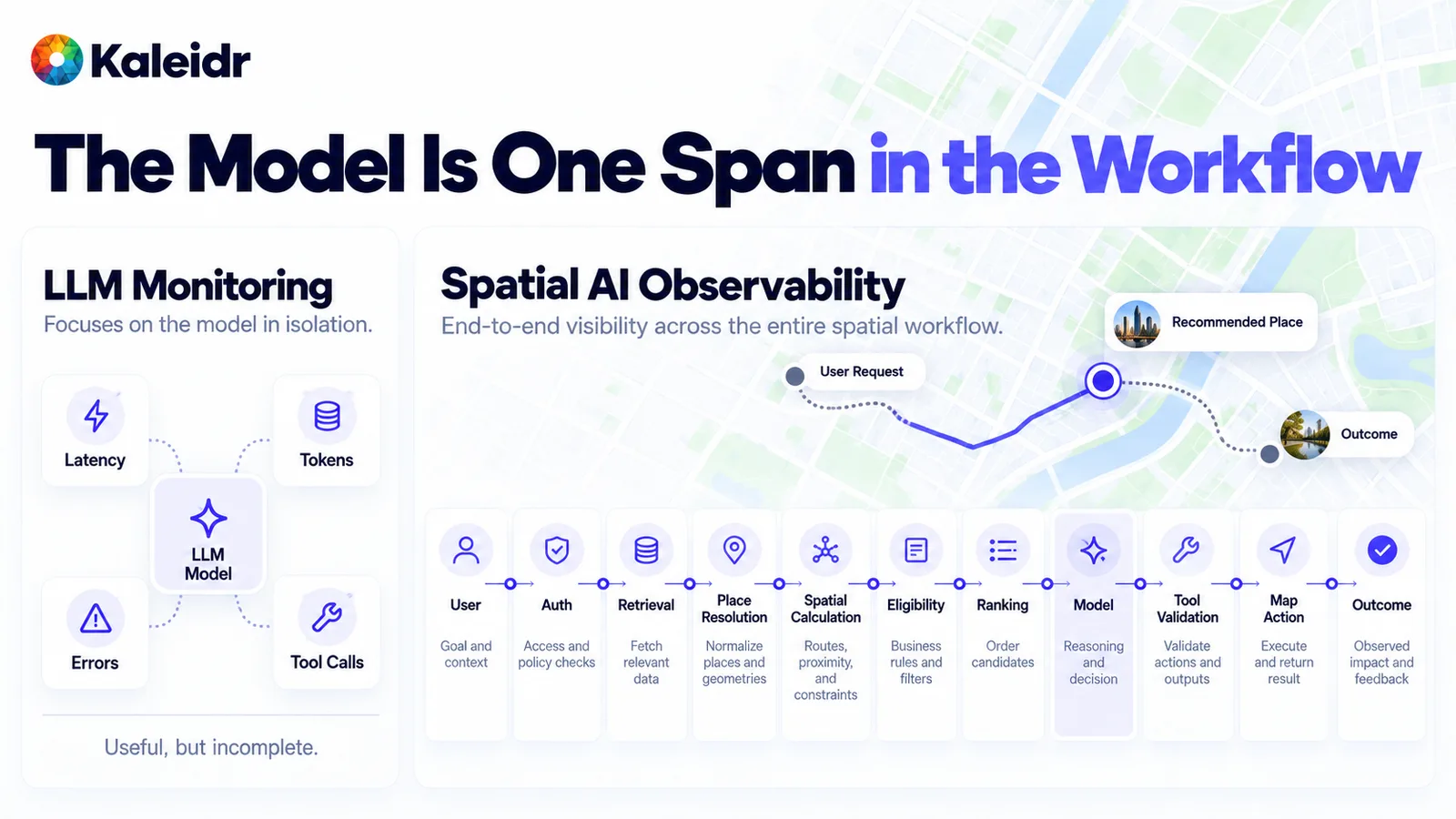
The left panel watches the model in isolation. The right panel keeps the model as one span among retrieval, place resolution, eligibility, ranking, tool validation, and the map action. The split is an observability pattern, not a Kaleidr benchmark.
Three kinds of truth have to meet. System truth covers latency, errors, retries, and dependency health. Decision truth covers which place IDs were authorized, which candidates failed a hard rule, which route ran, and which action was validated. Outcome truth covers whether a place was selected, a route was opened, or a host workflow finished. A dashboard of only the first kind can look calm while the product recommends a closed store. A dashboard of only map engagement can look busy while an expensive tool retries in the background.
What Belongs on One Spatial AI Trace?
One request should carry a stable request ID through the stages that actually ran. Authorization records the policy version and the allow or deny result. Retrieval records the source and the count of records returned, not the private rows. Place resolution records the candidate IDs. Routing records a route ID and a status. Eligibility records how many candidates remained and why others left. Ranking records the policy version and the ordered IDs. The model span records the provider, the version label, and token counts. Tool validation records whether a proposed action was rejected or executed. The closing events record a selected place and, when the host reports it, a completed workflow.
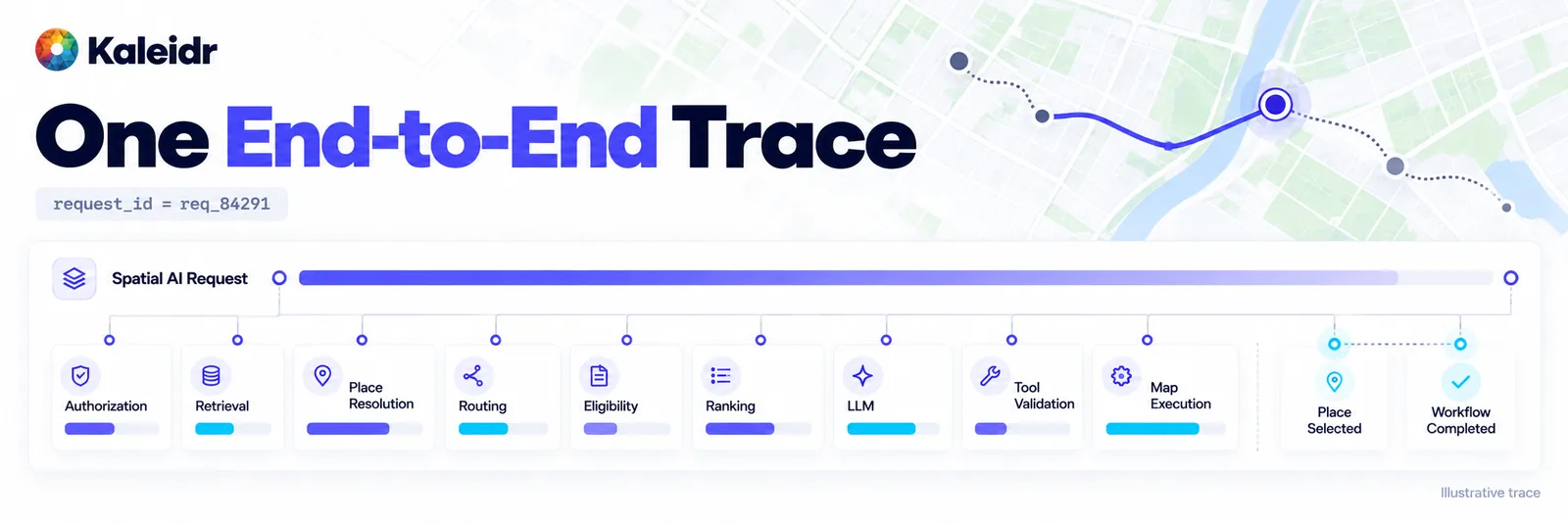
The parent span is the request. Child spans cover the stages that can fail independently, and the closing marks are place selected and workflow completed. Durations on the figure are an illustrative trace, not measured Kaleidr latency.
Not every request needs every span. A "show this place" action can skip ranking. A service recommendation may use the full chain. The trace should say which stages ran and which were skipped, so a missing routing span is not mistaken for a routing success. Version labels on the figure, including any model name printed on a card, are example metadata and not a Kaleidr model catalog.
How Should Traces, Metrics, Events, and Logs Be Split?
Traces answer where time went inside one request. Metrics answer whether a rate is getting worse across requests, such as p95 latency, a no-result rate, or a tool-failure rate. Events answer what changed at a point in time, such as a candidate removed, a place selected, or an action rejected. Logs hold diagnostic detail that does not need to become a formal metric, such as a parser warning. Mixing those jobs makes the expensive store the default store.
OpenTelemetry's event guidance draws the same line. Operations with a duration and a meaningful boundary belong in spans. A checkpoint, a state change, or another point-in-time outcome inside a longer operation is an event candidate (OpenTelemetry, 2026). A May 14, 2026 article by James Newton-King shows Generative AI operations recorded as traces, including model calls and tool activity, and notes that prompt content and tool arguments stay out of telemetry by default because they can contain sensitive data (Newton-King, 2026). The semantic conventions documentation, labeled 1.44.0 on the page read for this post, defines shared names for traces, metrics, and logs (OpenTelemetry, 2026). Spatial attributes such as a place-result set ID or a no-result reason can sit beside those names. Those spatial names are application examples, not official OpenTelemetry spatial conventions.
What Should Stay Out of the Telemetry Store?
Observability fails if the telemetry system becomes a second copy of customer, location, or business data. Record identifiers, versions, counts, status, latency, and reason codes by default. Treat redacted snippets, sampled content, and generalized geography as conditional, and only with a stated need, a retention limit, and access control. Avoid secrets, raw private records, full unrestricted prompts, precise coordinates that the question does not need, and access tokens. A city or market code often answers the operational question that a raw address would answer.
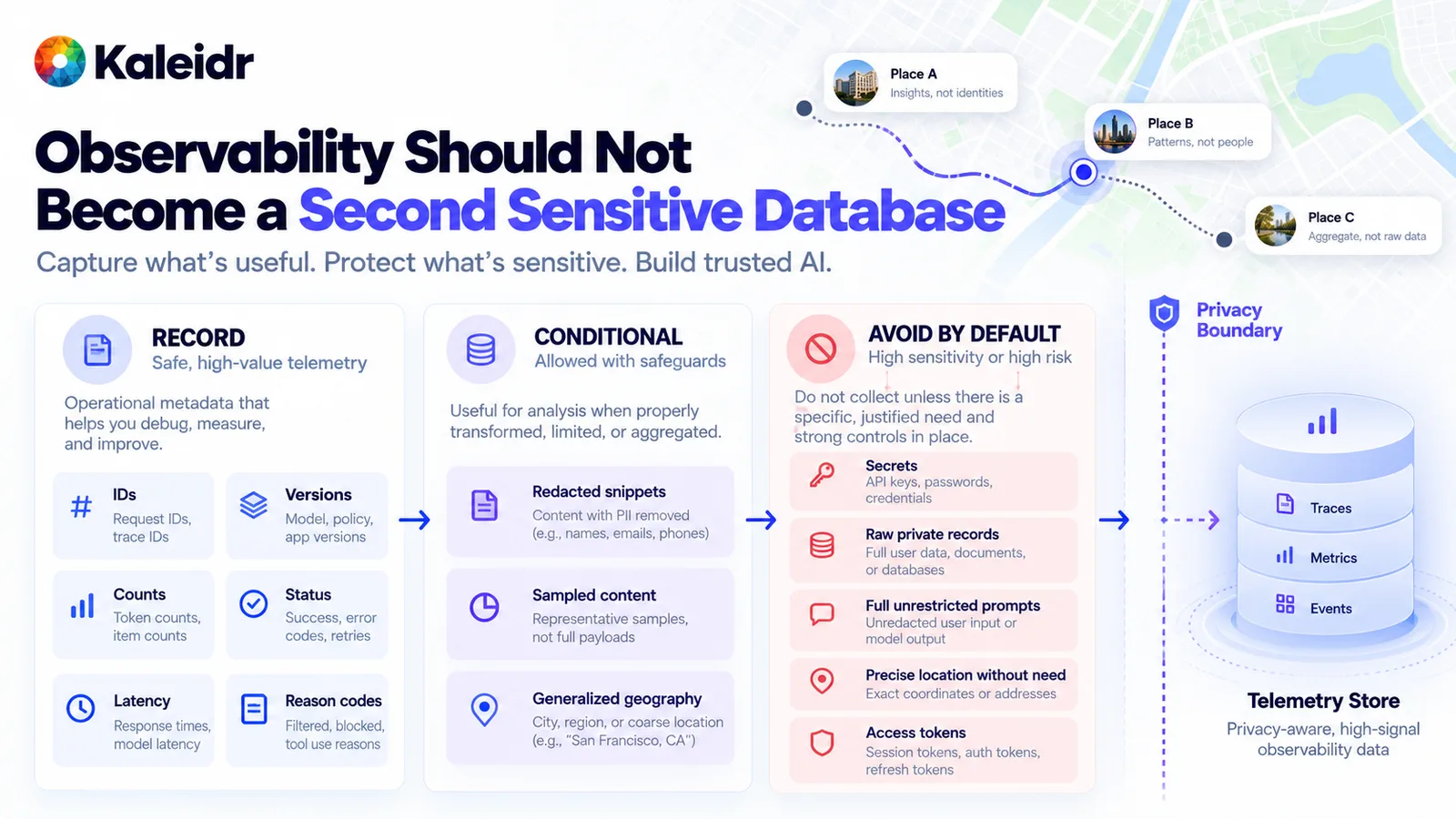
The left column is the default record. The middle column needs a safeguard. The right column stays out unless a specific control justifies it. The figure is a minimization pattern, not a certification.
OpenTelemetry's Generative AI attribute registry warns that retrieval query text may contain sensitive information, and it marks several content-bearing attributes as likely to include user or personal data (OpenTelemetry, 2026). Kaleidr's private-location guidance already puts authorization before the model receives records, and it warns against uploading an unrestricted internal database (Kaleidr, 2026). A trace should preserve that boundary. Log that authorization passed for a result-set ID. Do not log the private rows that the check allowed.
Why Log Why a Candidate Disappeared?
A single result count cannot explain a bad recommendation. The useful funnel records how many candidates were retrieved, how many remained after authorization, and how many remained after hard rules. Each removal needs a reason code: closed, out of stock, outside the service area, missing hours, unauthorized, or unknown freshness. Without the reason, a drop from twenty candidates to six looks like a ranking choice when it was an eligibility filter.
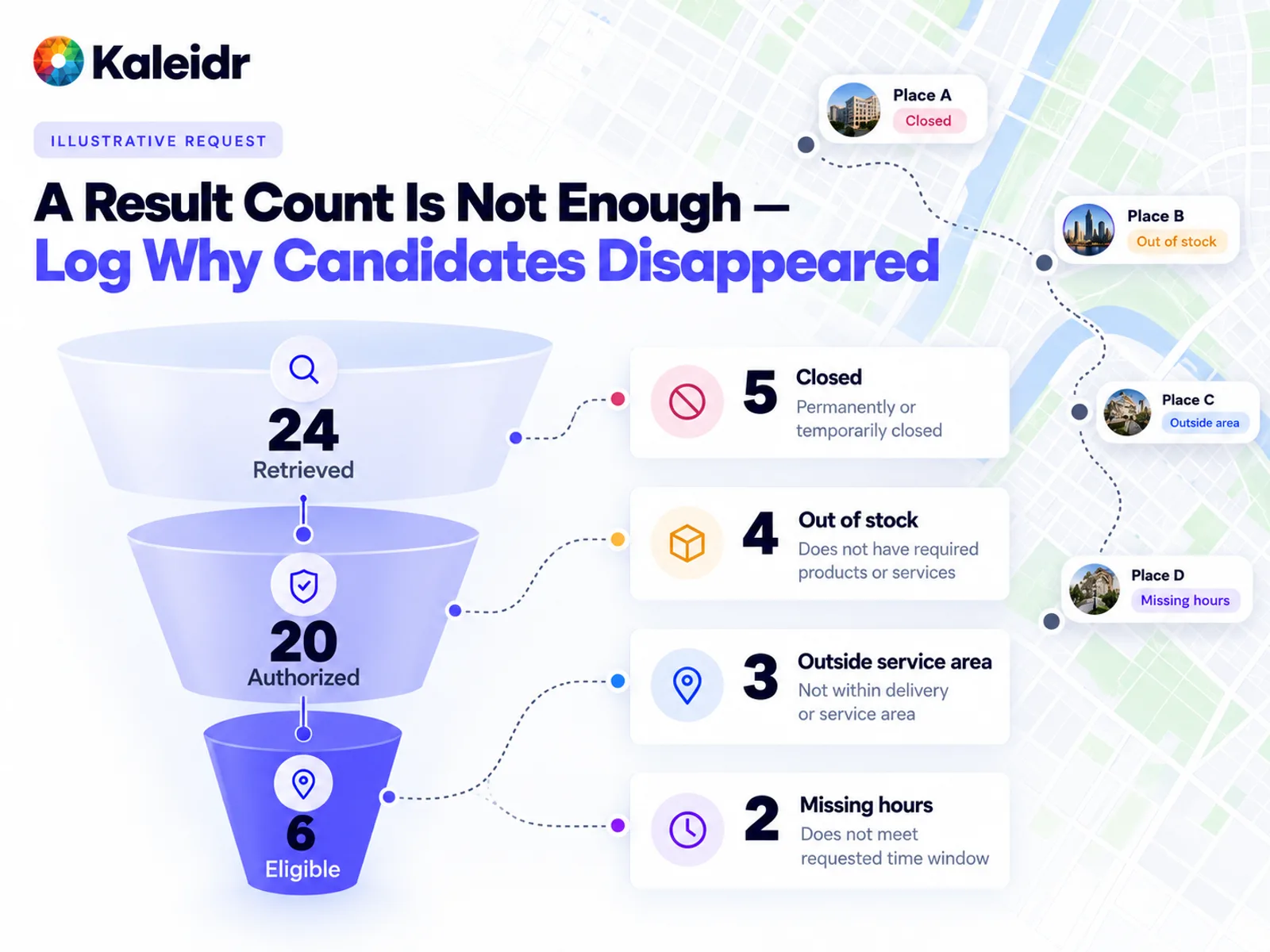
The counts on this figure are an illustrative request, not a Kaleidr measurement. The side cards show why candidates left the set. A production trace should store those reason codes, not only the final total.
Kaleidr's grounded Spatial AI guidance already recommends structured no-result reasons, such as closed, out of stock, out of area, unknown hours, or unauthorized, rather than a bare failure flag (Kaleidr, 2026). A valid no-result means every candidate failed a hard rule. A system failure means the source was unavailable or too stale to decide. Those two endings need different alerts. Relaxing a critical constraint in silence turns a valid empty set into a wrong recommendation.
How Should a Tool Call Be Traced?
A model can propose a tool call. Proposal is not approval, approval is not execution, and execution is not a completed business action. Record the tool name, the schema-validation result, the authorization decision, the policy check, the execution status, the latency, and the failure reason. Rejection exits matter as much as the success path: invalid arguments, an unauthorized caller, a blocked policy, or an execution error. The host outcome, such as a finished booking, stays in the system that owns the transaction.
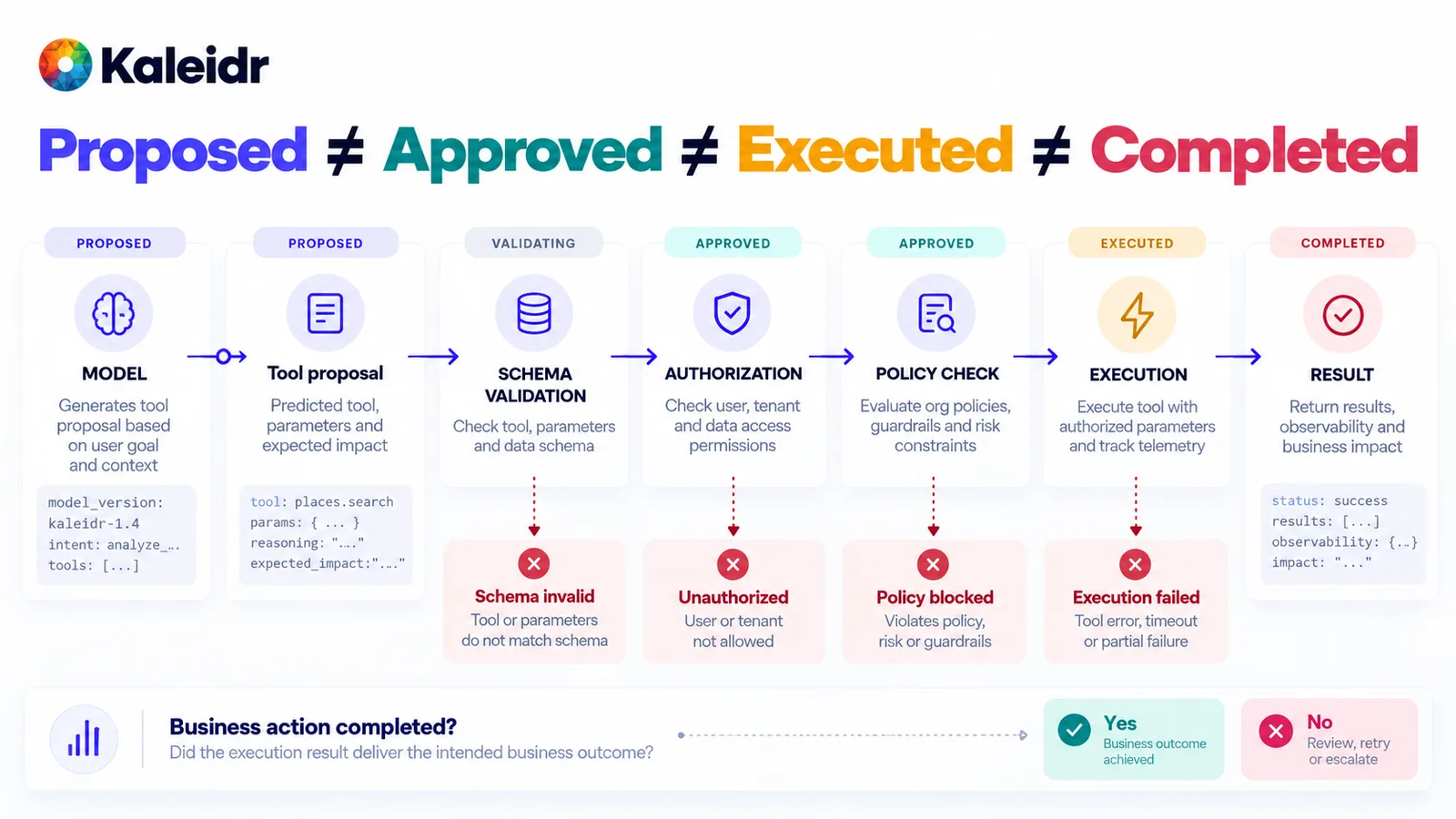
Each gate can stop the call before execution. The closing question is whether the host job finished, not only whether the tool returned a payload. The status chips are an architecture sketch, not a fixed Kaleidr permission list.
Map actions belong in the same pattern. Show places, fit bounds, and draw route are semantic actions. The adapter that talks to the renderer should emit an executed or rejected event. The model span should not be the only record that a pin appeared. If the assistant described a place the map never showed, the trace should make that mismatch visible.
How Should Production Behavior Be Read by Place?
A global average hides a local failure. Segment quality by market, language, data source, task type, and system version, using the coarsest geography that still answers the question. A city code or a market ID is often enough. Exact device coordinates are not required to see that one region is returning empty sets or that one routing provider is failing. New markets, a changed place provider, a new language, and a shift in the questions people ask are all forms of drift, and model drift is only one of them.
NIST Measure 2.4 says the functionality and behavior of an AI system and its components are monitored in production, because systems may encounter new issues and risks as the environment evolves. The page calls that effect drift, and says drift means systems no longer meet the assumptions and limitations of the original design. A suggested action is to document how metrics observed in production differ from the same metrics collected during pre-deployment testing (NIST, 2026). The same page states that AI RMF 1.0 is being updated and that the playbook will be updated after that revision. Use the page as context for what to watch. Kaleidr does not treat the page as a control list.
How Does Evaluation Meet Production?
Offline evaluation asks how the system performs on controlled cases with known truth. Production monitoring asks how the system behaves with live users, live data, and live geography. The two programs should share failure categories, such as interpretation, grounding, spatial calculation, ranking, action, and recovery. A production incident then becomes a test case. A benchmark regression becomes something the production dashboard can recognize after launch. Kaleidr's accuracy guide evaluates that decision chain rather than one blended model score (Kaleidr, 2026).
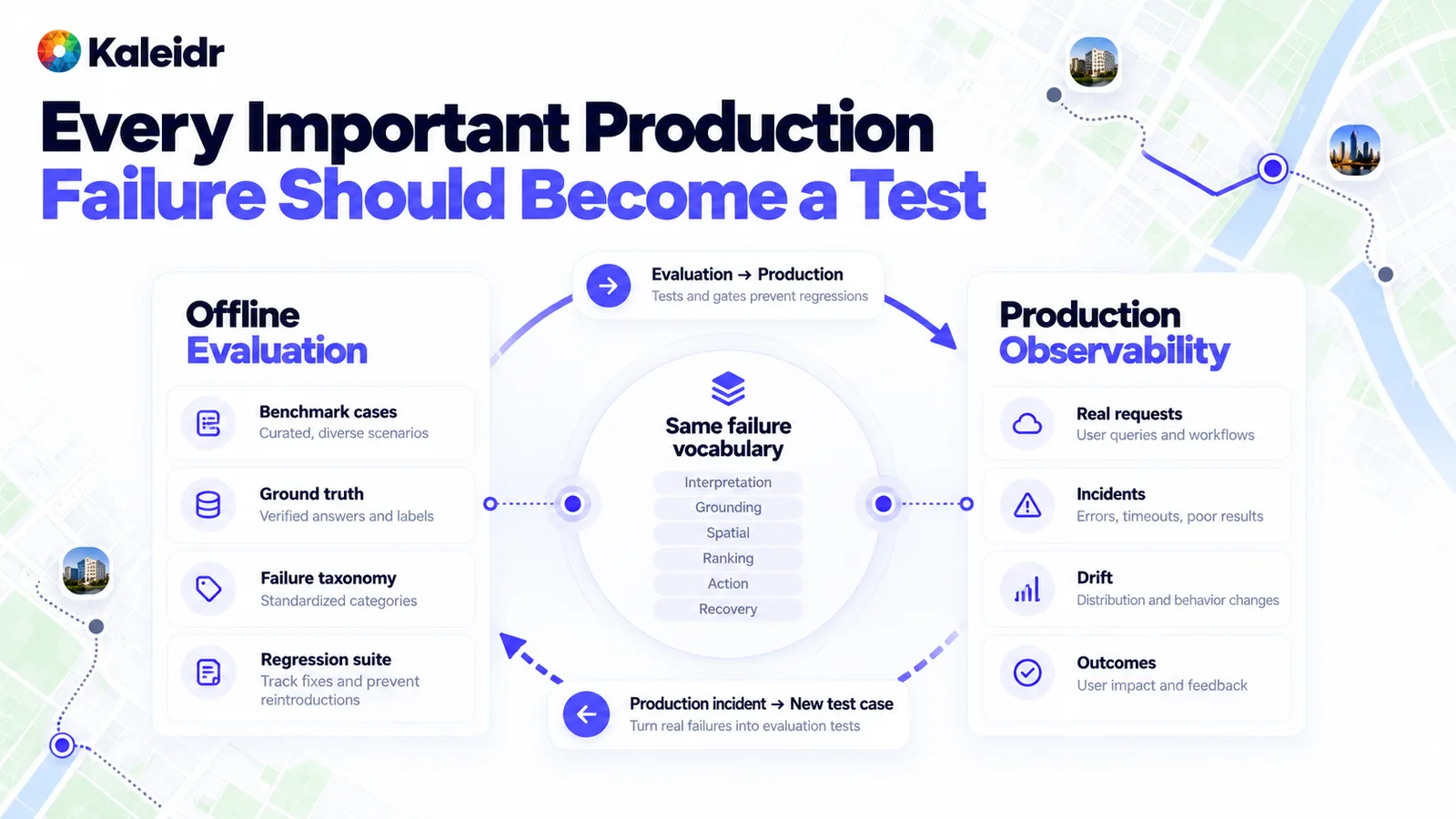
Evaluation supplies cases, ground truth, and a regression suite. Production supplies real requests, incidents, drift, and outcomes. The shared categories in the center are the contract between the two. The loop is a method, not a reported Kaleidr score.
Where Does Kaleidr Analytics Fit?
Kaleidr Analytics currently describes dashboards for reach, views, and engagement, audience location and activity, sessions, views, and interactions per map, place comparison, and spatial patterns (Kaleidr, 2026). Those signals describe how people use maps and places, and the signals are not a distributed trace of authorization, retrieval, routing, model calls, or host transactions. The host should keep instrumenting private services and the systems that record bookings, purchases, and other outcomes. A stable map ID, place ID, or workflow ID can join the two without copying every internal record into the analytics layer.
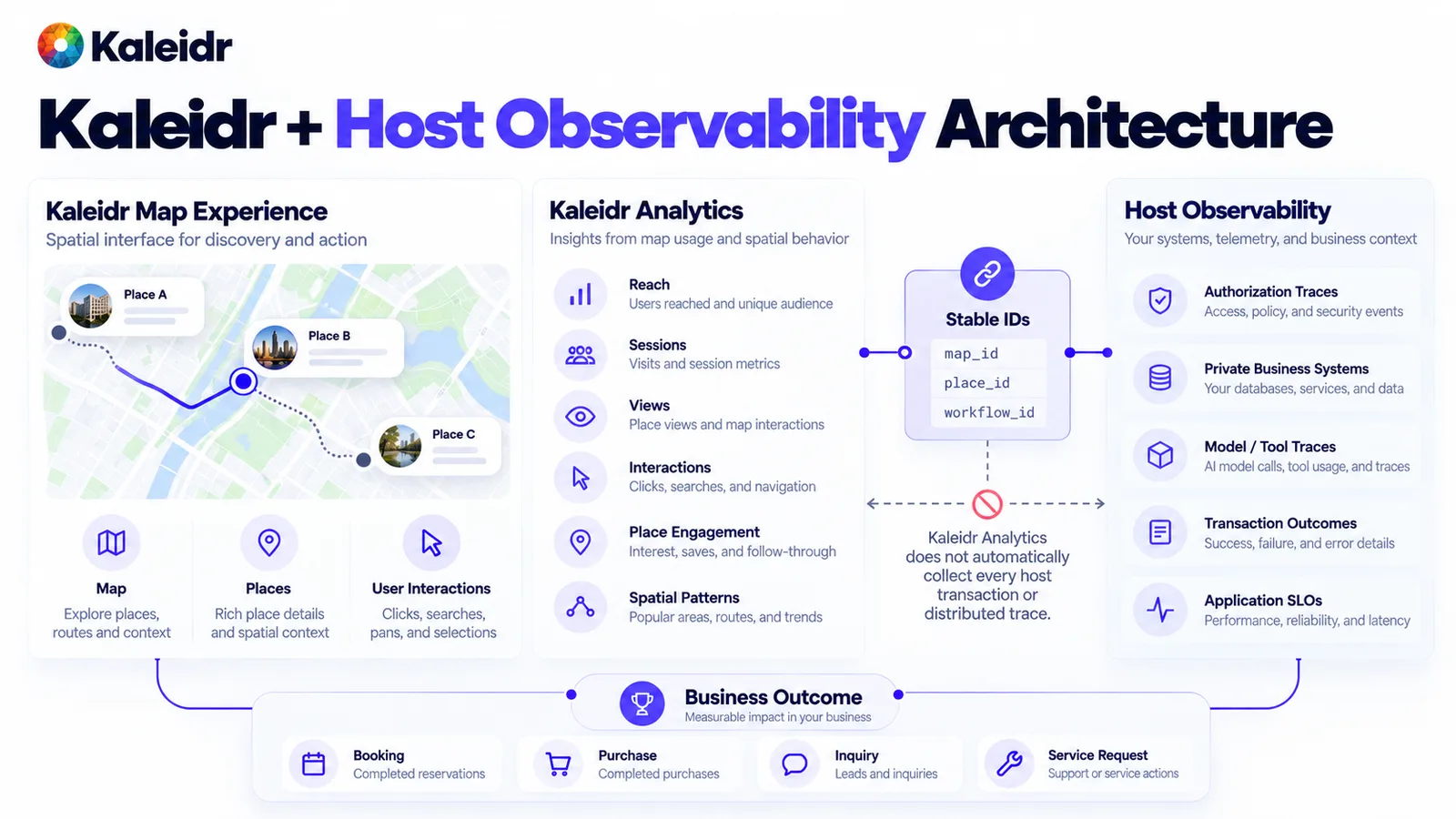
Analytics covers documented map and place engagement. The host column covers private traces and transaction outcomes. The join is an identifier, and the booking and purchase chips are host records, not a claim that Kaleidr Analytics stores those transactions.
Kaleidr Enterprise is the spatial-intelligence layer a product team can add beside that host stack, including inference APIs, ranking, and analytics (Kaleidr, 2026). Map and assistant signals still do not replace a host-owned outcome or a finance-approved unit value. Kaleidr's ROI guide makes that split explicit: leading signals explain the path, and the host record carries the value (Kaleidr, 2026).
How Does Spatial AI Observability Become a Release Gate?
Before a location-aware workflow scales, the team should be able to answer a short list from the trace alone. Which policy version authorized the records? Which place IDs were retrieved, and which reason codes removed the rest? Which route and ranking policy ran? Which model and tool versions were active? Which map action executed, and did the host job finish? Sensitive content should be minimized, versions should be recorded, and production incidents should land in the same failure vocabulary as the offline suite. Explore Kaleidr Analytics for documented map and place engagement. Explore Kaleidr Enterprise to add spatial capability beside the systems that already own users, data, and outcomes.
Note: Kaleidr uses AI-assisted tools for image creation, content refinement, and research throughout its creative and development workflows.
FAQs
Is spatial AI observability the same as language-model monitoring?
No. Model latency, tokens, and tool errors cover one span. Place identity, permissions, business data, geographic services, ranking, map state, and the host outcome can all change whether the result was right.
Should user prompts be logged?
Log prompts only with a defined need, a retention limit, and access control. Many location requests contain private addresses or business facts that a trace does not need in full.
Should precise user location be stored in traces?
Use the coarsest geography that answers the operational question, such as a market code, a place ID, or a route ID.
What is the difference between monitoring and evaluation?
Monitoring watches live production behavior. Evaluation tests defined cases against ground truth. A strong program uses one failure vocabulary so an incident can become a test and a regression can be seen after launch.
What is the most important metric?
There is no universal metric. Tie the measure to the job: eligible-result quality, place resolution, no-result correctness, route success, authorization correctness, or task completion.
How should tool calls be traced?
Record the tool name, schema validation, authorization, policy result, execution status, latency, and failure reason. Keep a proposed action separate from an executed action and from a completed host outcome.
Does Kaleidr Analytics replace application observability?
No. The public Analytics page describes map and place engagement, sessions, views, interactions, audience activity, and spatial patterns. Private service traces, internal authorization, and transaction outcomes stay with the host unless a specific integration says otherwise.
Can OpenTelemetry be used for Spatial AI?
Yes. OpenTelemetry is a practical base for traces, metrics, logs, events, and current generative AI conventions. Teams can add documented attributes for place IDs, route IDs, eligibility, ranking, map actions, and no-result reasons where the shared conventions do not already name them.
References
- Kaleidr. Spatial AI Accuracy Evaluation. https://kaleidr.com/blog/spatial-ai-accuracy-evaluation
- Kaleidr. An Enterprise Spatial AI Pilot Before Scaling. https://kaleidr.com/blog/enterprise-spatial-ai-pilot-before-scaling
- OpenTelemetry. Semantic Conventions for Events. Operations with a duration belong in spans. Checkpoints and point-in-time outcomes are event candidates. Accessed October 1, 2026. https://opentelemetry.io/docs/specs/semconv/general/events/
- OpenTelemetry. Inside the LLM Call: GenAI Observability with OpenTelemetry. James Newton-King, May 14, 2026. https://opentelemetry.io/blog/2026/genai-observability/
- OpenTelemetry. Semantic Conventions. Documentation labeled 1.44.0. Accessed October 1, 2026. https://opentelemetry.io/docs/specs/semconv/
- OpenTelemetry. Generative AI Semantic Convention Attributes. Registry warns that retrieval query text may contain sensitive information. Accessed October 1, 2026. https://opentelemetry.io/docs/specs/semconv/registry/attributes/gen-ai/
- Kaleidr. Private Location Data for AI Map Workflows. https://kaleidr.com/blog/private-location-data-for-ai-map-workflows
- Kaleidr. Grounded Spatial AI for Business Data. https://kaleidr.com/blog/grounded-spatial-ai-business-data
- National Institute of Standards and Technology. AI RMF Playbook, Measure. Production monitoring, drift, and the difference from pre-deployment testing. Notes that the AI RMF 1.0 is being updated and that the playbook will be revised afterward. Accessed October 1, 2026. https://airc.nist.gov/airmf-resources/playbook/measure/
- Kaleidr. Map Engagement and Location Analytics. Accessed October 1, 2026. https://kaleidr.com/analytics
- Kaleidr. Location Intelligence APIs and Map SDK. Accessed October 1, 2026. https://kaleidr.com/enterprise
- Kaleidr. Spatial AI ROI Business Case. https://kaleidr.com/blog/spatial-ai-roi-business-case
@misc{kaleidr_accuracy_observability_2026,
  title  = {Spatial AI Accuracy Evaluation},
  author = {{Kaleidr}},
  year   = {2026},
  url    = {https://kaleidr.com/blog/spatial-ai-accuracy-evaluation}
}

@misc{kaleidr_pilot_observability_2026,
  title  = {An Enterprise Spatial AI Pilot Before Scaling},
  author = {{Kaleidr}},
  year   = {2026},
  url    = {https://kaleidr.com/blog/enterprise-spatial-ai-pilot-before-scaling}
}

@misc{otel_events_2026,
  title  = {Semantic Conventions for Events},
  author = {{OpenTelemetry}},
  year   = {2026},
  note   = {Accessed October 1, 2026},
  url    = {https://opentelemetry.io/docs/specs/semconv/general/events/}
}

@misc{otel_genai_observability_2026,
  title  = {Inside the LLM Call: GenAI Observability with OpenTelemetry},
  author = {Newton-King, James},
  year   = {2026},
  note   = {May 14, 2026},
  url    = {https://opentelemetry.io/blog/2026/genai-observability/}
}

@misc{otel_semconv_2026,
  title  = {Semantic Conventions},
  author = {{OpenTelemetry}},
  year   = {2026},
  note   = {Documentation labeled 1.44.0. Accessed October 1, 2026},
  url    = {https://opentelemetry.io/docs/specs/semconv/}
}

@misc{otel_genai_attributes_2026,
  title  = {Generative AI Semantic Convention Attributes},
  author = {{OpenTelemetry}},
  year   = {2026},
  note   = {Accessed October 1, 2026},
  url    = {https://opentelemetry.io/docs/specs/semconv/registry/attributes/gen-ai/}
}

@misc{kaleidr_private_location_2026,
  title  = {Private Location Data for AI Map Workflows},
  author = {{Kaleidr}},
  year   = {2026},
  url    = {https://kaleidr.com/blog/private-location-data-for-ai-map-workflows}
}

@misc{kaleidr_grounded_observability_2026,
  title  = {Grounded Spatial AI for Business Data},
  author = {{Kaleidr}},
  year   = {2026},
  url    = {https://kaleidr.com/blog/grounded-spatial-ai-business-data}
}

@misc{nist_rmf_playbook_measure_2026,
  title  = {AI RMF Playbook, Measure},
  author = {{National Institute of Standards and Technology}},
  year   = {2026},
  note   = {Accessed October 1, 2026. Page states the playbook will be updated after the AI RMF revision},
  url    = {https://airc.nist.gov/airmf-resources/playbook/measure/}
}

@misc{kaleidr_analytics_observability_2026,
  title  = {Map Engagement and Location Analytics},
  author = {{Kaleidr}},
  year   = {2026},
  note   = {Accessed October 1, 2026},
  url    = {https://kaleidr.com/analytics}
}

@misc{kaleidr_enterprise_observability_2026,
  title  = {Location Intelligence APIs and Map SDK},
  author = {{Kaleidr}},
  year   = {2026},
  note   = {Accessed October 1, 2026},
  url    = {https://kaleidr.com/enterprise}
}

@misc{kaleidr_roi_observability_2026,
  title  = {Spatial AI ROI Business Case},
  author = {{Kaleidr}},
  year   = {2026},
  url    = {https://kaleidr.com/blog/spatial-ai-roi-business-case}
}