
Grounded Spatial AI connects a customer's natural-language request to authorized business records, eligibility rules, and deterministic spatial calculations so the product can recommend a place the company can actually fulfill. The language model interprets compound intent such as an in-stock pickup on the way home. Inventory, policy, and routing systems remain authoritative for stock, hours, permissions, and travel. Spatial AI then explains the grounded shortlist on the map.
The sections below separate current evidence from model behavior, then cover authorization, retrieval, ranking, Kaleidr mapping, evaluation, and a narrow pilot. Related reading includes Private Location Data for AI Map Workflows, How to Build a Map-Aware AI Assistant, and Spatial AI for Multi-Location Businesses. Teams already attaching conversation to an existing map can skip to the Kaleidr mapping; teams still naming source ownership should start with what grounded means.
Grounded Spatial AI essentials
- Facts stay in owners: Inventory, policy, price, and permissions never come from model invention.
- Space stays calculated: Distance, route, containment, and travel time belong to geospatial services.
- Authorize before retrieve: The model is not the permission engine.
- Eligibility before rank: Closed, empty, out of area, or unauthorized records leave the set first.
- Measure the task: Valid selection, handoff, and no-result geography beat chat length alone.
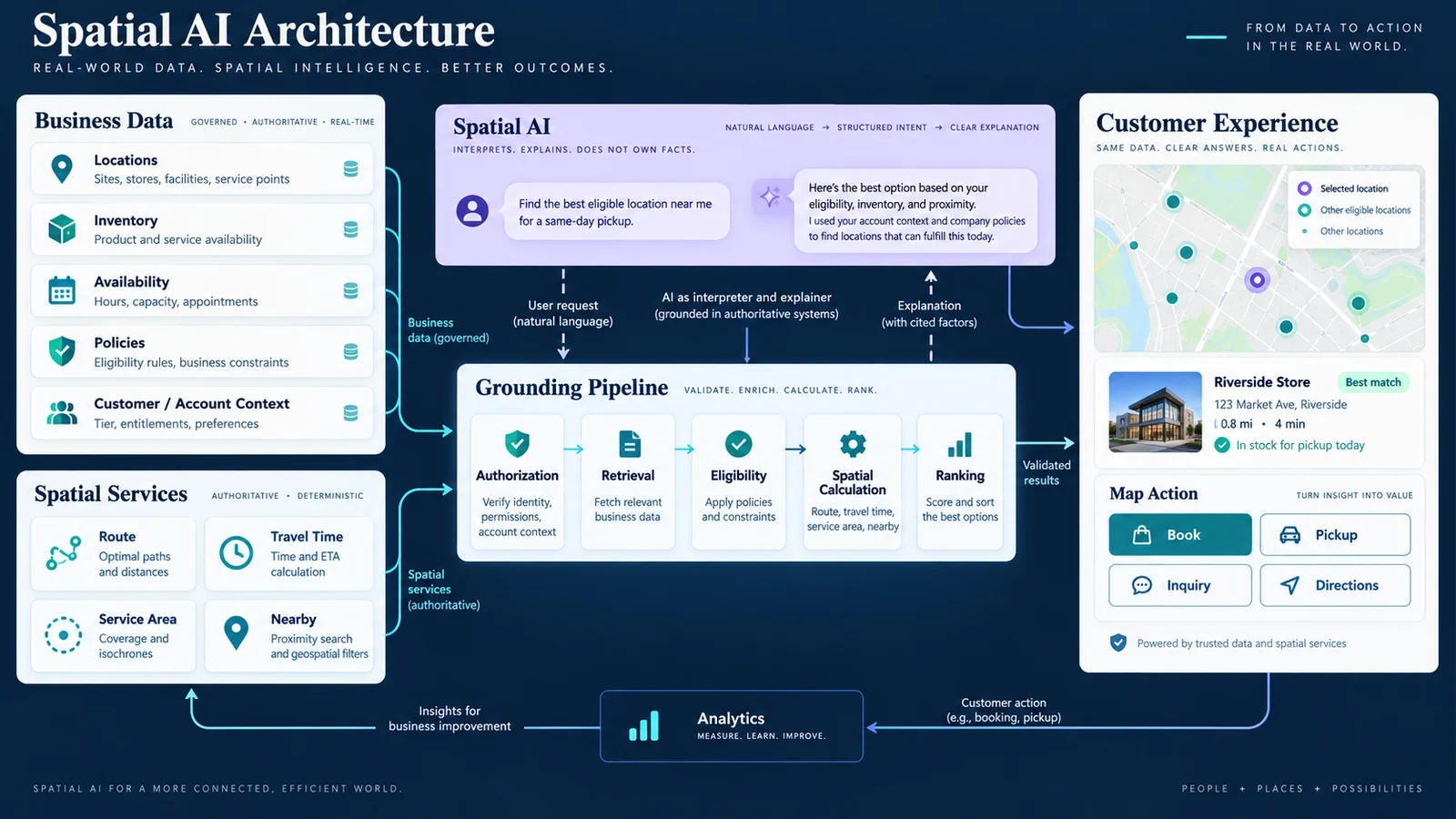
Grounded Spatial AI works when the model interprets the request while business and geospatial systems remain authoritative for the facts.
Why Is Grounded Spatial AI a Business Architecture Problem?
A generic assistant can answer broad questions about public places. A business product has to answer which store can fulfill a pickup, which partner restaurant is still serving after a show, which listing is still active under a commute constraint, or which provider can actually serve an address in the requested window. Those answers depend on inventory, hours, service area, listing status, partner eligibility, account permissions, and operational state. A language model should not invent those fields from training memory.
Kaleidr currently describes connecting business data, location information, and existing systems so Spatial AI can work with what a company already has, and describes a location-based business knowledge foundation for AI responses (Kaleidr, 2026). The AI Map Chat for Customer Discovery page currently frames location-aware chat as grounding recommendations in the host's places, inventory, and business rules. Those pages are authoritative about Kaleidr's own positioning. The same pages are not evidence that Kaleidr operates a native inventory ledger, CRM, hours feed, or franchise directory.
Keep three neighboring problems distinct. The private-location article covers authorization and minimization for records the host does not expose publicly. The map-aware assistant article covers shared map state and validated map actions. The multi-location guide covers canonical IDs, eligibility, and ranking across a branch network. This guide is the source-of-truth architecture that those journeys share: current evidence, deterministic spatial calculation, and a compact context package the model can explain without owning the facts.
What Does Grounded Mean in This Architecture?
A grounded answer is one whose load-bearing claims come from approved sources available to the application at request time. When a customer asks which store near Union Square has a jacket in medium, the product should resolve the SKU and size, retrieve eligible stores, read current inventory, calculate the geographic relationship to the named origin, rank valid stores, and only then let the model explain the result on the same map. The phrasing can be conversational. The stock record and the travel calculation should come from systems that can support the claim.
Grounding is an application architecture, not a larger prompt. The model interprets intent and names the question the systems should answer. The owners of inventory, policy, availability, and routing remain the systems of record. If no source owns a claim, ask whether the product should make the claim at all.
The following ownership table is editorial, not a documented Kaleidr schema. Use it to keep source boundaries inspectable. Real deployments should fill the same columns from the systems the host already runs.
| Claim | Authoritative source |
|---|---|
| Item is in stock | Inventory system |
| Check-in starts at a stated hour | Policy system |
| Listing is active | Listing system |
| Provider serves this area | Service-area system |
| Coordinates | Approved place source |
| Travel time | Routing service |
| User may see the record | Identity / authorization |
| Why this option ranked first | AI explanation of the above |
How Is Grounding Different From Fine-Tuning, RAG, and Prompting?
Teams often collapse four different jobs into one word. Grounding supplies current business and spatial facts at request time. Retrieval-augmented generation retrieves relevant records or documents and can be one grounding technique. Fine-tuning changes model behavior or output style from examples. Prompting supplies runtime instructions and task context. Live inventory, availability, listing status, service-area rules, and current travel time belong in current evidence, not in model memory.
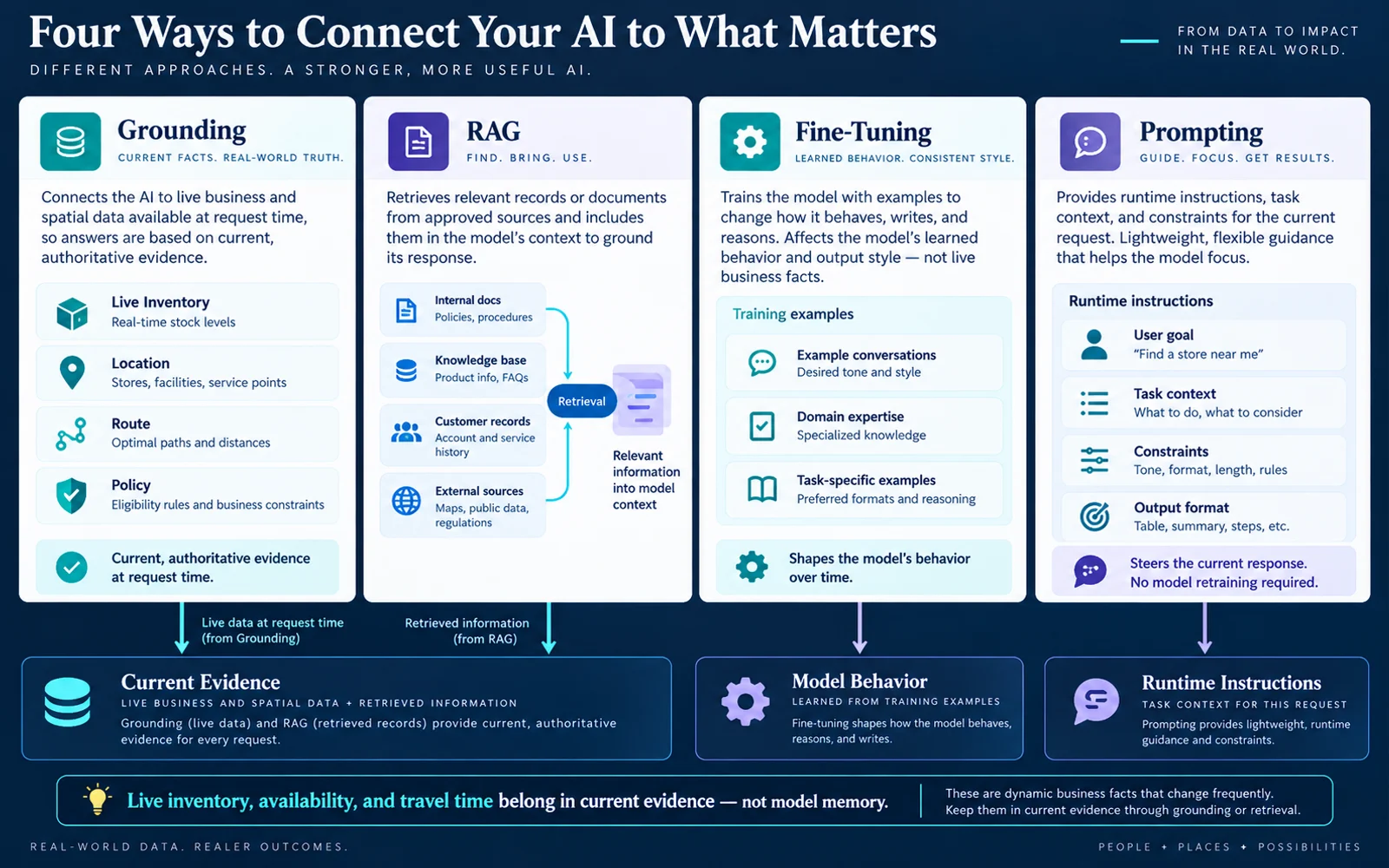
Grounding is an application architecture for current evidence; it is not another name for fine-tuning or a larger prompt.
RAG is useful for policy text, amenity descriptions, and brand guidance. Structured fields such as stock count, status, price, opening state, and a service-area polygon should stay typed so hard filters can run before any ranking. Fine-tuning can help tone and output shape. Fine-tuning is generally the wrong source of truth for a fact that changed this afternoon. Prompting can constrain how the assistant talks. Prompting alone does not make a fact authoritative.
Why Does Spatial Grounding Need Its Own Layer?
A business assistant can be grounded in documents and still be wrong spatially. Two stores can both have inventory while only one is reachable before the next stop. A language model should not estimate that relationship from store descriptions. The application needs a geospatial service that can take origin, destination, travel mode, and network and return a travel relationship the customer can inspect.
Grounded Spatial AI therefore combines business grounding with spatial grounding. Business data says what is true about the candidate. The geospatial layer says how candidates relate in space. A strong boundary is that AI chooses the question and spatial services compute the relationship. Place Ranking API covers ranking remaining eligible locations after those calculations exist, including when a next stop is already on the trip.
What Canonical Records Should Grounding Use?
Grounded Spatial AI needs stable identities. Each location, listing, SKU, service, or provider should keep a durable ID that is shared across the business database, map marker, AI context, analytics, and the booking or pickup handoff. Do not treat a display name as identity. Organization facts such as brand voice and company-wide policy can be inherited. Location facts such as hours, local inventory, and pickup eligibility must stay on the branch. A third layer, operational state, holds inventory, capacity, and temporary closures with an explicit freshness timestamp, because yesterday's stock is not a ranking feature.
Normalize coordinates, hours, status values, units, and category labels before request time so deterministic filters can run. Typed entities prevent a store ID from being treated as a product ID, or a building from being treated as a listing. The exact field list is product-specific. The load-bearing contract is one ID per place plus explicit source ownership for every claim the assistant is allowed to make.
Why Must Retrieval Follow Authorization?
The dangerous pattern is to retrieve a wide slice of business data, give it to the model, and ask the model what the user may see. The safer order is authenticate, resolve tenant, authorize objects and fields, retrieve the minimum needed, then give only that package to the model. A user may be allowed to see a provider location and not internal margin. The retrieval layer should drop the second field before context crosses the AI boundary.
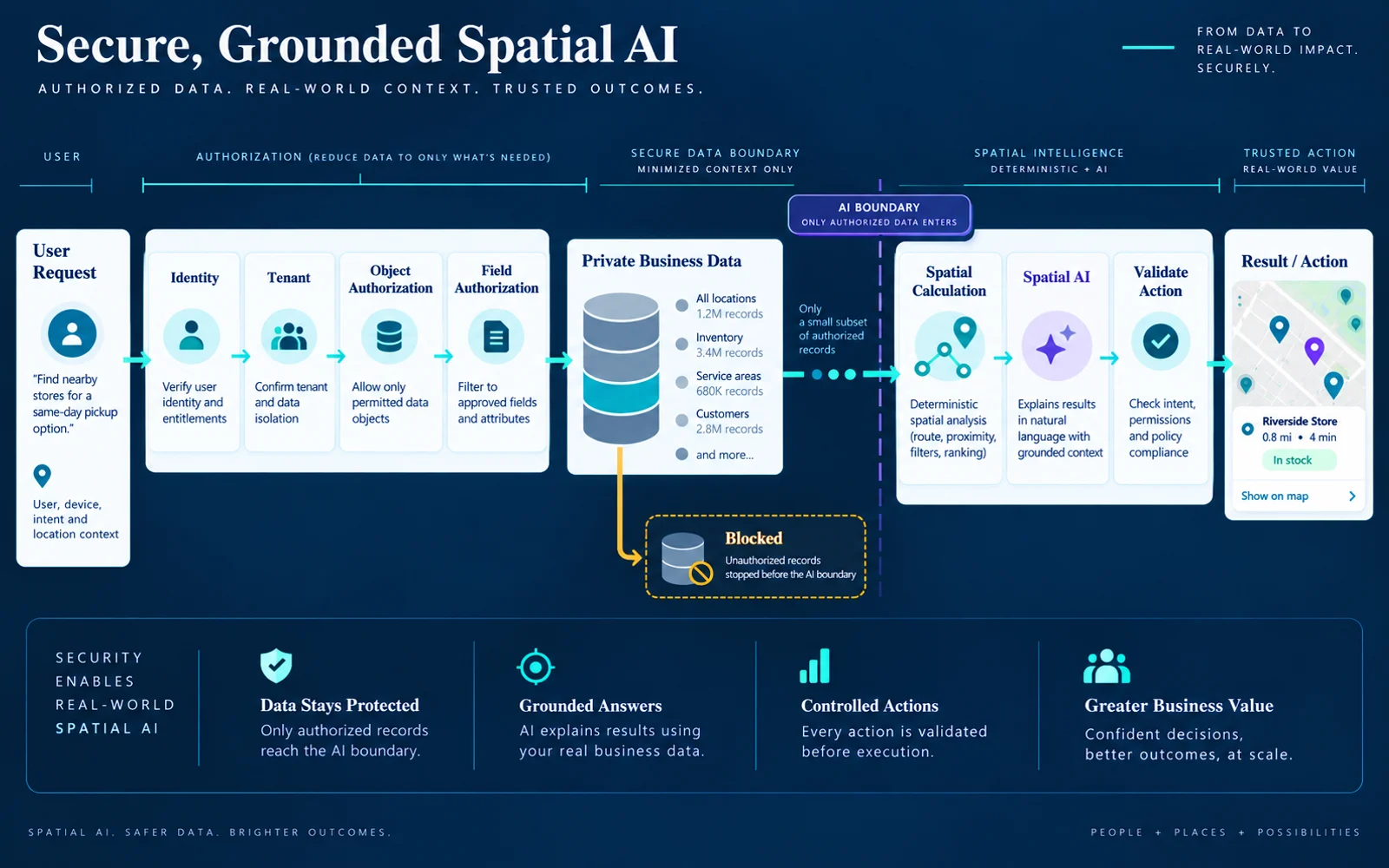
The model should never be the component that decides what a user is allowed to retrieve; authorization belongs before the AI context boundary.
Kaleidr currently documents a split between browser publishable keys and server keys, and states that a publishable key presented as a bearer is rejected (Kaleidr, 2026). The same docs currently describe a vendor scope that can let chat consult uploaded organization data the host chose to expose on that surface, and they warn that a publishable key is the wrong place for rates or anything the host would not publish. Treat that split as the public credential contract. Host inventory, unpublished locations, and customer records still belong behind the host's own authorization, not inside a prompt.
Map viewport is part of the request, not a permission grant. An administrator's private asset sitting in view must not enter another user's AI context merely because the camera moved. Current chat endpoints document fields such as location, map_zoom, language, and session context (Kaleidr, 2026). Those fields keep conversation attached to the map. Map context does not replace object and field authorization.
How Should Eligibility, Ranking, and Explanation Stay Separate?
Hard constraints are binary and belong with the location, inventory, and routing owners before ranking. Closed now, out of stock for the requested variant, outside the service area, inactive, missing a required service, or missing authorization should remove the candidate. Soft preferences such as slightly shorter travel then rank the remaining valid set. Grounding answers what is true. Ranking answers which valid option fits the request. Explanation is a grounded account of why the shortlist exists.
The language model can turn a request such as find this item for pickup today on my way home into inspectable fields: origin, item, opening-state requirement, pickup mode, and travel limit. Those fields are queries against the systems that already own the facts. Do not ask the model to invent travel minutes after the customer has already named the constraint. Do not rank a closed flagship because it is more famous. Revalidate inventory, availability, and hours before a high-impact action such as reserve, purchase, or pickup, because the recommendation snapshot can age while the customer compares options.
A compact context package should carry only the shortlist the customer can use, with source and freshness known to the application even when every metadata field is not shown to the model. Putting the whole database in the prompt creates leakage, latency, stale records, and a debugging surface nobody can inspect. Minimization is a security control and a product control.
Where Does Kaleidr Fit in a Grounded Stack?
A Kaleidr implementation can attach a conversational spatial layer to a map and location stack the host already operates. Kaleidr currently documents Chat as a product that mounts over a map the host already renders, plots resolved places, and frames the camera as the conversation resolves locations, with auto-detection for Mapbox, MapLibre, Google Maps, and Leaflet (Kaleidr, 2026). The attach contract confirms map-aware conversation exists in the current public developer surface. The same docs do not promise a native inventory catalog, booking engine, or hours feed.
The current public Platform API list includes SDK session exchange, streaming chat, route, POI enrichment, and design endpoints. The list does not currently publish a universal knowledge-upload, RAG-index, or inventory-connect route. Kaleidr's product pages describe connecting places and grounding AI on business inventory and policies; confirm the integration path for the deployment rather than treating marketing copy as an ingestion API. How to Add AI Chat to Mapbox, Google Maps, and MapLibre covers renderer-specific attach steps. The Location Intelligence APIs and Map SDK page currently describes SDKs, ranking, and analytics for spatial products. Treat developer documentation as the integration contract; marketing pages describe the use case, not the inventory-feed list.
Semantic map actions such as focus, show candidates, or show a route should be proposed by the assistant and validated by the host against IDs and permissions before the renderer runs them. Natural-language output must not execute arbitrary map code. Shared map, list, and chat state should keep one canonical location ID so asking what is closer keeps the same item and hours rules.
Grounding is not unique to mapping. Google Cloud currently documents custom search over structured business datasets such as hotel catalogs, real-estate listings, and restaurant directories, and separately describes grounded AI answer generation from connected data (Introduction to custom search, 2026). For Spatial AI the extra requirement is the geographic calculation. That Google Cloud page describes Google's own search product. The page is not a Kaleidr connector.
How Should Teams Evaluate Grounded Spatial AI?
A fluent answer can still be wrong. Measure retrieval correctness, authorization correctness, business-rule correctness, spatial correctness, explanation fidelity, action validity, and freshness as separate checks. A grounded system should sometimes return no eligible option. In many B2B workflows a false positive is more damaging than a no-result. Log structured no-result reasons such as closed now, out of stock, out of area, too far, unknown hours, or unauthorized, rather than a bare failure flag.
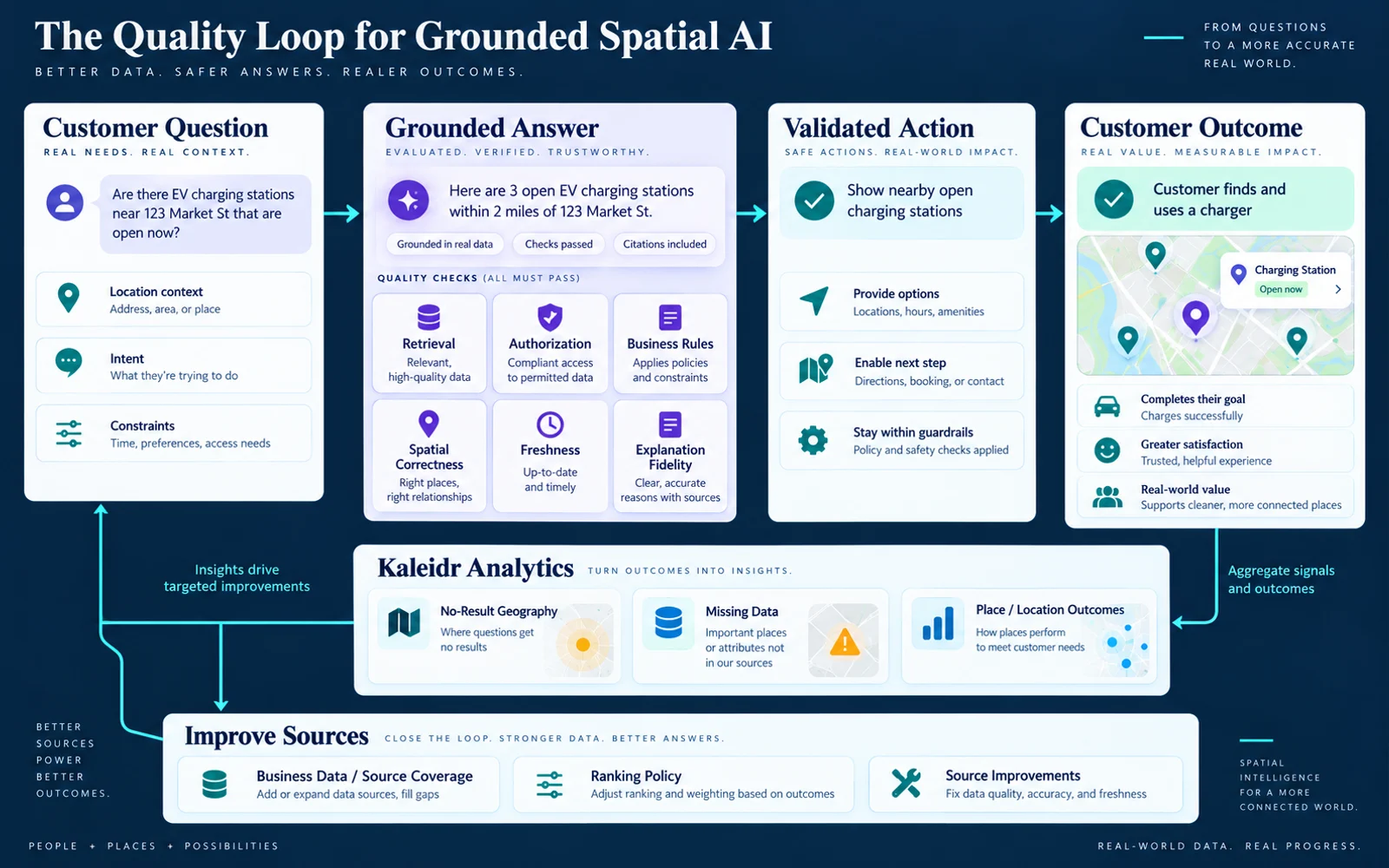
Grounding quality is measurable: factual and spatial correctness should connect to the customer action the product is designed to improve.
OWASP currently identifies prompt injection as a major language-model application risk and states that RAG and fine-tuning do not fully prevent it (LLM01:2025 Prompt Injection). Treat user input and retrieved content as potentially untrusted. OWASP also documents vector and embedding weaknesses, including poisoned retrieval content, cross-tenant leakage, and unauthorized access to embeddings (LLM08:2025 Vector and Embedding Weaknesses). Grounding requires source trust, tenant partitioning, and host validation of actions, not merely a larger retrieval set. NIST published the Generative Artificial Intelligence Profile in July 2024 as a companion to the AI Risk Management Framework for trustworthiness across the AI lifecycle (Generative Artificial Intelligence Profile, 2024). Evaluate grounding as part of that larger system, not as a factuality switch.
Kaleidr Analytics currently documents map and place engagement, place comparison, spatial patterns, and activity that product, inventory, and growth teams can act on (Kaleidr, 2026). Host systems still own inventory and booking. Use that loop to find ZIP codes with in-stock searches and no eligible branch, travel-time bands that lose the customer, and markets with demand and missing fields. Those questions are geographic rather than page-view questions. Spatial Analytics vs. Web Analytics covers why pageviews alone cannot answer them. Suggested event names in this article are editorial recommendations, not documented automatic Kaleidr Analytics event names.
How Should a Grounded Pilot Start?
Start with one high-value task, such as recommending one in-stock pickup location on the way from work to home in a single metro. Keep the location directory, hours, and inventory in the systems that already own them. Attach conversational map interaction to the existing map. Limit candidates to authorized branches, require opening state and stock for the requested item, calculate travel from the named origin, revalidate before pickup, and measure selection plus the host action that follows. Expand categories, cities, and franchise tenants only when that first window works.
Conversational discovery does not replace catalog quality, hours freshness, or fulfillment discipline. Travel times remain estimates. Stock claims are only as good as the inventory source behind them. Attaching an assistant to an existing map is usually cheaper than replacing the renderer, but the host still has to own authorization, supplier contracts, and the next business action. Treat missing data as unknown rather than as a pass, and roll out by market rather than every dataset at once.
Explore Kaleidr Spatial AI to add conversational location search on an existing map. Explore Kaleidr Enterprise to attach SDKs and ranking to the stack you already operate. Explore Kaleidr Analytics to measure place engagement and geographic demand around that journey. Confirm the current public pages before treating any example in this article as a shipping contract.
FAQs
What is grounded Spatial AI?
Grounded Spatial AI uses current, approved business data and deterministic geographic calculations to support AI answers about places, inventory, availability, eligibility, and travel. The language model interprets and explains the request; business and geospatial systems remain authoritative for the facts.
Is grounding the same as RAG?
No. Retrieval-augmented generation is one grounding technique. A production Spatial AI system can also use structured queries, authorization, business rules, ranking, routing, geometry calculations, and live operational APIs.
Is grounding the same as fine-tuning?
No. Fine-tuning changes model behavior. Grounding supplies current evidence at runtime. Rapidly changing facts such as inventory and availability should remain in authoritative business systems.
Should I upload my whole business database to a model?
No. Retrieve only the authorized records and fields required for the task. Minimize context before it reaches the model.
Who should own inventory and availability?
The host business system should remain authoritative for operational facts such as inventory, availability, price, listing status, or provider capacity.
Who should calculate distance and travel time?
Use an appropriate geospatial or routing service. The assistant can interpret which relationship matters and explain the result, but it should not invent exact spatial calculations.
Can grounded AI still hallucinate?
Yes. Grounding reduces unsupported answers but does not eliminate model error. Applications should validate structured outputs, restrict actions, evaluate explanation fidelity, and support no-result behavior.
Does RAG prevent prompt injection?
No. OWASP notes that RAG and fine-tuning do not fully mitigate prompt injection. Retrieval, tool permissions, and model actions still need application-level security controls.
Can Kaleidr use business inventory and policies?
Kaleidr's current AI page describes grounding recommendations on the host's places, inventory, and business rules. The exact data-integration path depends on the deployment and should be confirmed for the enterprise use case.
Does Kaleidr publish a generic knowledge-base ingestion API?
The current public Platform API documentation does not list a universal knowledge-upload, RAG-index, or arbitrary enterprise-database ingestion endpoint. It documents SDK sessions, chat, routing, POI enrichment, and design endpoints.
Can Kaleidr attach grounded AI to an existing map?
Yes. Current public Chat attach docs describe mounting conversation over a map the host already renders, including Mapbox, MapLibre, Google Maps, and Leaflet. The host still owns the location catalog and the next business action.
How should grounded Spatial AI be measured?
Retrieval correctness, authorization correctness, business-rule compliance, spatial correctness, explanation fidelity, freshness, no-result accuracy, valid actions, and downstream business outcomes. Chat volume alone is a weak success metric.
References
- Kaleidr. Build Your Own Spatial AI with Kaleidr. Accessed 13 September 2026. https://kaleidr.com/
- Kaleidr. AI Map Chat for Customer Discovery. Accessed 13 September 2026. https://kaleidr.com/ai
- Kaleidr. Auth & scopes. Developer documentation. Accessed 13 September 2026. https://docs.kaleidr.com/platform-api/auth-and-scopes
- Kaleidr. Endpoints. Developer documentation. Accessed 13 September 2026. https://docs.kaleidr.com/platform-api/endpoints
- Kaleidr. Chat attach. Developer documentation. Accessed 13 September 2026. https://docs.kaleidr.com/sdk/chat-attach
- Kaleidr. Location Intelligence APIs and Map SDK. Accessed 13 September 2026. https://kaleidr.com/enterprise
- Kaleidr. Map Engagement and Location Analytics. Accessed 13 September 2026. https://kaleidr.com/analytics
- OWASP Gen AI Security Project. LLM01:2025 Prompt Injection. Accessed 13 September 2026. https://genai.owasp.org/llmrisk/llm01-prompt-injection/
- OWASP Gen AI Security Project. LLM08:2025 Vector and Embedding Weaknesses. Accessed 13 September 2026. https://genai.owasp.org/llmrisk/llm082025-vector-and-embedding-weaknesses/
- Google Cloud. Introduction to custom search. Accessed 13 September 2026. https://docs.cloud.google.com/generative-ai-app-builder/docs/about-generic-search
- NIST. Artificial Intelligence Risk Management Framework: Generative Artificial Intelligence Profile. Published 26 July 2024. Accessed 13 September 2026. https://www.nist.gov/publications/artificial-intelligence-risk-management-framework-generative-artificial-intelligence
@misc{kaleidr_home_grounded_2026_09_13,
  title  = {Build Your Own Spatial AI with Kaleidr},
  author = {{Kaleidr}},
  note   = {Accessed 13 September 2026},
  url    = {https://kaleidr.com/}
}

@misc{kaleidr_ai_grounded_2026_09_13,
  title  = {AI Map Chat for Customer Discovery},
  author = {{Kaleidr}},
  note   = {Accessed 13 September 2026},
  url    = {https://kaleidr.com/ai}
}

@misc{kaleidr_auth_grounded_2026_09_13,
  title  = {Auth \& scopes},
  author = {{Kaleidr}},
  note   = {Developer documentation; accessed 13 September 2026},
  url    = {https://docs.kaleidr.com/platform-api/auth-and-scopes}
}

@misc{kaleidr_endpoints_grounded_2026_09_13,
  title  = {Endpoints},
  author = {{Kaleidr}},
  note   = {Developer documentation; accessed 13 September 2026},
  url    = {https://docs.kaleidr.com/platform-api/endpoints}
}

@misc{kaleidr_chat_attach_grounded_2026_09_13,
  title  = {Chat attach},
  author = {{Kaleidr}},
  note   = {Developer documentation; accessed 13 September 2026},
  url    = {https://docs.kaleidr.com/sdk/chat-attach}
}

@misc{kaleidr_enterprise_grounded_2026_09_13,
  title  = {Location Intelligence APIs and Map SDK},
  author = {{Kaleidr}},
  note   = {Accessed 13 September 2026},
  url    = {https://kaleidr.com/enterprise}
}

@misc{kaleidr_analytics_grounded_2026_09_13,
  title  = {Map Engagement and Location Analytics},
  author = {{Kaleidr}},
  note   = {Accessed 13 September 2026},
  url    = {https://kaleidr.com/analytics}
}

@misc{owasp_llm01_prompt_injection_2025,
  title  = {LLM01:2025 Prompt Injection},
  author = {{OWASP Gen AI Security Project}},
  note   = {Accessed 13 September 2026},
  url    = {https://genai.owasp.org/llmrisk/llm01-prompt-injection/}
}

@misc{owasp_llm08_vector_embedding_2025,
  title  = {LLM08:2025 Vector and Embedding Weaknesses},
  author = {{OWASP Gen AI Security Project}},
  note   = {Accessed 13 September 2026},
  url    = {https://genai.owasp.org/llmrisk/llm082025-vector-and-embedding-weaknesses/}
}

@misc{google_cloud_custom_search_2026,
  title  = {Introduction to custom search},
  author = {{Google Cloud}},
  note   = {Accessed 13 September 2026},
  url    = {https://docs.cloud.google.com/generative-ai-app-builder/docs/about-generic-search}
}

@misc{nist_genai_profile_2024,
  title  = {Artificial Intelligence Risk Management Framework: Generative Artificial Intelligence Profile},
  author = {{National Institute of Standards and Technology}},
  note   = {Published 26 July 2024; accessed 13 September 2026},
  url    = {https://www.nist.gov/publications/artificial-intelligence-risk-management-framework-generative-artificial-intelligence}
}