
Build vs buy spatial AI is a decision about which layers a company should own. Keep inventory, identity, eligibility, business rules, and transactions in the systems that already govern them. Then decide whether maps, spatial calculations, ranking, conversational interaction, and analytics are built inside, bought as components, or combined. The boundary depends on differentiation, data sensitivity, team capability, and how soon a production-shaped pilot has to ship.
The sections below separate the three ownership patterns, the layers that usually stay in-house, the cost that sits below the first invoice, and a pilot that tests the boundary. Related reading includes An Enterprise Spatial AI Pilot, Map SDK vs. Map API vs. Map Platform, and Grounded Spatial AI for Business Data. A hybrid is not a compromise badge. A hybrid draws the line between proprietary business systems and reusable spatial infrastructure.
Build vs buy essentials
- Own the business record: Inventory, identity, eligibility, rules, and transactions stay with the host.
- Name the infrastructure: Maps, routing, ranking, and conversational interaction can be shared components.
- Count the years: Initial engineering and a vendor fee are the visible slice of a three-year cost.
- Pilot one job: A bounded workflow beats a company-wide architecture debate.
- Keep an exit: IDs, exports, and host-owned records should survive a vendor change.
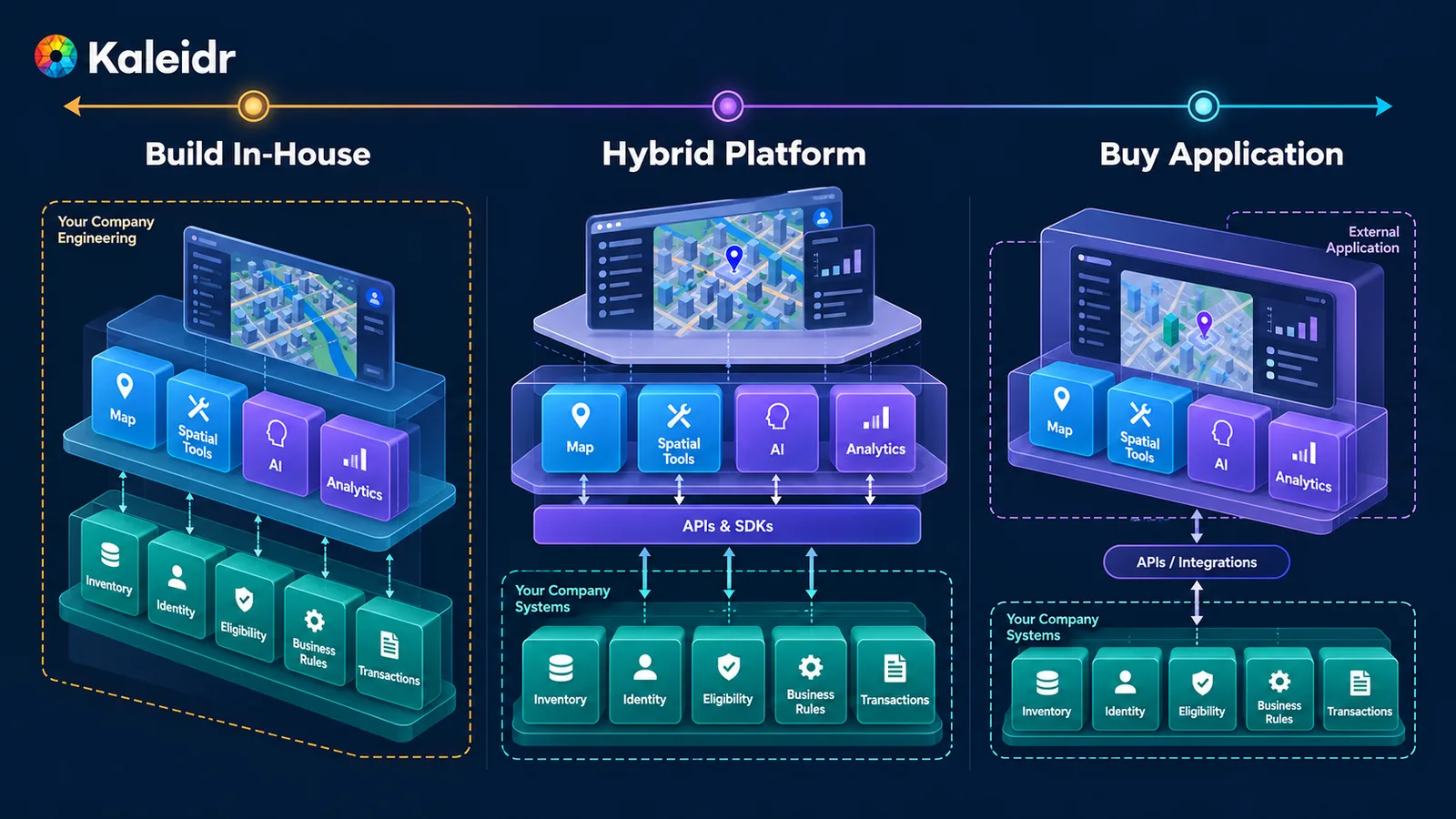
Build versus buy is an ownership-boundary decision: keep proprietary business logic where it belongs and decide which spatial layers are infrastructure.
Why Is Build vs Buy Spatial AI an Ownership Decision?
A Spatial AI product can include business data, identity and authorization, location identity, place and routing data, spatial calculations, eligibility rules, ranking, language-model orchestration, shared map state, rendering, actions, analytics, evaluation, and publishing. Asking whether to buy Spatial AI collapses that stack into one purchase. The useful question is which layers are core to the business and which layers are infrastructure the company can consume. That split produces an architecture, not a slogan.
Three patterns cover most teams. An in-house build keeps orchestration, map interaction, spatial tools, and ranking inside the engineering boundary, which can fit a proprietary algorithm or a specialized environment and also means the company staffs every layer. A purchased application moves more of the experience outside, which can be fast when the job matches the product and brittle when inventory, eligibility, or transactions must stay in systems the company already runs. A hybrid leaves proprietary business systems inside and plugs spatial modules in through APIs and SDKs. None of the three is a default winner. The right one follows the job and the boundary.
Kaleidr Enterprise currently describes location-intelligence infrastructure with inference APIs, ranking systems, analytics, and deployment support for spatial products (Kaleidr, 2026). The public page also lists chat, editing, custom tiles, and embeddable viewers as products a host can add to a map it already has. That positioning is a hybrid offer, not a claim that Kaleidr replaces inventory, a booking engine, a fleet source, or an identity provider. Grounded spatial AI for business data makes the same separation: answers have to come from authorized records.
What Should Stay In-House, and What Is Infrastructure?
Inventory and availability usually stay in-house because they are the business. A marketplace, a clinic, a store network, or a fleet already has a system of record for what can be offered, where, and when. Identity and permissions stay with the host as well: who may see a record, which tenant it belongs to, and which action is allowed. Business rules such as eligibility, pricing policy, and service territory are how the company decides, and a language model should not invent them. Transactions, bookings, and payments remain on the ledger the finance team already trusts.
Infrastructure is the layer that is expensive to rebuild and rarely the product's secret. Geocoding, a basemap, routing, travel-time calculation, map rendering, and a conversational surface over an existing map are common examples. Kaleidr's developer docs describe one SDK with four surfaces: Chat attaches to a map the host already runs, Editor mounts inside the product, Tile serves a designed basemap, and Viewer embeds a published map by share id without a key (Kaleidr, 2026). The same introduction says a publishable key is for browser use and a server key is for backend calls, under one organization and one usage pool. The host still owns the business systems those surfaces sit beside.
The production stack is larger than the language model. Below orchestration sit business data, authorization, place data, eligibility, and spatial calculation. Beside it sit ranking and shared map state. Above it sit rendering, map actions, analytics, and evaluation. A team that budgets only for model access will miss security, grounding, and the work of keeping the map and the business record in step. Map SDK versus map API versus map platform separates those delivery shapes so a procurement conversation does not treat every "map" as the same ownership model.
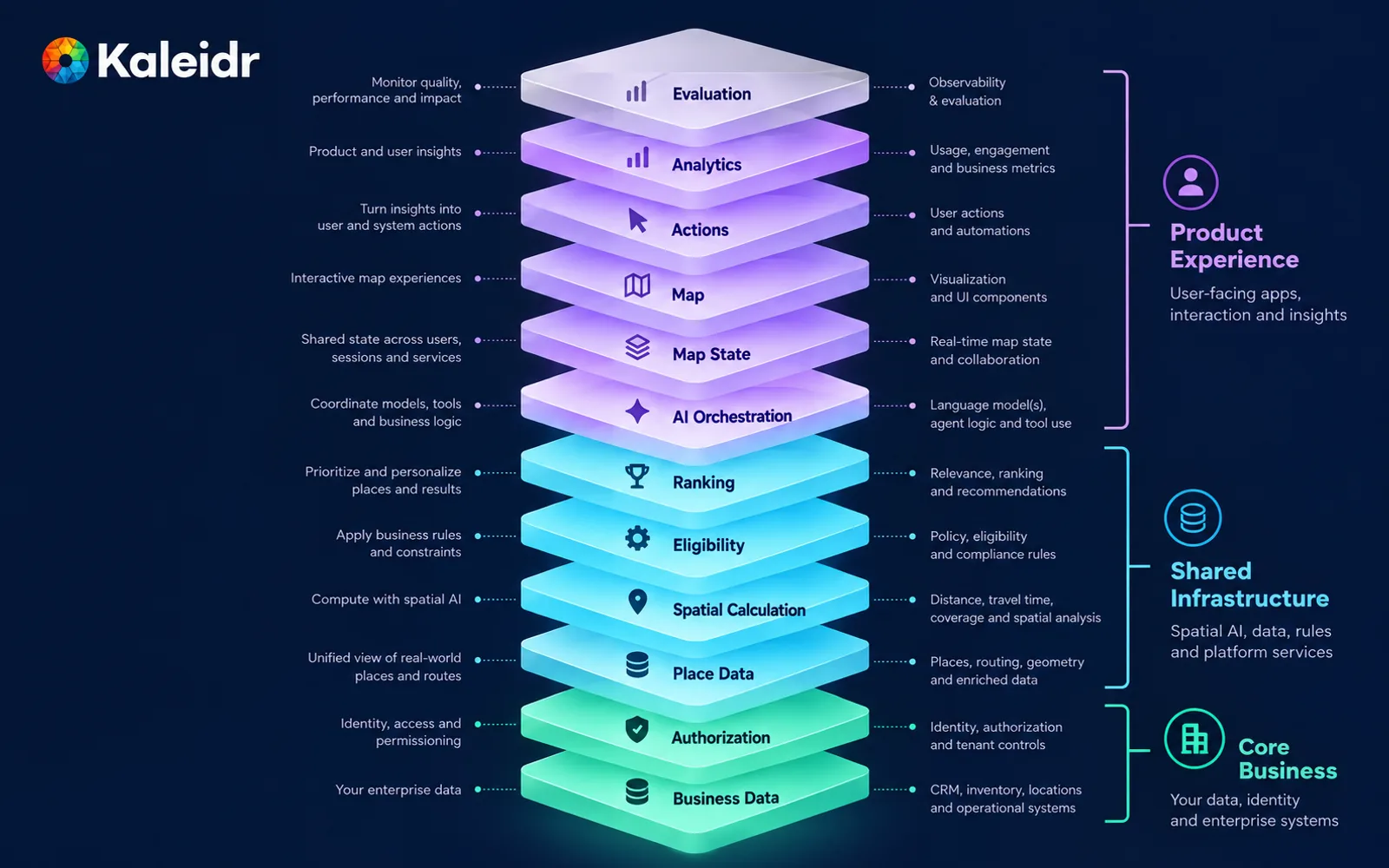
The language model is one layer; most production complexity lives in grounding, state, security, spatial computation, actions, and operations around it.
Where Does the Cost of Ownership Actually Sit?
An in-house build has four costs, and only the first one shows up in the kickoff plan. Initial engineering covers the map provider, orchestration, grounding, and the first workflow. Ongoing operations cover monitoring, support, security review, and the people who keep the feed healthy. Change cost covers model updates, map-provider upgrades, and the next integration. Opportunity cost is the product work the same team did not ship while they owned the stack. Treating the internal build as free because no invoice arrived is the comparison error.
Buying has a matching set. The vendor fee and the first integration are the visible slice. Below them sit security review, evaluation, support, future integrations, migration, and the cost of a boundary the team cannot explain. NIST's Generative Artificial Intelligence Profile, published in 2024 as NIST AI 600-1, tells organizations to update due diligence for generative-AI acquisition so vendor assessments include intellectual property, data privacy, and security, and to keep contracts and service-level agreements that specify content ownership, usage rights, and security requirements (NIST, 2024). The profile is a voluntary companion to the AI Risk Management Framework. The profile is not a Kaleidr control list, and it does not score any vendor.
A three-year worksheet is enough to compare the patterns without fake precision. Count people, infrastructure, vendor fees, change, risk, and the opportunity cost of a delayed job. Do not invent a savings percentage the pilot has not measured. The iceberg is a reminder that the first invoice and the first sprint are the part above the waterline.
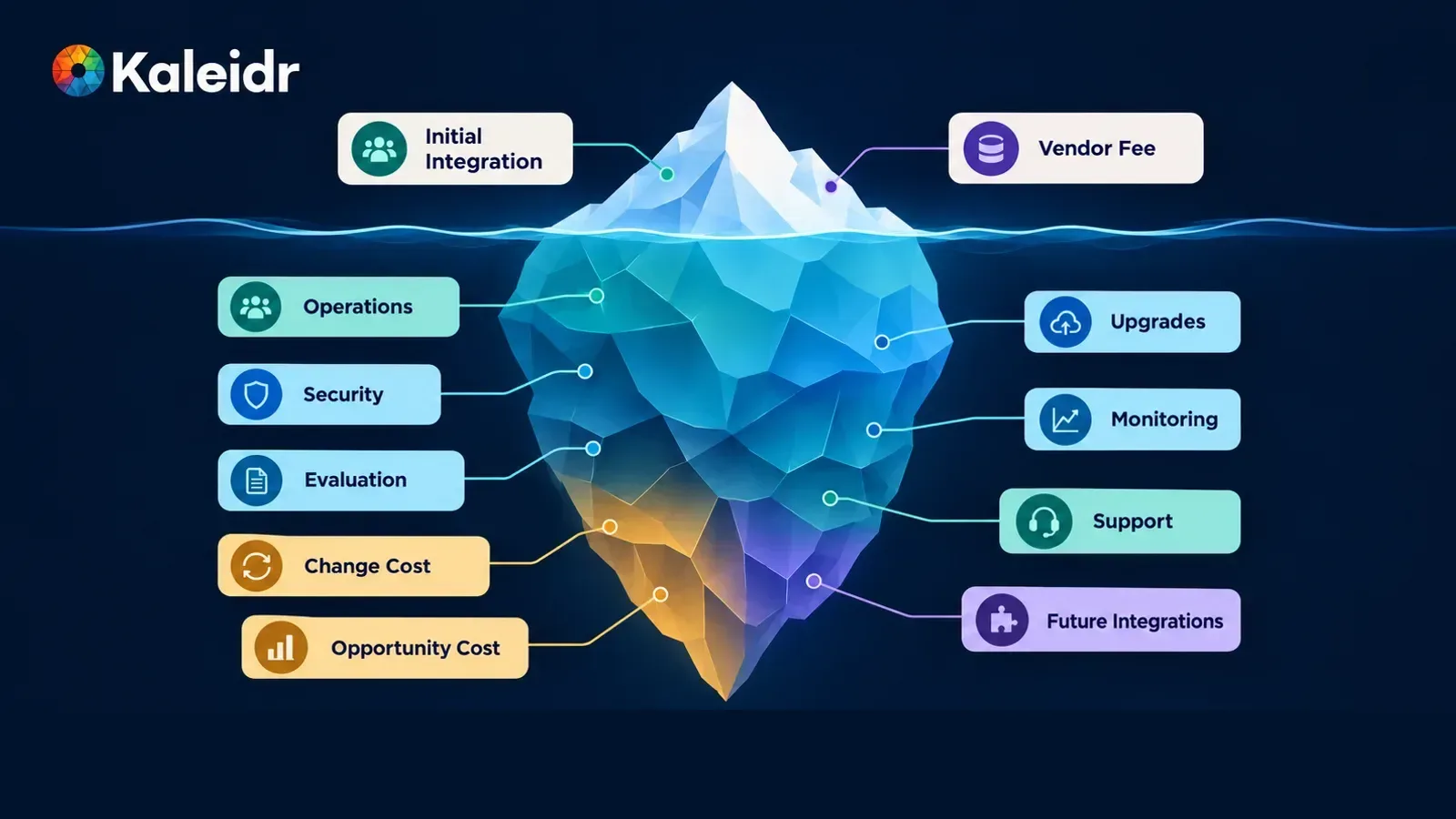
Compare total ownership over time, not an external invoice against an internal build treated as free.
Security follows the same boundary. Kaleidr's API-key docs separate a publishable browser key, which the SDK exchanges for a short-lived session, from a server key meant for backend calls and not for the browser (Kaleidr, 2026). The current Platform API documents session exchange, chat streams, route control, place enrichment, and design endpoints (Kaleidr, 2026). Those pages describe Kaleidr's own credential and API surface and do not mean Kaleidr owns the host's inventory, CRM, booking engine, fleet database, or transaction ledger. Any platform review should still ask who holds the business records, whether IDs export, and what happens when the provider changes.
How Should Teams Pilot the Ownership Boundary?
A practical sequence starts with one customer job, such as finding an eligible branch and starting an appointment. Draw the system boundary: which system owns the customer, the locations, availability, eligibility, routing, and the transaction. Mark the layers that differentiate the business. Estimate three-year ownership for an internal build and for a platform-assisted version of the same job. Run a bounded pilot. Test failure states: no result, stale inventory, an unauthorized record, an ambiguous place, a wrong map state, a provider outage, and a model change. Then choose the boundary, and plan to revisit it when scale or the job changes.
The comparison below is editorial. Real teams should fill the same columns from the systems they already run. Neither column is a recommended winner.
| Question | Build more | Hybrid or buy more |
|---|---|---|
| Where is the advantage? | A proprietary spatial method the product depends on | The advantage is inventory, policy, or the transaction |
| Who can staff the stack? | A team that will own maps, grounding, and evaluation | A team that should spend its time on the business system |
| What must the pilot prove? | The in-house path reaches the same job with a supportable cost | The platform respects host records, auth, and an exit |
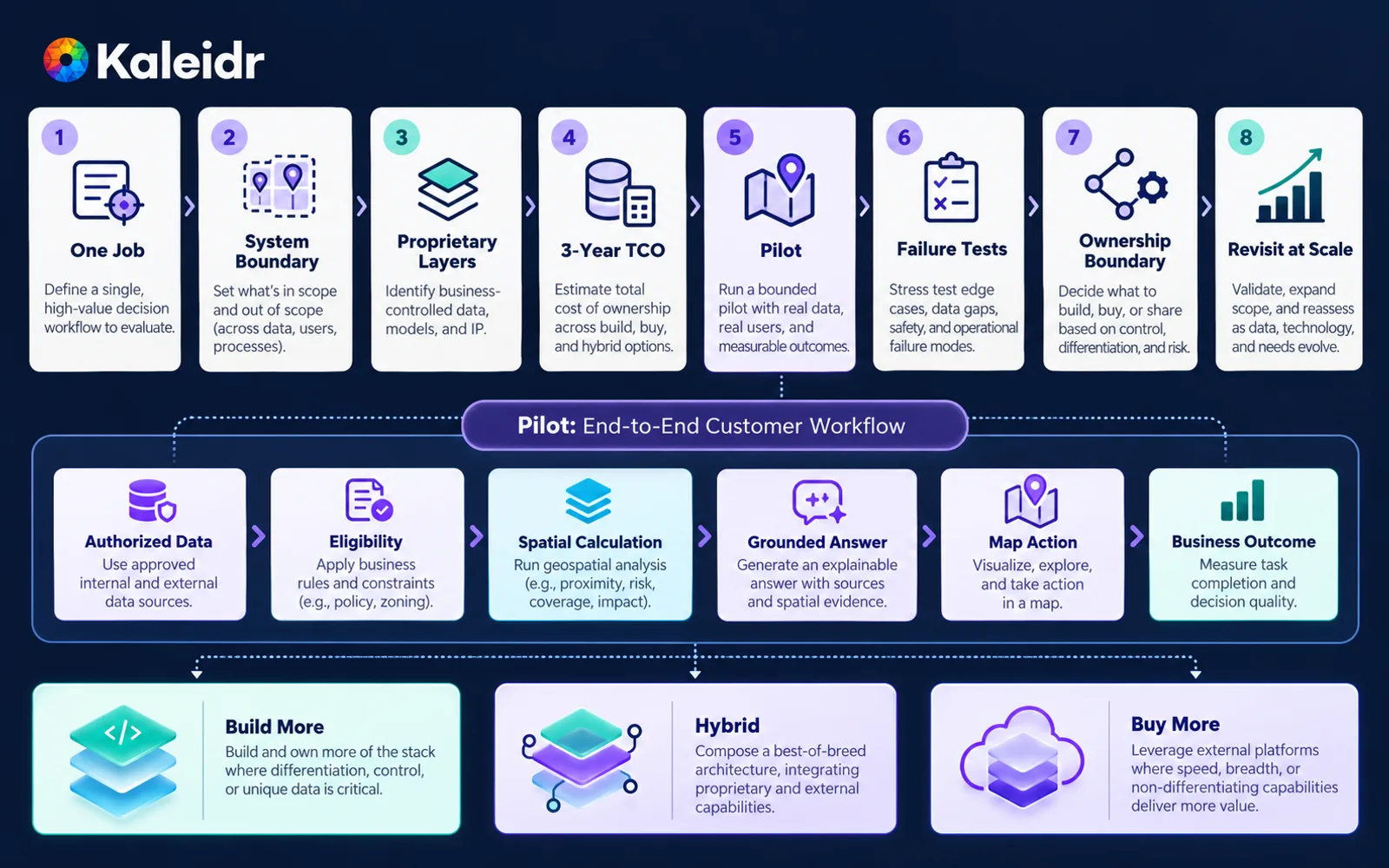
Use one production-shaped pilot to compare the real integration and ownership costs before committing to a company-wide Spatial AI architecture.
Explore Kaleidr Enterprise to see location-intelligence infrastructure, inference APIs, ranking, analytics, and deployment support beside the stack the company already runs. Explore Kaleidr Spatial AI to attach conversational search and visualization to an existing map. The host still owns the business systems, the data licenses, and the decision about which layers to build.
FAQs
What does build vs buy spatial AI mean?
Build vs buy spatial AI means deciding which layers a company should own and which it should consume as infrastructure. The choice is rarely "build everything" or "outsource the product." Most teams keep business systems and choose a boundary for maps, spatial calculation, ranking, and conversational interaction.
What should usually remain in-house?
Inventory, identity and permissions, eligibility and other business rules, and transactions should usually remain in the systems that already govern them. A language model can query those records. The model should not become the system of record.
What capabilities are often reasonable to buy?
Basemaps, geocoding, routing, map rendering, and a conversational layer attached to a map the host already runs are often infrastructure. Buying them does not transfer accountability for customer data, authorization, or the business outcome.
Is a hybrid architecture lock-in?
A hybrid can increase or reduce lock-in depending on whether the host keeps portable IDs, an export of its own records, and business actions on its own systems. Opaque result IDs and a workflow that cannot leave one vendor are the lock-in, not the mere use of an API.
Is building in-house cheaper?
Not by default. An internal build avoids a vendor invoice and still carries engineering, operations, security, evaluation, upgrades, and the opportunity cost of the work the team did not ship. Compare three years of ownership, not the first sprint against the first invoice.
When should a company build more internally?
Build more when the spatial method itself is the product advantage, the environment is too specialized for a general platform, or the team will staff maps, grounding, and evaluation as a long-term platform. Extreme latency or scale can also justify owning a layer, once that requirement is measured rather than assumed.
How does Kaleidr fit this decision?
Kaleidr Enterprise describes location-intelligence infrastructure with inference APIs, ranking, analytics, and deployment support. Developer docs describe Chat, Editor, Tile, and Viewer on one SDK, including Chat attached to a map the host already runs. Public pages do not describe Kaleidr as a replacement for CRM, inventory, bookings, payments, telematics, or an identity provider.
Should the architecture be chosen before a pilot?
Name one job and the system boundary before the pilot, and treat the company-wide ownership choice as something the pilot informs. An enterprise Spatial AI pilot uses the same order: prove one job before scaling the workflow.
References
- Kaleidr. Location Intelligence APIs and Map SDK. Accessed 25 September 2026. https://kaleidr.com/enterprise
- Kaleidr. Build with Kaleidr. Developer documentation. Accessed 25 September 2026. https://docs.kaleidr.com/
- National Institute of Standards and Technology. Artificial Intelligence Risk Management Framework: Generative Artificial Intelligence Profile. NIST AI 600-1. 26 July 2024. https://nvlpubs.nist.gov/nistpubs/ai/nist.ai.600-1.pdf
- Kaleidr. Get an API Key. Developer documentation. Accessed 25 September 2026. https://docs.kaleidr.com/get-an-api-key
- Kaleidr. Endpoints. Developer documentation. Accessed 25 September 2026. https://docs.kaleidr.com/platform-api/endpoints
- Kaleidr. Enterprise Spatial AI Pilot Before Scaling. Accessed 25 September 2026. https://kaleidr.com/blog/enterprise-spatial-ai-pilot-before-scaling
- Kaleidr. Map SDK vs. Map API vs. Map Platform. Accessed 25 September 2026. https://kaleidr.com/blog/map-sdk-vs-map-api-vs-map-platform
- Kaleidr. Grounded Spatial AI for Business Data. Accessed 25 September 2026. https://kaleidr.com/blog/grounded-spatial-ai-business-data
@misc{kaleidr_enterprise_build_vs_buy_2026,
  title  = {Location Intelligence APIs and Map SDK},
  author = {{Kaleidr}},
  year   = {2026},
  note   = {Accessed 25 September 2026},
  url    = {https://kaleidr.com/enterprise}
}

@misc{kaleidr_docs_build_vs_buy_2026,
  title  = {Build with Kaleidr},
  author = {{Kaleidr}},
  year   = {2026},
  note   = {Developer documentation; accessed 25 September 2026},
  url    = {https://docs.kaleidr.com/}
}

@techreport{nist_ai_600_1_2024,
  title       = {Artificial Intelligence Risk Management Framework: Generative Artificial Intelligence Profile},
  author      = {{National Institute of Standards and Technology}},
  year        = {2024},
  number      = {NIST AI 600-1},
  institution = {National Institute of Standards and Technology},
  url         = {https://nvlpubs.nist.gov/nistpubs/ai/nist.ai.600-1.pdf}
}

@misc{kaleidr_api_key_build_vs_buy_2026,
  title  = {Get an API Key},
  author = {{Kaleidr}},
  year   = {2026},
  note   = {Developer documentation; accessed 25 September 2026},
  url    = {https://docs.kaleidr.com/get-an-api-key}
}

@misc{kaleidr_endpoints_build_vs_buy_2026,
  title  = {Endpoints},
  author = {{Kaleidr}},
  year   = {2026},
  note   = {Developer documentation; accessed 25 September 2026},
  url    = {https://docs.kaleidr.com/platform-api/endpoints}
}

@misc{kaleidr_pilot_build_vs_buy_2026,
  title  = {Enterprise Spatial AI Pilot Before Scaling},
  author = {{Kaleidr}},
  year   = {2026},
  note   = {Accessed 25 September 2026},
  url    = {https://kaleidr.com/blog/enterprise-spatial-ai-pilot-before-scaling}
}

@misc{kaleidr_sdk_api_platform_2026,
  title  = {Map SDK vs. Map API vs. Map Platform},
  author = {{Kaleidr}},
  year   = {2026},
  note   = {Accessed 25 September 2026},
  url    = {https://kaleidr.com/blog/map-sdk-vs-map-api-vs-map-platform}
}

@misc{kaleidr_grounded_build_vs_buy_2026,
  title  = {Grounded Spatial AI for Business Data},
  author = {{Kaleidr}},
  year   = {2026},
  note   = {Accessed 25 September 2026},
  url    = {https://kaleidr.com/blog/grounded-spatial-ai-business-data}
}