
A place ranking API orders eligible locations for a specific customer decision using spatial context, customer intent, business rules, and freshness. Hard constraints such as authorization, availability, required service, and service area are filters, not scores. The language model can interpret a request into structured requirements; geospatial and business systems supply the facts the ranker combines.
The sections below cover retrieval versus ranking, provider ranking modes, hard filters, geographic features, intent boundaries, feature design, authentication, Kaleidr’s current public surfaces, and evaluation. Related reading includes Location Intelligence Customer Experience Maps, What Is a Location Intelligence API?, Location-Aware Booking, AI Store Locator With Map Chat, and How to Build a Map-Aware AI Assistant.
Place ranking essentials
- Eligibility before scoring: Authorization, availability, required capability, and service area remove invalid places; they do not merely lower a number.
- The spatial feature matches the task: Straight-line distance, travel time, route detour, containment, and multi-anchor fit answer different questions.
- Intent is structured input: The language model interprets preferences; place, inventory, and routing systems remain authoritative for facts.
- Reasons beat opaque scores: Customers and operators need inspectable signals such as travel time, open status, and required service.
- Measure the decision, not only clicks: Candidate recall, constraint violations, stale data, and downstream outcomes belong in the quality contract.
What Is a Place Ranking API?
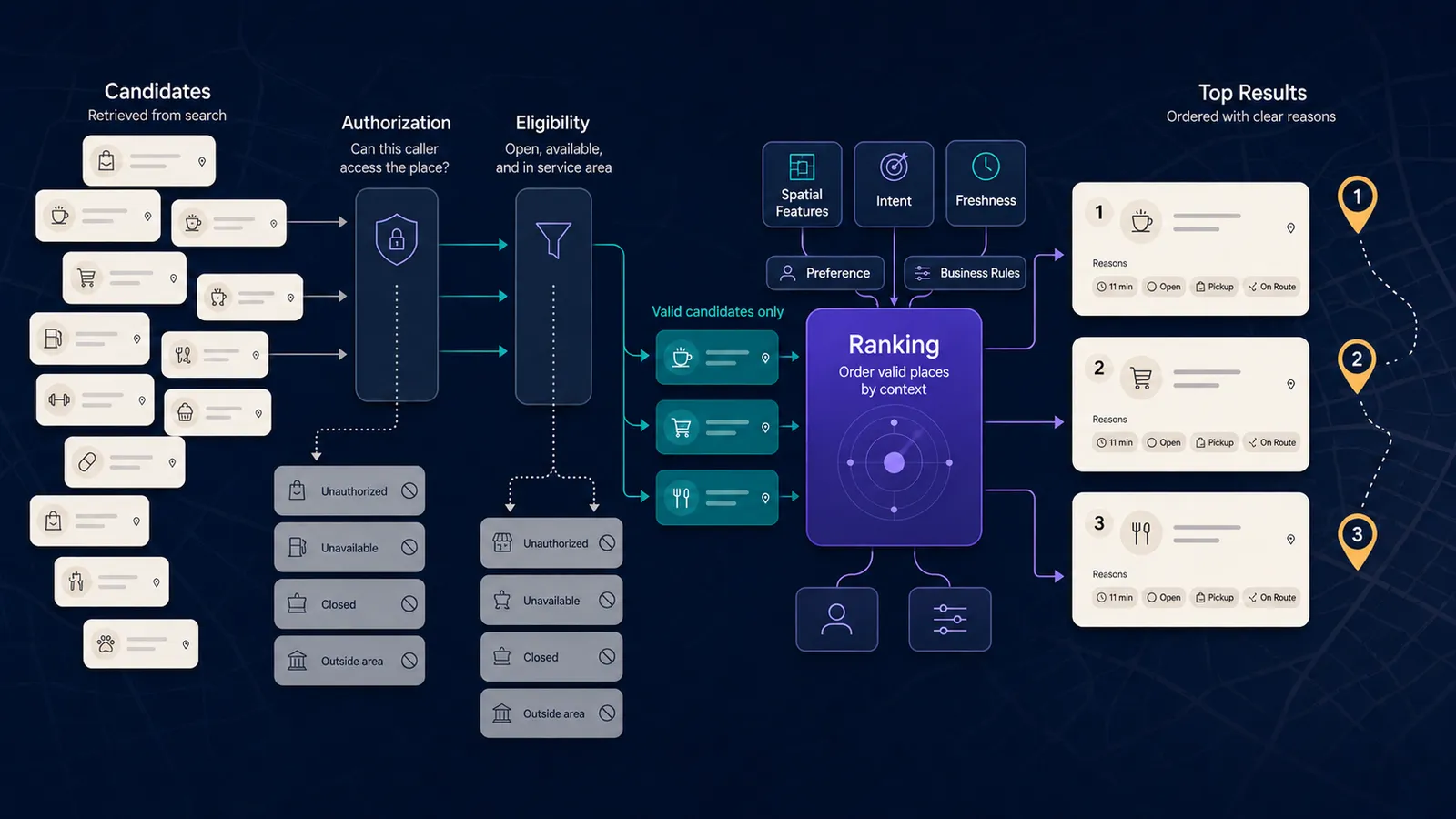
A place ranking API answers which valid locations should appear first for this customer, this task, and this current state. A search or retrieval API typically finds candidates: restaurants near a city, stores in a viewport, or hotels along a route. Ranking then orders the places that remain after authorization and hard eligibility. Production location intelligence usually needs all three stages—retrieve, filter, rank—because a high score on an invalid record is a product defect, not a ranking success.
The useful output is an ordered list synchronized with the map, not a single opaque number. Each result should carry the place identifier, the rank position, and a small set of reasons tied to real signals. Discover still retrieves eligible records. Compare still makes travel relationship, service fit, and freshness inspectable. Act is a highlight, directions where routing exists, a booking or pickup handoff, or a saved place. Customer-facing ranking exists to improve that decision, not to decorate a directory.
Why Is Ranking Different From Nearest Search?
Nearest search is a legitimate ranking policy when the customer asks for the closest eligible location and every other constraint is already satisfied. Sorting by distance fails as soon as the closest store does not offer pickup, is closed, lacks inventory, requires a large detour, or sits outside the service area. The stronger pipeline is valid place plus required service plus current availability plus travel relationship plus preference, then order. Distance remains one signal rather than the entire decision.
The distinction matters for product language as well as for scoring. A store locator, booking shortlist, property commute search, or venue amenity guide can all look like “near me” in the interface while needing different spatial features underneath. Teams that ship nearest-by-default and then bolt on weights for availability usually discover that an unavailable location can still win. Keep the hard rule in eligibility, then rank what remains.
How Do Search Providers Rank Places Today?
Current map-search APIs already expose more than one ranking mode, which is evidence that no universal order exists even at retrieval time. Google Places Nearby Search (New) documents a rankPreference of POPULARITY or DISTANCE (Nearby Search (New)). Google Places Text Search (New) documents RELEVANCE or DISTANCE for applicable categorical queries, and recommends leaving rankPreference unset for non-categorical queries such as a city name (Text Search (New)). Those controls order the provider’s candidate set; they do not know a host’s private inventory, ticket rules, or booking windows.
Mapbox Search Box documents a rank_strategy that accepts distance or relevance, plus proximity bias, route-aware search, and optional ETA calculation (Search Box API). Suggestion objects can include added_distance in meters and added_time in minutes when an input route is present, which is a detour signal rather than raw proximity. Google Places can also bias Text Search to a route polyline through searchAlongRouteParameters (Search along route). Provider ranking is useful candidate retrieval. Product ranking starts when the host enriches those candidates with facts the place provider does not own.
Which Decision Should a Place Ranking API Optimize?
Do not begin with a demand for an AI ranking model. Begin with the decision the ordered list is supposed to improve. Retail asks which eligible store the customer should visit. Booking asks which available option fits the itinerary. Property search asks which listing matches the location requirements. Hospitality asks which approved partner is convenient for the guest request. Events ask which exhibitor or amenity is relevant before the next session. Marketplace fulfillment asks which available provider can complete the request with the best geographic fit.
The decision determines candidates, hard constraints, spatial features, business features, labels, and evaluation metrics. A commute-sensitive listing ranker needs travel time to several anchors. A pickup ranker needs current inventory and opening state before convenience. An along-route amenity ranker needs detour, not crow-flies distance. Write the task in one sentence the ranker can be tested against. Vague “relevance” hides the fact that two legitimate customers can need opposite orders for the same catalog.
What Pipeline Should a Place Ranking API Use?
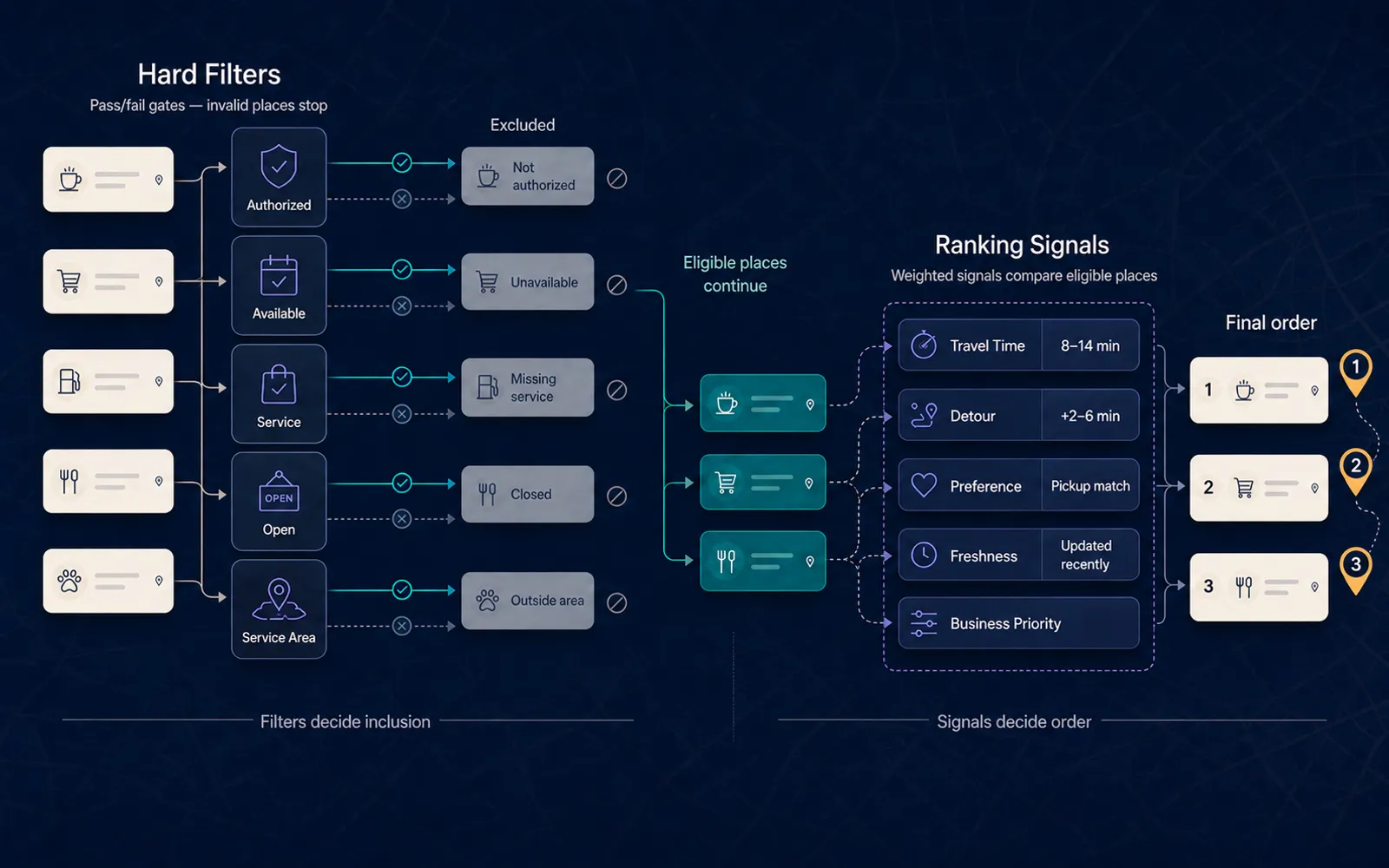
A robust pipeline is request interpretation, candidate retrieval, authorization, hard eligibility, feature computation, ranking, reason generation, map-and-list presentation, then outcome measurement. Invalid places must leave the set before scoring so that a convenient but unauthorized, closed, or out-of-area record cannot occupy a top slot. Feature computation then attaches travel time, detour, preference fit, freshness, and business policy only to survivors. Ranking orders those survivors. Reasons are derived from the same signals, not generated as independent prose.
Larger catalogs often split cost across stages. Retrieval returns a bounded candidate set. A cheap pre-rank can use approximate distance, category, and coarse availability. Expensive work—travel-time matrices, route detours, deep enrichment—runs only on the remaining shortlist. The exact cut sizes are an application choice, not a universal constant. Latency should be measured per stage. Teams that attribute all delay to “AI” often find that routing or inventory lookup dominates the budget.
Why Must Hard Filters Run Before Ranking Signals?
A hard filter is binary: the candidate either may participate or must not. Typical gates include an active listing, the requested service, current inventory, a bookable room, containment in the service area, ticket permission, opening during the requested window, and the user’s right to view the record. Ranking signals are comparative among survivors: travel time, detour, distance, price fit, category fit, declared preference, freshness, business priority, and historical conversion. Converting a hard rule into a weight such as “unavailable gets minus twenty points” still allows the invalid place to win.
Required accessibility is the same class of rule. A weighted mix of relevance, distance, and a small accessibility term can rank an inaccessible location above an accessible one. If accessibility is required, exclude places that fail the requirement, then rank the remaining accessible set. Permissions, legal service area, inventory, ticket access, and required capability follow the same pattern. Soft preference belongs in ranking. Required capability belongs in eligibility.
Missing data is not the same as a failing score. A candidate may have known travel time and hours while lacking a rating. Assigning zero to a missing rating treats unknown as bad and systematically penalizes sparse records. Safer policies are a neutral default, a feature-specific fallback, a reduced-confidence flag, or exclusion only when the missing field is itself a hard requirement. Document the missing-data rule as part of the ranking policy version.
Which Geographic Signals Should Ranking Use?
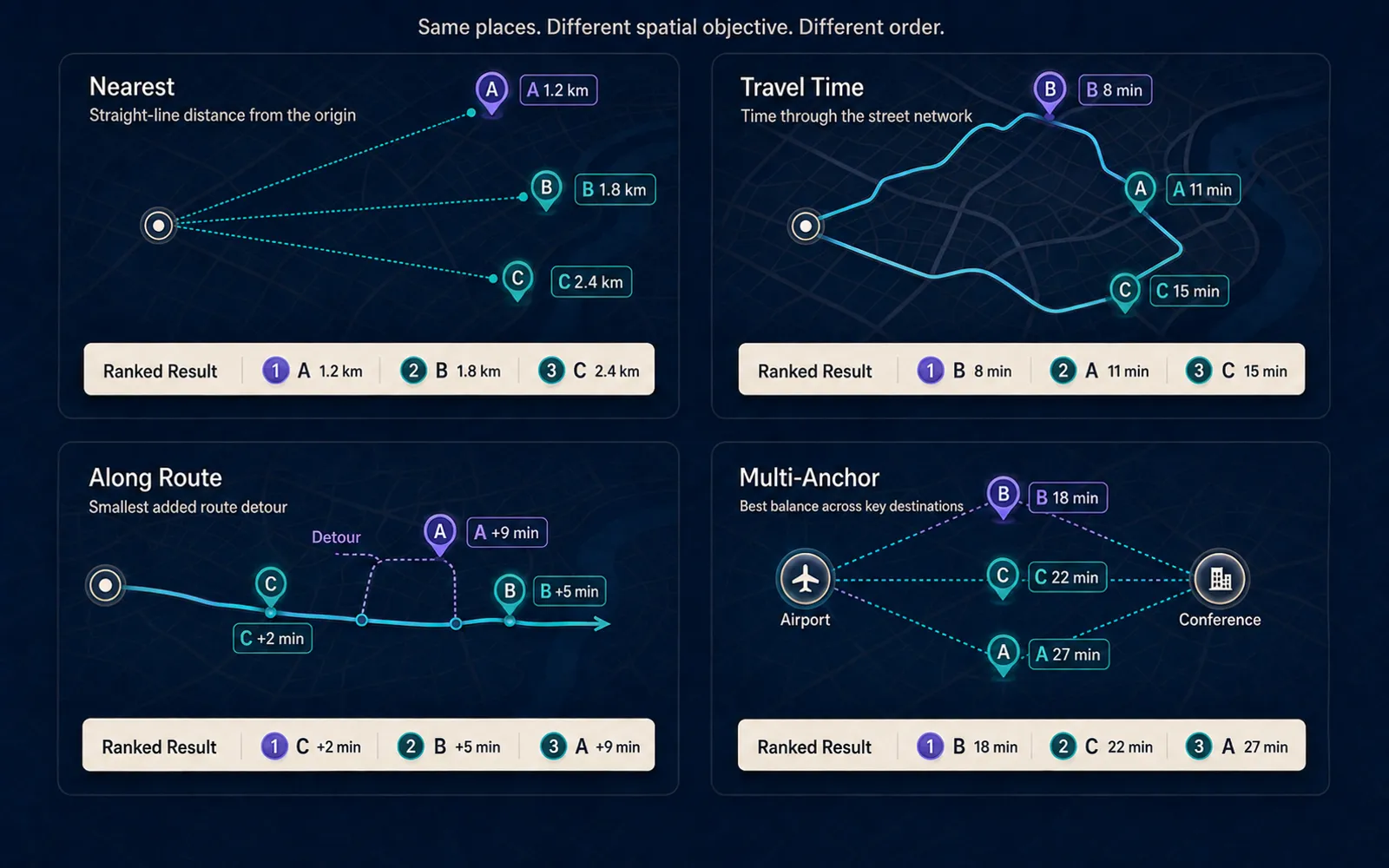
A place has no universal rank. Straight-line distance is a cheap approximation when network travel is irrelevant. Travel time is the better convenience feature for appointments, store visits, hotels, and property commute. Along-route detour is the right feature for road trips, delivery stops, and service calls; Mapbox’s added_time and added_distance fields illustrate that product shape at retrieval time (Search Box API). Containment answers whether the place sits inside a delivery territory, school zone, or event area. Multi-anchor fit asks whether one candidate works relative to several important places at once, such as a hotel against airport, conference, and office.
The scoring function should match the customer task rather than the most convenient geometry. One multi-anchor policy averages travel times. Another minimizes the worst leg. Another requires every anchor under a threshold and then ranks by price. Those policies produce different winners from the same feature vector. Choose the function because it reflects the decision, not because the formula is tidy. The map and the list must show the same order for the same policy version.
How Should Customer Intent Enter Ranking?
Natural-language requests often mix a required constraint with several preferences. “Find a quiet cafe near the conference that is still convenient on my way to the airport” encodes an entity type, an implied open window, a meeting-suitability preference, a near-anchor, and an along-route constraint. A structured interpretation can carry required fields separately from preferences so eligibility still runs as gates. The language model interprets the request. The place system resolves candidates. The routing service calculates the route relationship. The ranker combines validated signals.
Keep the intent model out of the facts layer. A generated claim that a cafe is open, an item is in stock, a room is available, or a detour takes eleven minutes is not a ranking feature unless an approved system supplied the value. OWASP Top 10 for LLM Applications 2025 names LLM06:2025 Excessive Agency: connected functions should not run solely because the model proposed them. The same boundary that makes a map-aware assistant reliable applies here. The model proposes structured ranking requirements; deterministic code or a controlled ranker combines authorized features; the host validates the map action.
Personalization can use declared preferences such as walking, parking, quiet environment, saved categories, or preferred neighborhoods. Give the customer control to edit, reset, or ignore those preferences. Do not infer sensitive traits for ranking without a legitimate basis, and do not log raw sensitive inputs when derived features suffice. The NIST Privacy Framework treats privacy as enterprise risk management. Private location data for AI map workflows covers the same host-catalog boundary: authorized business data stays behind the application layer.
How Should Ranking Features Be Combined and Explained?
A ranking feature should be meaningful for the task, available, fresh enough, correctly normalized, permitted, and testable. Raw units do not combine: meters, star-like ratings, currency, and preference scores are not one arithmetic. Convert each signal into a comparable fit value, and treat the normalization function as product policy. A transparent weighted sum of travel fit, intent fit, freshness, and business fit is often a better first version than a learned model because teams can inspect, debug, explain, measure, and change it deliberately. Illustrative weights are policy, not evidence.
Do not publish the internal score as meaning. Customers cannot interpret 87.4. Prefer reasons tied to signals: a twelve-minute walk, open during the requested time, the requested service, or a match to a selected preference. Business priority—preferred partners, loyalty, capacity, promoted inventory, contractual rank, operational balancing—can adjust order, but it should remain separable from geographic relevance. If commercial placement affects the list, follow applicable disclosure rules; this article describes the architecture, not a legal determination.
Freshness is a first-class feature because location facts decay: hours, inventory, listings, event rooms, entrance status, and provider availability. Attach freshness to the field or source. Stale critical facts should be revalidated or excluded rather than smoothed by historical popularity. Popularity itself is a feedback loop; use it deliberately or it will keep promoting whatever was already easy to tap. Result diversity and geographic coverage are optional second steps when five near-duplicate branches or a tight map cluster fail the customer’s actual request for options across an area.
How Do Provider Rankings Differ From Product Rankings?
A ranker cannot recover a place that retrieval never returned. Evaluate candidate recall separately from ranking quality. Google’s rankPreference modes and Mapbox’s rank_strategy, proximity, and route fields are provider-level orders over the provider’s index (Nearby Search (New), Text Search (New), Search Box API). A host can take a bounded candidate set, enrich it with inventory or eligibility, compute routes, and re-rank for the product task. Provider rank is not business-task rank.
The same store can be an excellent result for one context and a poor result for another because origin, route, required service, inventory, and intent differ. Rank place given user context, task context, and current state—not place in the abstract. A static directory sort has no room for that conditioning. Pre-rank, rank, and re-rank exist to spend expensive features where they change the decision, not to add ceremony.
How Should a Ranking Request Be Authenticated and Shaped?
An architectural ranking request can name the task, an origin, candidate identifiers, hard requirements, preferences, and a result limit. The response can return ordered placeId values plus inspectable reasons. That shape is a design example, not a documented Kaleidr route. Prefer candidate IDs plus authorized backend enrichment over sending entire private records from the browser. The user authenticates to the host; the host retrieves permitted candidates; ranking runs on that authorized set.
Kaleidr’s platform authenticates with publishable keys in the browser and server keys for trusted backend operations (Auth & Scopes). Publishable keys are exchanged for a short-lived, origin-bound session; server keys stay on the backend. Private inventory, ticket state, and ranking credentials do not belong in page source merely because the result will render on a map. Batch travel-time or matrix requests where the routing provider supports them rather than issuing one route call per candidate.
How Does Kaleidr Currently Position Ranking?
Kaleidr Enterprise currently describes the platform as location intelligence infrastructure with inference APIs, ranking systems, and analytics for modern spatial products (Location Intelligence APIs and Map SDK). The same page’s definition of a location intelligence API is answers about places—context, ranking, and analysis—rather than only coordinates or tiles. Kaleidr’s inference APIs are positioned as following that model. The vendor page is authoritative about Kaleidr’s own positioning; it is not a substitute for the live endpoint list.
The current public Platform API reference documents chat, route, POI enrichment, and design routes under https://api.kaleidr.com/inference-api/b2b/v1/. Documented chat-family paths include POST /chat/control/stream, POST /chat/control/route, and GET /retrieval/poi/enrich, plus design endpoints under the design scope (Endpoints). The reference does not document a dedicated public /rank route. Treat custom ranking as an Enterprise integration requirement. Do not implement POST /rank unless the current deployment contract provides it.
Those public inference surfaces can still contribute to a ranking workflow: conversational intent, route calculation, and POI enrichment are inputs, not a standalone ranker. Kaleidr Enterprise remains the product surface for organization-level spatial inference, contracts, and deployment support (Location Intelligence APIs and Map SDK). Confirm the supported integration before encoding an assumed path into a client.
How Should Place Ranking Quality Be Evaluated?
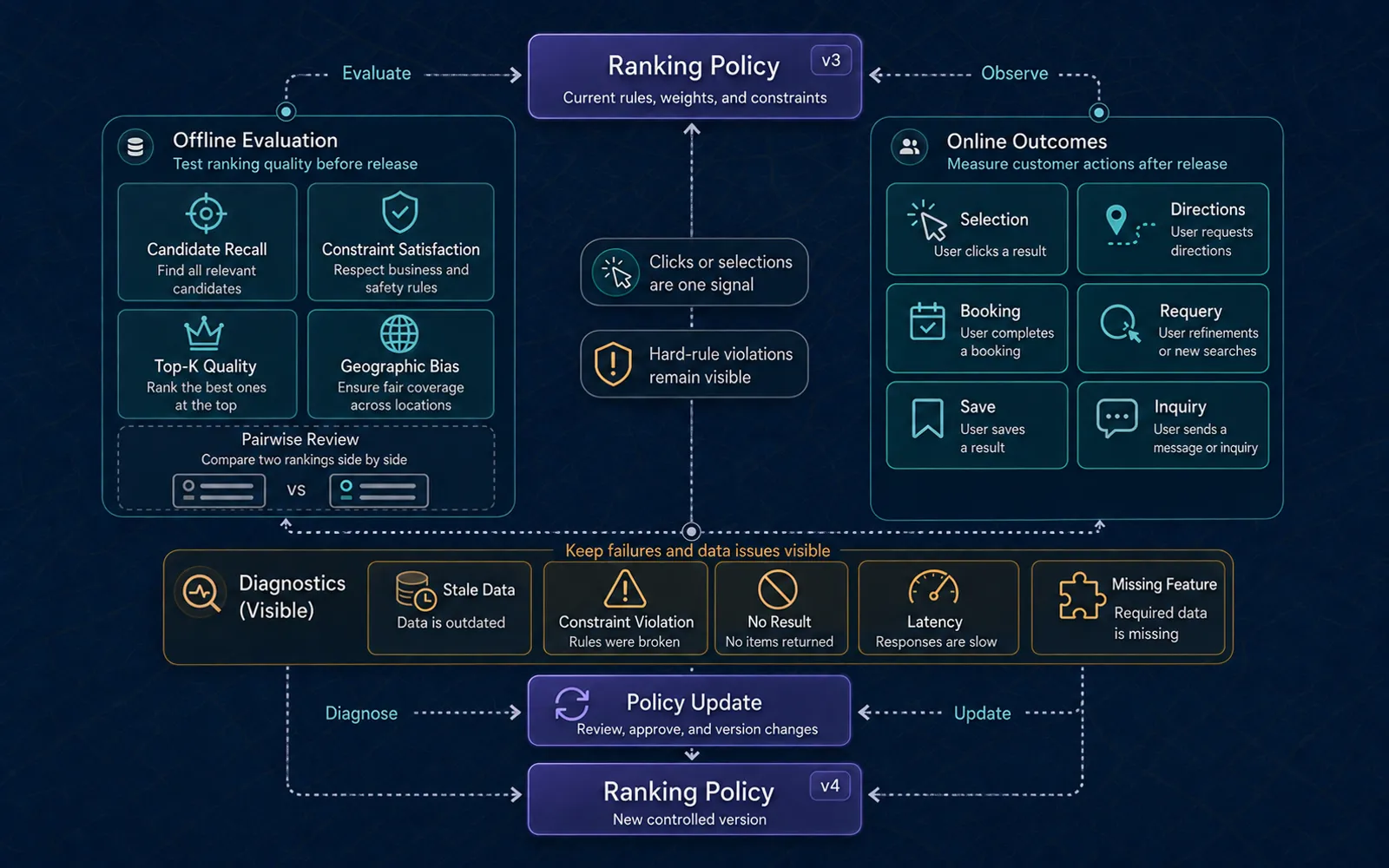
Offline evaluation needs a frozen task set: query, origin, hard rules, and preferred signals. Measure candidate recall, eligibility accuracy, top-K quality, constraint-satisfaction rate, explanation correctness, and geographic bias. Pairwise labels—“should A rank above B for this task?”—are often easier to collect than a perfect absolute score and remain useful if the team later trains a learned ranker. Constraint-satisfaction is non-negotiable: if the customer required open, pickup, and in-area, a top result that violates any of those rules is a failure even when click-through looks strong.
Online measurement can include place selected, directions opened, booking or pickup started, listing saved, inquiry, or requery. Clicks are biased by position; the first result receives attention because it is first. A click does not prove the place was the best eligible option. Diagnostics should remain visible: no result, hard-rule violation, stale data, latency by stage, and missing required features. Feed those outcomes into a versioned policy update with a rollback path. The spatial analytics KPI guide likewise prioritizes task completion over raw interaction.
Freshness tests belong in the same suite. A store that closed twenty minutes ago, a disabled venue entrance, an inactive listing, or sold-out inventory should not stay high because yesterday’s engagement was strong. Historical popularity must not compensate for a current eligibility failure. Version the ranking policy so experiments remain traceable.
What Failure Modes Should Product Teams Expect?
| Mistake | Result | Better approach |
|---|---|---|
| Rank before eligibility | Invalid location appears high | Filter hard constraints first |
| Treat nearest as best | Task context is ignored | Use the spatial feature the decision needs |
| Put a required rule into a weight | Invalid option can still win | Keep required capability as a hard filter |
| Let the language model invent facts | Ranking becomes ungrounded | Read hours, inventory, and routes from authoritative systems |
| Mix missing with zero | Sparse records are punished | Define a missing-data policy |
| Rely only on provider order | Product context is lost | Re-rank with host facts |
| Optimize clicks only | Position bias looks like quality | Measure outcomes and constraint violations |
| Hide every reason | Trust and debugging collapse | Expose inspectable signals |
| Ignore ranking version | Experiments cannot be traced | Version and roll back policy |
Assume a Kaleidr /rank route |
Integration targets fiction | Confirm the current Enterprise contract |
Mobile ranking experiences need large targets, readable reasons, and a map that remains usable when the model or an expensive feature times out. Direct search must still work: a customer who types a store name should not need a conversation. Cache base geometry and labels; degrade enrichment in a controlled way. Test ambiguous names, reversed origins, closed locations, and stale inventory until map, list, and reasons update together.
Build a Place Ranking API Into Your Product
The production pattern is retrieve, authorize, filter hard constraints, compute spatial features, rank, explain, and measure. Distance, popularity, and semantic relevance can all be useful; none is universally correct. The ranking policy should reflect the decision the customer is trying to make, with reasons a person can inspect on the map.
Explore Kaleidr Enterprise to discuss location-intelligence APIs, ranking systems, and deployment support. Review the current public inference, retrieval, auth, and SDK surfaces in the Kaleidr developer documentation before encoding an integration path.
FAQs
What is a place ranking API?
A place ranking API orders a set of candidate locations for a specific task using geographic, business, and customer-context signals after hard eligibility.
Is place ranking the same as nearest-place search?
Nearest-place search orders primarily by distance. Place ranking can also consider travel time, route detour, availability, eligibility, preferences, freshness, and business rules.
Should unavailable places receive a lower score?
If availability is a hard requirement, unavailable places should be removed before ranking rather than given a penalty that can still lose to convenience.
What is the difference between retrieval and ranking?
Retrieval finds candidate places. Ranking orders the valid candidates. A ranking system cannot recover a relevant place that retrieval never returned.
Can a product use provider ranking and then re-rank?
A place provider can supply candidates using relevance, popularity, distance, proximity, or route-aware search. The application can then enrich, filter, and re-rank those candidates for its specific business task.
Which spatial signal should ranking use?
Use the signal that matches the customer decision. Straight-line distance may be enough for simple proximity; travel time is better for real convenience; detour is useful along routes; containment is appropriate for service areas.
What is multi-anchor ranking?
Multi-anchor ranking evaluates a candidate relative to several important locations, such as a hotel relative to both an airport and a conference venue.
Should a language model calculate the ranking score?
A language model can interpret natural-language preferences. Deterministic code or a controlled ranking model should combine validated features. Travel time, inventory, and availability should come from authoritative systems.
How should place ranking be explained?
Return concise reasons tied to real signals, such as travel time, pickup availability, or open during the requested window, rather than exposing a raw internal score.
How should place ranking be evaluated?
Evaluate candidate recall, hard-constraint satisfaction, top-K quality, ranking metrics such as NDCG or MRR where the labeled set supports them, and downstream customer outcomes.
Does Kaleidr have a public place-ranking endpoint?
Kaleidr Enterprise currently describes ranking systems and location-intelligence APIs that return ranking and analysis. The current public Platform API endpoint reference does not document a dedicated standalone /rank endpoint. Confirm the supported Enterprise integration for custom ranking.
References
- Google Maps Platform. Nearby Search (New). Places API. Accessed 26 August 2026. https://developers.google.com/maps/documentation/places/web-service/nearby-search
- Google Maps Platform. Search along route. Places API. Accessed 26 August 2026. https://developers.google.com/maps/documentation/places/web-service/search-along-route
- Google Maps Platform. Text Search (New). Places API. Accessed 26 August 2026. https://developers.google.com/maps/documentation/places/web-service/text-search
- Kaleidr. Auth & Scopes. Kaleidr Developer Docs. Accessed 26 August 2026. https://docs.kaleidr.com/platform-api/auth-and-scopes
- Kaleidr. Endpoints. Kaleidr Developer Docs. Accessed 26 August 2026. https://docs.kaleidr.com/platform-api/endpoints
- Kaleidr. Location Intelligence APIs and Map SDK. Accessed 26 August 2026. https://kaleidr.com/enterprise
- Mapbox. Search Box API. Accessed 26 August 2026. https://docs.mapbox.com/api/search/search-box/
- National Institute of Standards and Technology. NIST Privacy Framework: A Tool for Improving Privacy through Enterprise Risk Management, Version 1.0. NIST.CSWP.01162020. 16 January 2020. https://nvlpubs.nist.gov/nistpubs/CSWP/NIST.CSWP.01162020.pdf
- OWASP Gen AI Security Project. OWASP Top 10 for LLM Applications 2025. Accessed 26 August 2026. https://owasp.org/www-project-top-10-for-large-language-model-applications/assets/PDF/OWASP-Top-10-for-LLMs-v2025.pdf
@misc{google_nearby_search_2026_08_26,
  title  = {Nearby Search (New)},
  author = {{Google Maps Platform}},
  note   = {Places API; accessed 26 August 2026},
  url    = {https://developers.google.com/maps/documentation/places/web-service/nearby-search}
}

@misc{google_search_along_route_2026_08_26,
  title  = {Search along route},
  author = {{Google Maps Platform}},
  note   = {Places API; accessed 26 August 2026},
  url    = {https://developers.google.com/maps/documentation/places/web-service/search-along-route}
}

@misc{google_text_search_2026_08_26,
  title  = {Text Search (New)},
  author = {{Google Maps Platform}},
  note   = {Places API; accessed 26 August 2026},
  url    = {https://developers.google.com/maps/documentation/places/web-service/text-search}
}

@misc{kaleidr_auth_scopes_2026_08_26,
  title  = {Auth \& Scopes},
  author = {{Kaleidr}},
  note   = {Kaleidr Developer Docs; accessed 26 August 2026},
  url    = {https://docs.kaleidr.com/platform-api/auth-and-scopes}
}

@misc{kaleidr_endpoints_2026_08_26,
  title  = {Endpoints},
  author = {{Kaleidr}},
  note   = {Kaleidr Developer Docs; accessed 26 August 2026},
  url    = {https://docs.kaleidr.com/platform-api/endpoints}
}

@misc{kaleidr_enterprise_2026_08_26,
  title  = {Location Intelligence APIs and Map SDK},
  author = {{Kaleidr}},
  note   = {Accessed 26 August 2026},
  url    = {https://kaleidr.com/enterprise}
}

@misc{mapbox_search_box_2026_08_26,
  title  = {Search Box API},
  author = {{Mapbox}},
  note   = {Accessed 26 August 2026},
  url    = {https://docs.mapbox.com/api/search/search-box/}
}

@techreport{nist_privacy_framework_2020,
  title       = {NIST Privacy Framework: A Tool for Improving Privacy through Enterprise Risk Management, Version 1.0},
  author      = {{National Institute of Standards and Technology}},
  number      = {NIST.CSWP.01162020},
  institution = {National Institute of Standards and Technology},
  year        = {2020},
  month       = jan,
  url         = {https://nvlpubs.nist.gov/nistpubs/CSWP/NIST.CSWP.01162020.pdf}
}

@misc{owasp_llm_top10_2025,
  title  = {OWASP Top 10 for LLM Applications 2025},
  author = {{OWASP Gen AI Security Project}},
  note   = {Accessed 26 August 2026},
  url    = {https://owasp.org/www-project-top-10-for-large-language-model-applications/assets/PDF/OWASP-Top-10-for-LLMs-v2025.pdf}
}