
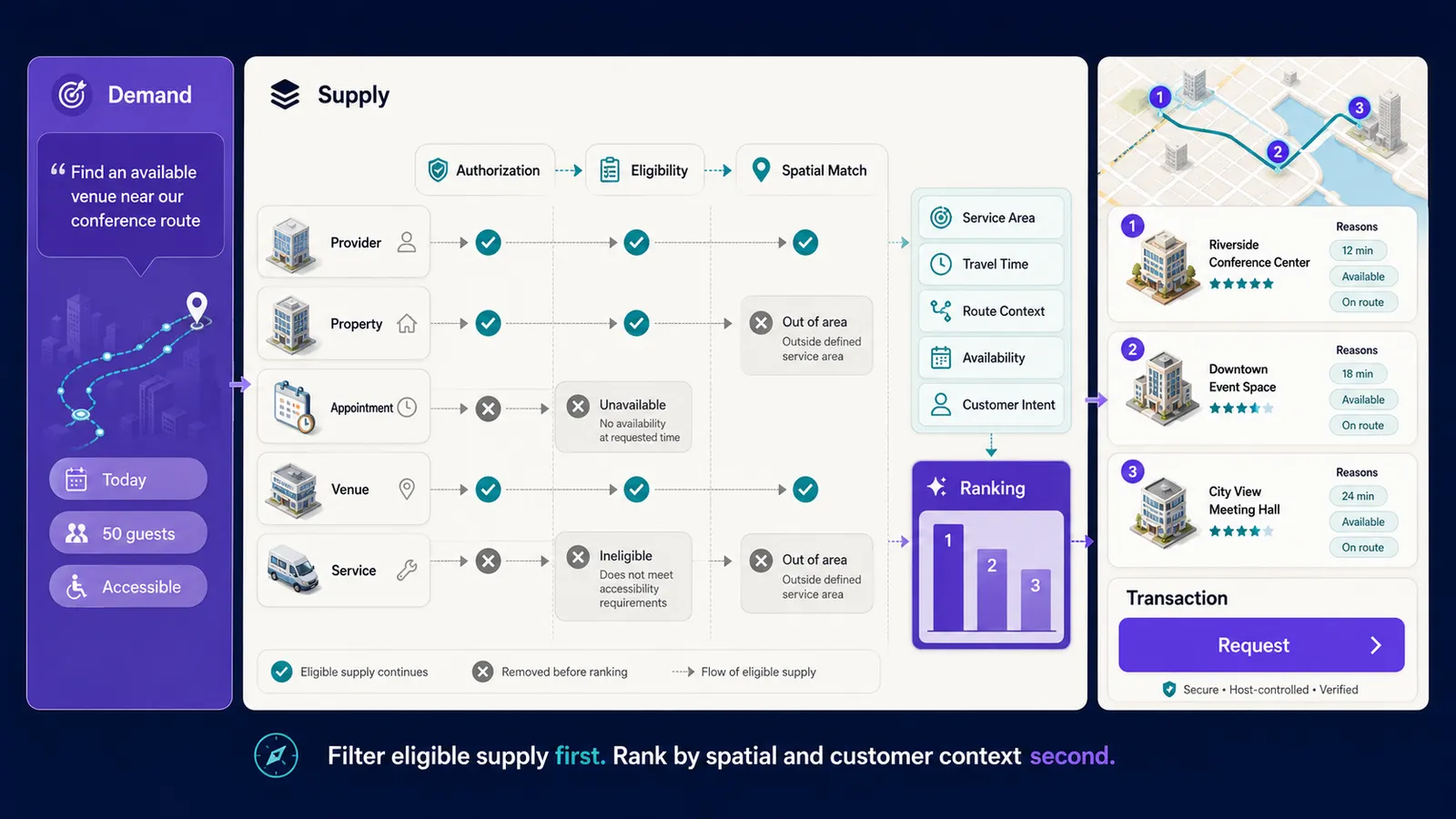
A location-aware marketplace matches customer demand with supply using both business eligibility and spatial context. Instead of listing every nearby provider, property, appointment, venue, or service, the product first determines which supply can fulfill the request, then compares valid options by travel time, service area, detour, availability, customer intent, and business rules. The language model can interpret a natural-language request into structured constraints; the marketplace remains authoritative for inventory, pricing, permissions, and transactions.
The sections below cover search versus match versus transaction, hard eligibility, spatial matching modes, natural-language intent, shared state, Kaleidr’s current public fit, measurement, and failure modes. Related reading includes Place Ranking API for Customer Intent, Location-Aware Booking, Location Intelligence Customer Experience Maps, How to Build a Map-Aware AI Assistant, and Private Location Data for AI Map Workflows.
Location-aware marketplace essentials
- Eligibility before ranking: Unavailable, unauthorized, or out-of-area supply leaves the set; it does not merely score lower.
- The spatial feature matches the job: Service area, travel time, route detour, and multi-anchor fit answer different questions.
- The language model interprets intent: Marketplace systems remain authoritative for inventory, price, permissions, and checkout.
- Map and list share one state: Markers, cards, explanations, and the transaction use the same supply identifiers.
- Measure match and completion: Clicks are not proof that eligible supply reached a host-owned action.
What Is a Location-Aware Marketplace?
A location-aware marketplace is a matching product in which geography participates in eligibility, ranking, or fulfillment rather than decorating a finished directory. Conventional marketplace search often retrieves a category, applies a radius, and plots markers. Customers still have to infer whether a result can actually serve the address, whether the appointment is still open, or whether the stop is a small detour on an existing trip. The useful product keeps supply state, spatial calculation, and a host-owned transaction in one inspectable flow.
Kaleidr’s current homepage lists booking and marketplace experiences among AI-driven customer journeys and states that those experiences are ones “in which location, availability, and customer intent influence every decision” (AI-Powered Map Experiences for Business). That page is authoritative about Kaleidr’s own positioning. The architecture below is a product contract for hosts: the language model interprets the request; supply, pricing, permissions, and checkout remain sources of truth.
Customer-facing location intelligence still uses Discover → Compare → Act. Discover retrieves eligible supply. Compare makes travel relationship, service fit, availability, and policy inspectable. Act is a book, reserve, request, contact, or purchase handoff inside the marketplace. Ranking exists to improve that decision. Location-aware booking is the reservation-shaped sibling of the same contract; a marketplace generalizes it across providers, properties, services, and other first-party supply.
Why Is Marketplace Search a Spatial Decision?
Marketplace products solve a matching problem: customer demand against available supply. Location changes whether that match is useful. A provider can be relevant and still sit outside the service area, take too long to reach, lack the requested time slot, sit on the wrong side of a route, lack a license for the market, or fail to offer the requested service. A property can match budget and features while failing a commute requirement. A venue can have capacity and still be inconvenient for attendee geography. Straight-line nearness hides those failures.
The product question is which eligible supply best fits this customer’s need in this geographic context. Four inputs usually combine. Customer intent covers the requested service, time, budget, neighborhood, accessibility, route, and urgency. Supply state covers the provider, property, slot, rental, venue, store, or bookable unit. Spatial context covers origin, destination, service area, travel time, route, and boundary. Business rules cover eligibility, licensing, account tier, partner status, operating market, inventory, and capacity. A recommendation is only as trustworthy as those inputs.
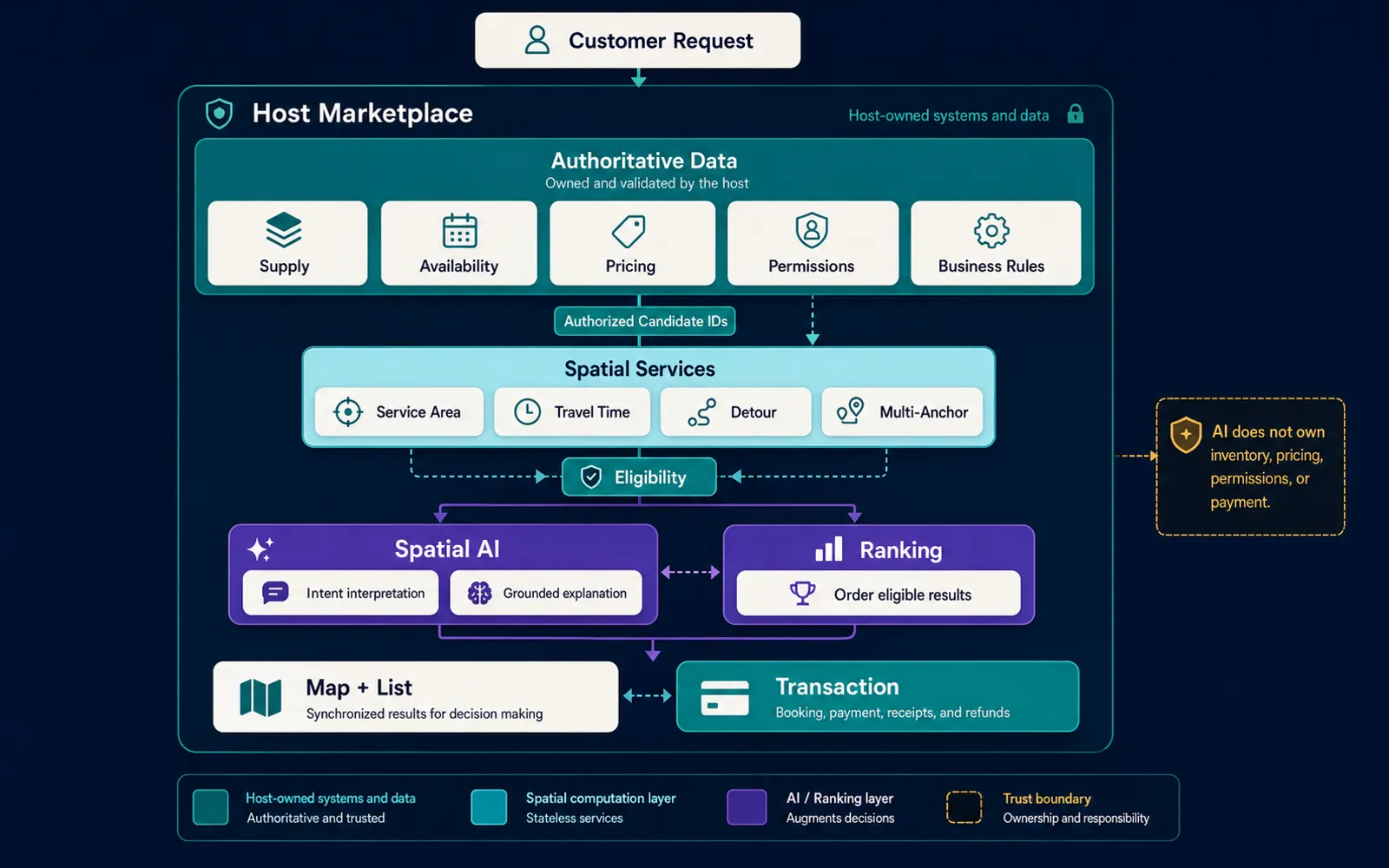
Search, match, and transaction are different stages. Search finds candidates in a category, city, or viewport. Match determines which candidates are valid and useful for the current request. Transaction completes the business action. The language model should not own all three. The host marketplace should remain authoritative for checkout, payment, inventory locks, and account rules.
Why Must Hard Eligibility Run Before Ranking?
A candidate that cannot fulfill the request should leave the set before scoring. Unavailable providers, inactive listings, taken slots, out-of-area service, unsupported capabilities, unlicensed markets, insufficient venue capacity, and unauthorized customers are gates. Converting a hard rule into a penalty still allows the invalid record to win. The place ranking API uses the same order: retrieve, authorize, filter, then rank. Marketplace matching inherits that pipeline with first-party supply as the catalog.
Some marketplace rules are geographic and binary. Service-area containment asks whether the customer point sits inside a provider polygon. Market eligibility asks whether the listing is permitted in the selected region. Pickup or fulfillment asks whether a store can complete the request from a postal area. Those checks are spatial filters. Ranking then compares survivors on travel time, detour, neighborhood fit, preference, freshness, and business policy. A low score does not make an invalid provider valid.
| Candidate | Straight-line distance | Drive time | Available |
|---|---|---|---|
| A | farther | slower | Yes |
| B | farther still | faster | Yes |
| C | nearest | fastest | No |
Nearest-by-distance returns C. Eligibility removes C. Network travel can then rank B above A. A radius query cannot express that sequence. Travel mode should be explicit: driving, walking, cycling, or transit. Missing availability is not a ranking feature when availability is required; the record is excluded until the marketplace system confirms a bookable state.
Which Spatial Features Should Marketplace Matching Use?
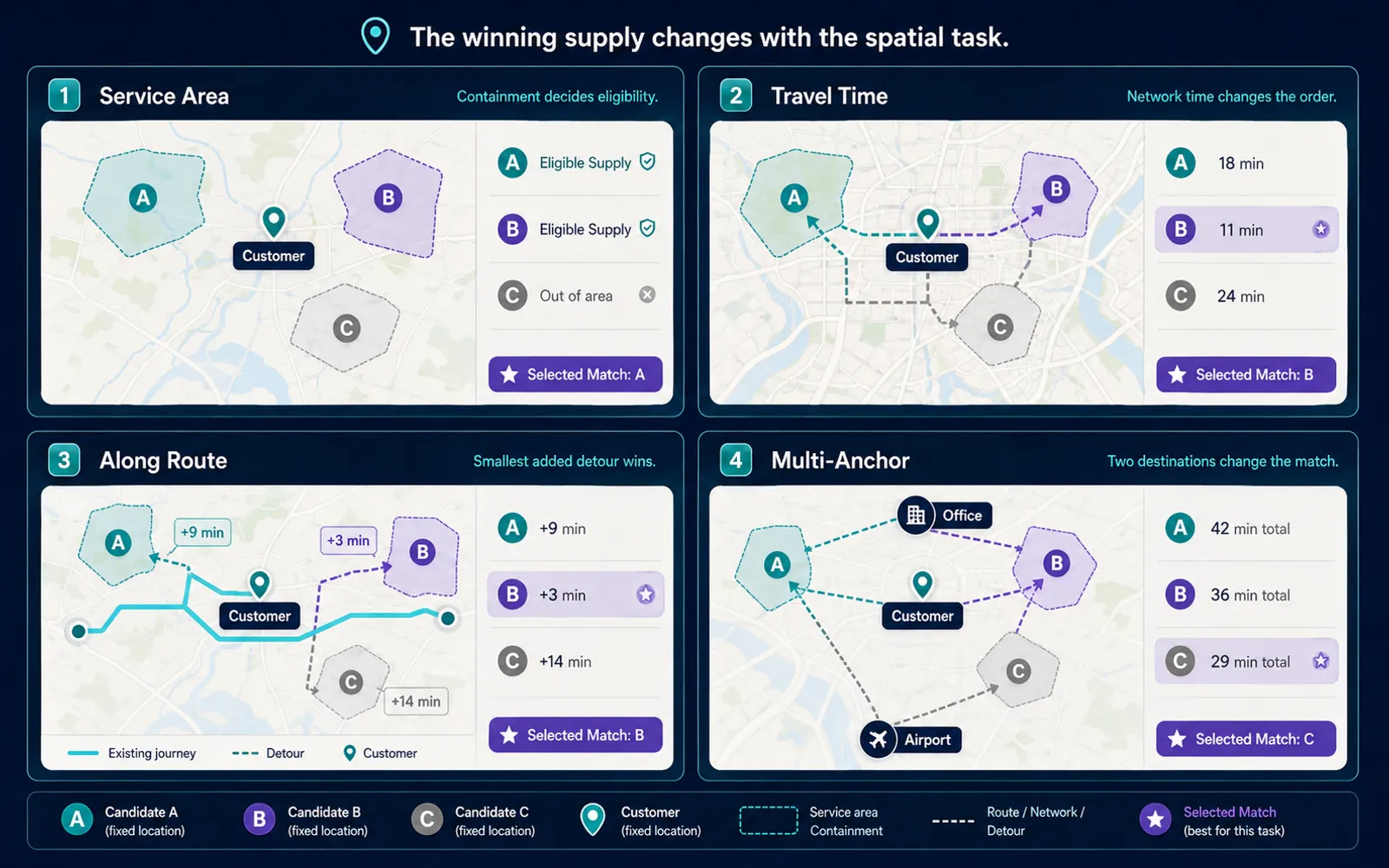
Once supply is eligible, geography becomes comparative. Straight-line distance is a cheap approximation when network travel is irrelevant. Travel time is often the better convenience feature for appointments, property commute, and service visits because it uses the network the customer actually travels. Along-route matching applies when demand occurs during a journey: a service stop on the way home, an activity with the smallest added detour before the airport, or pickup locations along an existing path. The feature is added travel cost relative to a route, not distance from origin.
Current Mapbox Search Box documentation supports route-aware search and exposes added_distance in meters and added_time in minutes on suggestion objects when an input route is present (Search Box API). Those fields illustrate detour as a retrieval signal. Google Places can bias Text Search to a route polyline through searchAlongRouteParameters (Search along route). Provider search is not marketplace inventory. Product matching starts when the host enriches first-party supply with facts a place provider does not own.
Multi-anchor matching asks whether one candidate works relative to several important places, such as a coworking space against a hotel and a client office. One policy requires every anchor under a threshold, then ranks by price. Another minimizes the worse of the two trips. Those policies produce different winners from the same travel-time vector. Choose the function because it reflects the customer decision. Supply-side geography matters as well: provider home base, service territory, active work area, route capacity, current job location, fulfillment region, and listing geometry. Demand-side geography can be an address, neighborhood, route, destination, viewport, or drawn area. Do not force device geolocation. The W3C Geolocation specification, a Candidate Recommendation Snapshot dated 26 March 2026, provides access to device location only after express permission and states that the API gives no guarantee of the device’s actual location.
How Should Natural-Language Intent Work With Marketplace Filters?
Structured filters remain faster for explicit constraints such as date, price, category, availability, and capacity. Conversation becomes useful when the request combines several of them. “Find an available photographer near the venue who can cover a two-hour event tomorrow evening” encodes category, availability, duration, and a spatial relationship. “Show coworking spaces between the airport and downtown that have meeting rooms” encodes multi-anchor geography plus an amenity. The language model can recover those fields as inspectable constraints. The marketplace validates them against supply, calendar, and policy.
Interpreted constraints should be visible and editable. If a customer asks for options close to the airport under a stated budget, the interface should show the recovered airport relationship, price ceiling, and availability gate so the customer can correct them. Phrases such as close, nearby, convenient, and on the way do not have one universal numeric meaning. Deterministic filters, map, list, and conversation should share one candidate set. Conversation should not become the only path to a named provider or a typed address.
Map, list, explanation, and transaction should use the same supply identifiers. Selecting a marker should select the same marketplace card. Changing a filter should update both surfaces. An assistant recommendation should focus the same entity rather than a second unofficial result. Names are not enough: two providers can share a brand, one building can contain several units, and one venue can have multiple bookable spaces. Stable IDs keep search, map, analytics, and checkout synchronized.
Public place data and first-party marketplace supply serve different jobs. Public places are useful for neighborhood context, nearby amenities, and landmarks. First-party supply is authoritative for availability, price, inventory, service, provider status, bookable units, and marketplace eligibility. A public listing can exist while the corresponding marketplace item is unavailable. Do not substitute a place-search API for the supply database.
Private marketplace data needs a tight retrieval path. Authenticate, resolve tenant, authorize, retrieve a minimal eligible set, rank, then explain. Do not send the full catalog into the language model. Private location data for AI map workflows covers that host-owned boundary. Multi-tenant platforms must preserve organization, tenant, market, and user on every ranking request. Organization-level API credentials do not replace application-level tenant authorization. Map API authentication covers publishable versus server keys for Kaleidr surfaces that attach conversation to a host map.
OWASP’s LLM01:2025 Prompt Injection describes how user or retrieved text can alter model behavior, including influence over connected functions. The OWASP Top 10 for LLM Applications 2025 lists LLM06:2025 Excessive Agency: damaging actions from unexpected or manipulated model output when a system is granted too much functionality, permission, or autonomy. A marketplace assistant should propose a supply identifier and an allowed action. The host application should execute booking, payment, or inventory lock after schema, eligibility, and revalidation. Permissions belong to the application and infrastructure, never to the language model.
How Does Kaleidr Fit an Existing Marketplace Stack?
Kaleidr’s current Spatial AI page describes a business implementation pattern of Connect your places, Ground the AI, and Deploy on your platform, and states that answers can be grounded on inventory, brand voice, and policies rather than generic web search alone (AI Map Chat for Customer Discovery). Chat attach mounts conversational navigation, place summaries, and pins over a Mapbox, MapLibre, Google Maps, or Leaflet instance the host already runs. Location Intelligence APIs and Map SDK is the current commercial surface for inference APIs, ranking systems, analytics, and deployment support. Publishable keys are origin-locked for the browser; server keys stay off the page (Auth & Scopes).
The practical stack is the existing marketplace, supply database, transaction system, and map, plus Kaleidr for spatial AI and map-aware interaction. Kaleidr does not need to own checkout. Book, request, reserve, contact, and purchase can remain host actions keyed to a validated supply identifier. Private inventory credentials belong on the backend. The current public Platform API documentation lists Chat, route, POI enrichment, and design endpoints (Endpoints). The Endpoints page does not document a dedicated /marketplace/search or /match route. Custom ranking or inference should be confirmed through the supported Enterprise integration rather than encoded from marketing language.
A useful pilot starts with one customer job, such as finding the best available provider for a service near a customer address. Phase one is deterministic: service filter, availability, service area, and travel time. Phase two synchronizes eligible supply on map and list from one state. Phase three adds conversational compound questions. Phase four shows factual reasons. Phase five measures no-supply rate, time to selection, transaction conversion, and geographic coverage gaps. Expand only after the ranking improves the marketplace decision.
Supply changes quickly: a slot is booked, a provider goes offline, a rental is reserved, inventory sells, a venue closes, or a service area changes. Attach freshness to operational fields and revalidate price, availability, and eligibility before the transaction. If state changed, tell the customer. Do not silently swap the provider. Reasons on a result card should map to actual data: available at the requested time, inside the service area, a measured drive time, and the requested service. Commercial placement should stay separate from customer relevance and follow applicable disclosure requirements. Capacity can be a hard exclusion when a provider is full, or a softer ranking signal when utilization is only a preference. Make that distinction explicit.
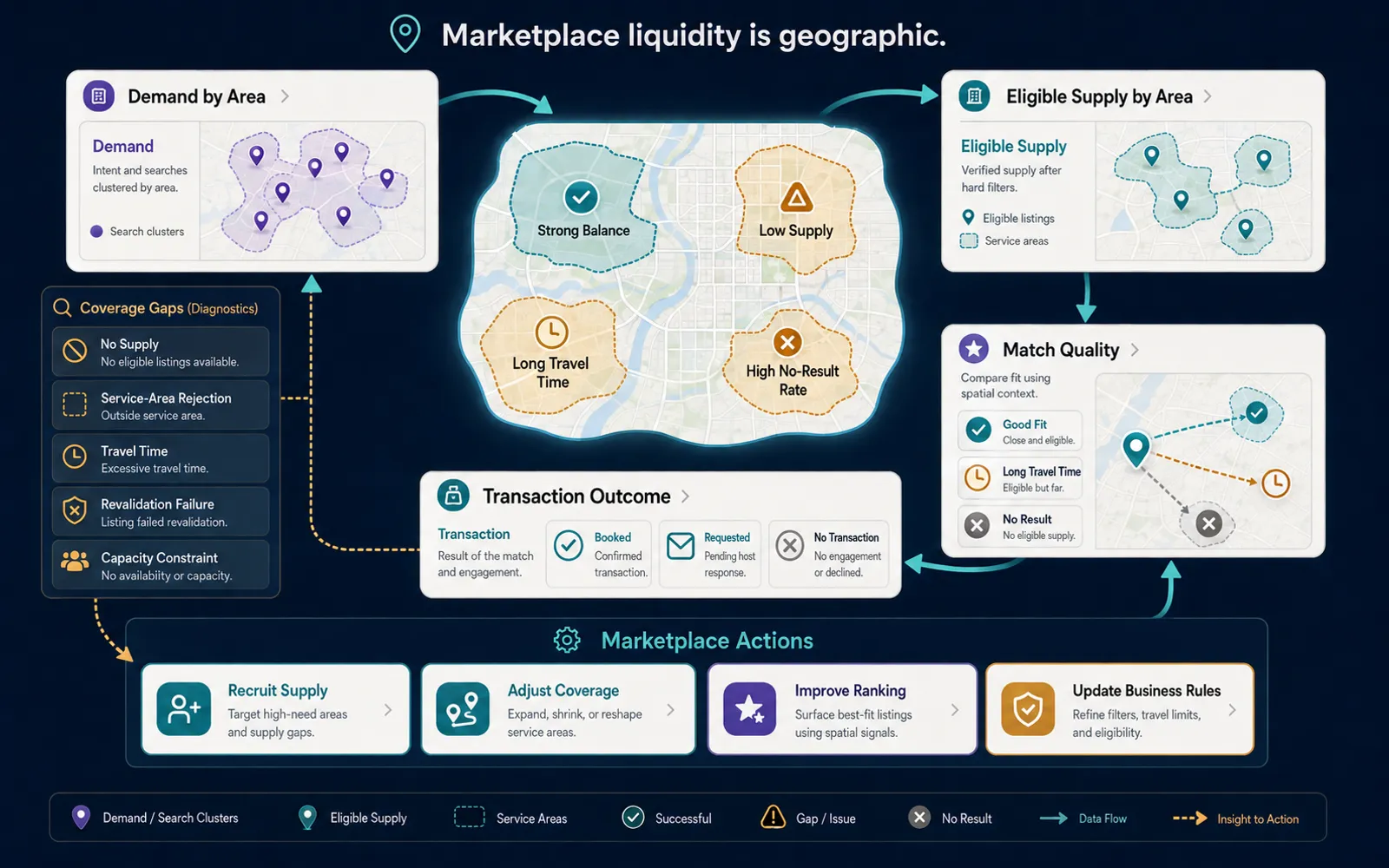
Marketplace liquidity is geographic. Strong national supply can still fail in a neighborhood. Compare demand, eligible supply, match quality, and transaction outcome by area. Instrument why a query returned nothing: bad search, no eligible supply, wrong service area, exhausted availability, stale data, or misinterpreted intent. Do not collapse every empty state into one generic no-results event. The NIST Privacy Framework (NIST.CSWP.01162020, 16 January 2020) treats privacy as enterprise risk management: identify what is collected, why, and for how long. Prefer an explicit address or selected area over continuous device tracking when the job does not require a live position.
How Should Teams Measure Location-Aware Marketplace Search?
Measure the matching job, not chat volume. Customer-side metrics include result rate, time to a useful selection, requery rate, selection, transaction start, and completion. Supply-side metrics include eligible supply per query, provider exposure distribution, capacity rejection, and service-area rejection. Spatial metrics include median travel time, detour distribution, no-supply geography, coverage gaps, and conversion by travel-time band. Editorial event names such as candidates eligible, no supply, result selected, revalidation failed, and transaction completed are product analytics, not documented automatic Kaleidr Analytics events. Spatial analytics dashboard KPIs belong to that measurement layer.
A no-result that is actually a coverage gap is an operations signal, not a search-relevance failure. Demand minus eligible supply by area can show neighborhoods with repeated empty states, underserved service zones, oversupplied markets, excessive travel time, and regions that need provider recruitment. Conversion can be compared across travel-time bands so the marketplace learns the geographic tolerance of demand rather than assuming a radius. Task completion outranks interaction count. A customer who books an eligible provider from filters without chatting has succeeded. A long conversation that ends on an unavailable listing has not.
What Failure Modes Should Marketplace Products Avoid?
The recurring failure is treating nearby search as matching. Invalid supply is ranked. Public place data is treated as inventory. Distance substitutes for travel time or service area. Conversation hides the recovered constraints. The language model invents availability. Map and list diverge. Tenant authorization is skipped. Checkout is handed to unconstrained model output. Clicks are treated as marketplace health. Geographic liquidity stays unmeasured. A fictional Kaleidr /match route is encoded from positioning copy.
| Mistake | Result | Better approach |
|---|---|---|
| Rank before eligibility | Invalid providers appear | Filter hard constraints first |
| Use public place data as inventory | Availability becomes unreliable | Keep first-party supply authoritative |
| Sort by distance only | Convenience is oversimplified | Use travel time, detour, or service area |
| Hide interpreted constraints | Customers cannot correct intent | Expose and edit recovered fields |
| Let the language model invent availability | Dead-end transaction | Read live marketplace state |
| Mix map and list states | Results disagree | Share canonical IDs |
| Ignore tenant authorization | Private supply can leak | Authorize before retrieval |
| Let the model own checkout | Transaction integrity weakens | Hand off to the host |
| Measure only clicks | Outcome is unclear | Measure match and completion |
Assume a Kaleidr /match route |
Integration targets fiction | Confirm the current Enterprise contract |
Mobile marketplace search needs large targets, readable reasons, and a map that remains usable when the model or an expensive travel-time matrix times out. Direct category and name search must still work. Cache base geometry. Degrade enrichment in a controlled way. Revalidate before the host transaction.
Build Spatial AI Into Your Marketplace
The production pattern is demand intent, supply retrieval, authorization, eligibility, spatial features, ranking, explanation, synchronized map and list, then a host transaction. Kaleidr can attach conversational spatial AI to the map a marketplace already runs, while supply, policy, and checkout stay authoritative.
Explore Kaleidr Enterprise for current APIs, SDK surfaces, and deployment support. Review attach patterns and key types in the Kaleidr developer documentation before encoding an integration path.
FAQs
What is a location-aware marketplace?
A location-aware marketplace uses geographic context as part of matching demand with eligible supply. The product can use service areas, travel time, route context, availability, and customer intent rather than showing every nearby option.
Is a location-aware marketplace the same as a local marketplace?
No. A local marketplace is geographically focused. A location-aware marketplace uses spatial relationships directly in search, eligibility, ranking, or fulfillment.
Should a marketplace rank the nearest provider first?
Not automatically. The nearest provider may be unavailable, outside the service area, unable to provide the requested service, or inconvenient by actual travel time.
What should a language model do in a marketplace?
A language model is useful for translating complex customer intent into structured requirements and explaining results. The language model should not invent supply, pricing, availability, or eligibility.
Who should own marketplace inventory?
The marketplace's authoritative supply or inventory system should own availability, price, provider state, and transaction data.
What is service-area matching?
Service-area matching checks whether the customer's location falls inside a provider's allowed operating area. Service-area matching is usually a hard eligibility rule.
Can marketplace ranking use travel time?
Yes. Travel time can be a better convenience signal than straight-line distance because it reflects the actual network and travel mode.
What is along-route marketplace search?
Along-route search matches supply relative to an existing journey, often minimizing added time or detour rather than distance from the origin alone.
Can a marketplace use multiple location anchors?
Yes. A product can rank supply relative to several important locations, such as an airport and office or two customer destinations.
How should a B2B marketplace measure location intelligence?
Measure result rate, time to useful selection, eligible supply per query, transaction conversion, travel-time distribution, service-area rejections, and geographic demand-supply gaps.
Can Kaleidr replace a marketplace application layer?
Replacing the marketplace application layer is not the recommended architecture. The marketplace should keep supply, permissions, pricing, and transactions authoritative. Kaleidr can add spatial intelligence and conversational map interaction around those systems.
Does Kaleidr have a public marketplace matching endpoint?
The current public Platform API documentation does not list a dedicated marketplace matching endpoint. Custom marketplace ranking or inference requirements should be confirmed through the supported Kaleidr Enterprise integration.
References
- Google Maps Platform. Search along route. Places API. Accessed 28 August 2026. https://developers.google.com/maps/documentation/places/web-service/search-along-route
- Kaleidr. AI Map Chat for Customer Discovery. Accessed 28 August 2026. https://kaleidr.com/ai
- Kaleidr. AI-Powered Map Experiences for Business. Accessed 28 August 2026. https://kaleidr.com/
- Kaleidr. Auth & Scopes. Kaleidr Developer Docs. Accessed 28 August 2026. https://docs.kaleidr.com/platform-api/auth-and-scopes
- Kaleidr. Chat attach. Kaleidr Developer Docs. Accessed 28 August 2026. https://docs.kaleidr.com/sdk/chat-attach
- Kaleidr. Endpoints. Kaleidr Developer Docs. Accessed 28 August 2026. https://docs.kaleidr.com/platform-api/endpoints
- Kaleidr. Location Intelligence APIs and Map SDK. Accessed 28 August 2026. https://kaleidr.com/enterprise
- Mapbox. Search Box API. Accessed 28 August 2026. https://docs.mapbox.com/api/search/search-box/
- National Institute of Standards and Technology. NIST Privacy Framework: A Tool for Improving Privacy through Enterprise Risk Management, Version 1.0. NIST.CSWP.01162020. 16 January 2020. https://nvlpubs.nist.gov/nistpubs/CSWP/NIST.CSWP.01162020.pdf
- OWASP Gen AI Security Project. LLM01:2025 Prompt Injection. Accessed 28 August 2026. https://genai.owasp.org/llmrisk/llm01-prompt-injection/
- OWASP Gen AI Security Project. OWASP Top 10 for LLM Applications 2025. Accessed 28 August 2026. https://owasp.org/www-project-top-10-for-large-language-model-applications/assets/PDF/OWASP-Top-10-for-LLMs-v2025.pdf
- W3C. Geolocation. W3C Candidate Recommendation Snapshot, 26 March 2026. Accessed 28 August 2026. https://www.w3.org/TR/geolocation/
@misc{google_search_along_route_2026_08_28,
  title  = {Search along route},
  author = {{Google Maps Platform}},
  note   = {Places API; accessed 28 August 2026},
  url    = {https://developers.google.com/maps/documentation/places/web-service/search-along-route}
}

@misc{kaleidr_marketplace_ai_2026_08_28,
  title  = {AI Map Chat for Customer Discovery},
  author = {{Kaleidr}},
  note   = {Accessed 28 August 2026},
  url    = {https://kaleidr.com/ai}
}

@misc{kaleidr_marketplace_home_2026_08_28,
  title  = {AI-Powered Map Experiences for Business},
  author = {{Kaleidr}},
  note   = {Accessed 28 August 2026},
  url    = {https://kaleidr.com/}
}

@misc{kaleidr_auth_scopes_2026_08_28,
  title  = {Auth \& Scopes},
  author = {{Kaleidr}},
  note   = {Kaleidr Developer Docs; accessed 28 August 2026},
  url    = {https://docs.kaleidr.com/platform-api/auth-and-scopes}
}

@misc{kaleidr_chat_attach_2026_08_28,
  title  = {Chat attach},
  author = {{Kaleidr}},
  note   = {Kaleidr Developer Docs; accessed 28 August 2026},
  url    = {https://docs.kaleidr.com/sdk/chat-attach}
}

@misc{kaleidr_endpoints_2026_08_28,
  title  = {Endpoints},
  author = {{Kaleidr}},
  note   = {Kaleidr Developer Docs; accessed 28 August 2026},
  url    = {https://docs.kaleidr.com/platform-api/endpoints}
}

@misc{kaleidr_enterprise_marketplace_2026_08_28,
  title  = {Location Intelligence APIs and Map SDK},
  author = {{Kaleidr}},
  note   = {Accessed 28 August 2026},
  url    = {https://kaleidr.com/enterprise}
}

@misc{mapbox_search_box_2026_08_28,
  title  = {Search Box API},
  author = {{Mapbox}},
  note   = {Accessed 28 August 2026},
  url    = {https://docs.mapbox.com/api/search/search-box/}
}

@techreport{nist_privacy_framework_2020,
  title       = {NIST Privacy Framework: A Tool for Improving Privacy through Enterprise Risk Management, Version 1.0},
  author      = {{National Institute of Standards and Technology}},
  number      = {NIST.CSWP.01162020},
  institution = {National Institute of Standards and Technology},
  year        = {2020},
  month       = jan,
  url         = {https://nvlpubs.nist.gov/nistpubs/CSWP/NIST.CSWP.01162020.pdf}
}

@misc{owasp_llm01_prompt_injection_2025,
  title  = {LLM01:2025 Prompt Injection},
  author = {{OWASP Gen AI Security Project}},
  note   = {Accessed 28 August 2026},
  url    = {https://genai.owasp.org/llmrisk/llm01-prompt-injection/}
}

@misc{owasp_llm_top10_2025,
  title  = {OWASP Top 10 for LLM Applications 2025},
  author = {{OWASP Gen AI Security Project}},
  note   = {Accessed 28 August 2026},
  url    = {https://owasp.org/www-project-top-10-for-large-language-model-applications/assets/PDF/OWASP-Top-10-for-LLMs-v2025.pdf}
}

@misc{w3c_geolocation_2026_03_26,
  title  = {Geolocation},
  author = {{W3C}},
  note   = {W3C Candidate Recommendation Snapshot, 26 March 2026; accessed 28 August 2026},
  url    = {https://www.w3.org/TR/geolocation/}
}