
Spatial AI for workplace amenities connects an employee's natural-language request to authorized office spaces, internal services, and approved nearby places so the product can recommend an option that fits access, availability, and the next task. The language model interprets compound intent such as a quiet room near the following meeting. Workplace systems remain authoritative for reservations, badges, and operating status. Geospatial services calculate walking and campus relationships, and Spatial AI then explains the grounded shortlist on the map.
The sections below separate internal amenities from nearby public places, then cover identity, eligibility, workday context, privacy, Kaleidr's public mapping, evaluation, and a narrow pilot. Related reading includes Local Amenities: How to Map Nearby Places, Grounded Spatial AI for Business Data, Spatial AI for Multi-Location Businesses, and Private Location Data for AI Map Workflows. The rest of the article is written for teams that already own a workplace application and need a spatial layer around it, not for teams shopping for a replacement facilities platform.
Workplace amenity essentials
- Task first: Start from the employee job, not from a decorative office map.
- Owners stay split: Internal rooms and nearby cafés do not share one system of record.
- Authorize before retrieve: The model is not the badge or booking engine.
- Usable beats nearest: Closed, full, or out-of-path spaces leave the set first.
- Measure the task: Valid selection, handoff, and no-result geography beat chat length alone.
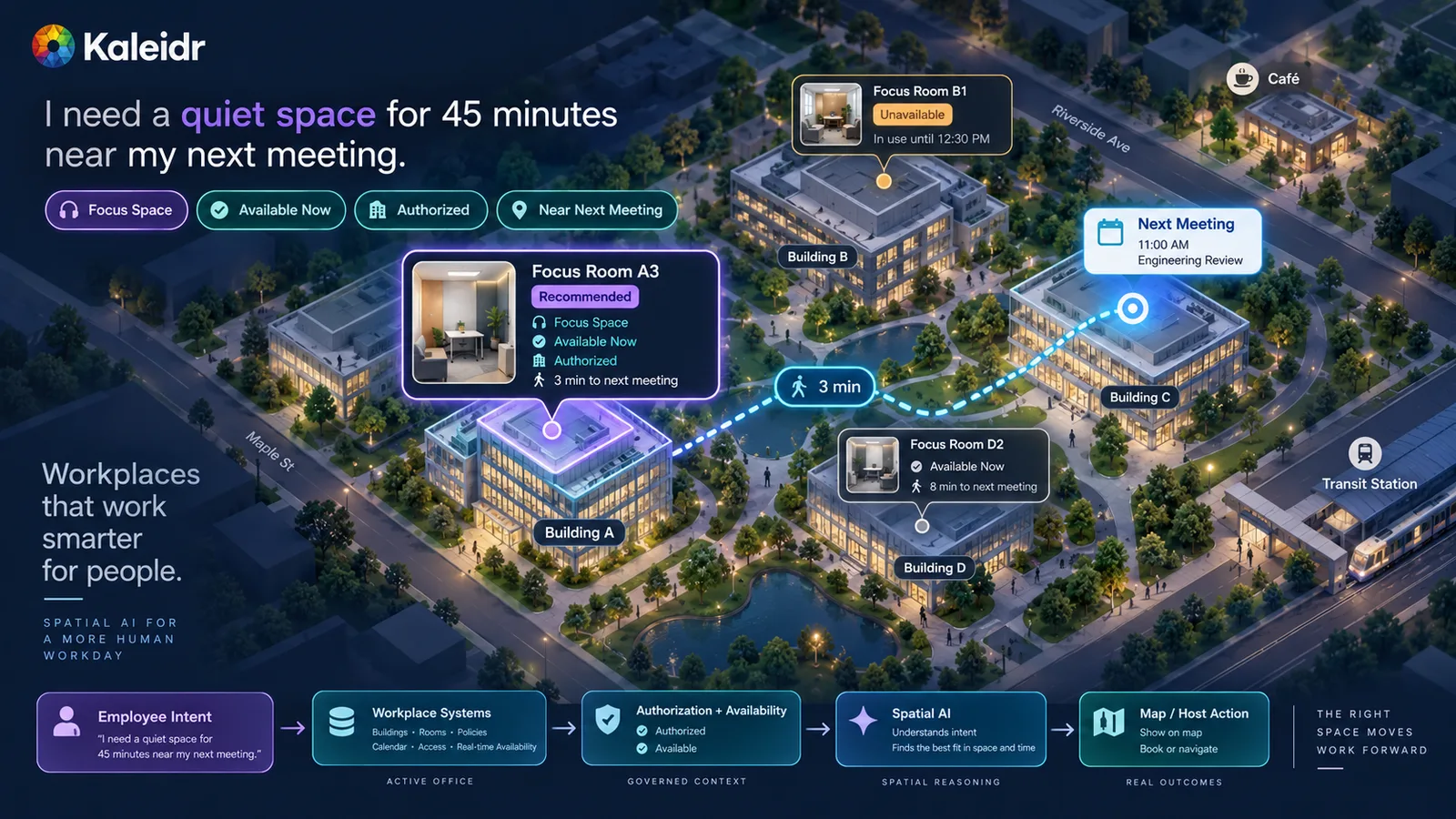
Workplace Spatial AI becomes useful when it connects employee intent to authorized, available spaces and the geography of the workday.
Why Is Spatial AI for Workplace Amenities a Workplace Architecture Problem?
A generic local-search assistant can list restaurants or parks around a pin. A workplace product has to answer which focus room the employee may enter, which tenant lounge is open after six, which café still serves before the next meeting, or which campus building a visitor can reach without a badge. Those answers depend on access policy, reservation state, service hours, floor or building identity, and the employee's next commitment. A language model should not invent those fields from training memory.
Cushman & Wakefield's analysis of large 2022 office leases treats amenity demand as part of a broader flight-to-quality pattern: convenience of access, including parking and nearby transit, on-site or nearby food, and wellness features appear among common building attributes (Cushman & Wakefield, 2026). The same report states that adding amenities by themselves is not meant to imply that occupier engagement and attendance problems are solved. The product opportunity is therefore not an AI catalog of perks. Location, workplace state, and employee intent still have to reduce friction inside and around the workplace without replacing the systems that already own access and reservations.
What Counts as a Workplace Amenity?
A workplace amenity can be internal or external, and employees do not think in those database boundaries. Internal examples include meeting rooms, focus rooms, phone booths, cafés, kitchens, fitness centers, wellness rooms, lockers, showers, bike storage, parking, reception, mail services, IT support, collaboration spaces, terraces, and tenant lounges. Nearby external examples include restaurants, coffee shops, pharmacies, transit stations, parking garages, grocery stores, gyms, parks, and other services around the office. Childcare or other sensitive categories should appear only when the user asks for them and the host has approved the source.
The compound task is the point. An employee with forty-five minutes before a meeting is asking for a usable space or a meal that still returns in time, not for a complete directory. A static amenity list answers what exists. Spatial AI for workplace amenities answers which authorized, currently usable option fits the task, the origin, and the next stop.
Why Must Internal Amenities and Nearby Places Stay Separate?
Do not merge every amenity into one generic place database. The workplace system owns internal identity, operating status, access policy, capacity, reservation state, and internal service details. An approved place source owns nearby external businesses, public addresses, categories, and public operating information where supported. A routing or walking service owns route, distance, and travel-time estimates. The host workplace application owns employee identity, office assignment, visitor permissions, and service requests. The AI layer owns intent interpretation, clarification, explanation, and supported map or workflow actions.
The owner split is the trust model. A café hours feed cannot authorize a locked focus room, and a room-booking record cannot stand in for a public restaurant. Keep the owners inspectable so a wrong recommendation can be traced to the system that produced the field.
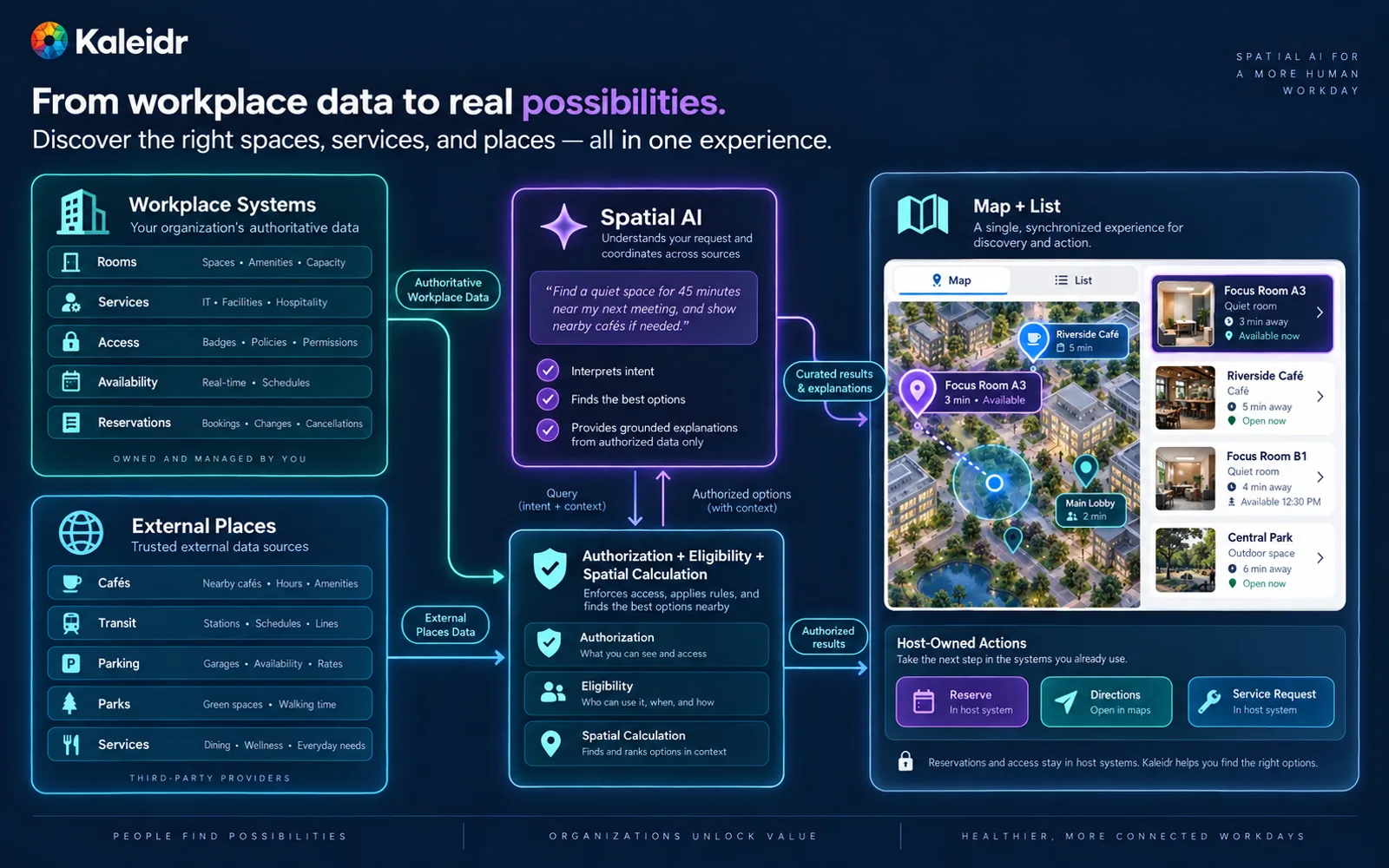
The AI layer coordinates workplace and neighborhood context; it does not replace booking, access, or facilities systems.
How Should Workplace Spatial AI Be Architected?
A production sequence can run as employee request, identity and workplace context, authorized amenities, hard eligibility, availability plus spatial calculation, contextual ranking, grounded explanation, map and list, then a host-owned reservation or service action. The order is load-bearing. The language model should not receive every private room record and then be asked to guess what the user may access. Authorization belongs before retrieval, the same pattern Private Location Data for AI Map Workflows sets for other tenant-controlled records.
Start from the employee job rather than from a decorative workplace map. Typical jobs include finding a quiet space near a named room, printing near a team area, eating and returning before the next meeting, comparing two offices for a visitor's transit path, asking which tenant lounge the badge can open, or planning a focus block then a café near the station. Ordinary filters become cumbersome once several of those constraints appear in one sentence. The AI layer is useful when it names the question the workplace systems should answer, not when it invents availability.
Why Do Canonical Amenity IDs Matter?
Every internal amenity should keep a durable identifier that is shared across the workplace directory, map feature, availability feed, booking action, AI explanation, and analytics. Display names such as "Focus Room 3" repeat across floors and buildings, so they are labels rather than identity. A useful hierarchy preserves organization, campus or site, building, floor, and amenity. Without that hierarchy, "a room near me" can return a similarly named space in another tower.
The following comparison is editorial, not a documented Kaleidr schema. Real deployments should fill the same columns from the systems the host already runs.
| Claim | Authoritative source |
|---|---|
| Employee may enter the space | Access / identity system |
| Room is free in the requested window | Booking / reservation system |
| Gym is open now | Facilities or hours system |
| Café still serving | Workplace or place hours feed |
| Walking time to the next meeting | Routing or indoor-distance service |
| External restaurant exists nearby | Approved place source |
| Why this option ranked first | AI explanation of the above |
Why Must Eligibility and Availability Come Before Ranking?
Some spaces are simply not usable for the current request: the employee lacks access, the room is reserved, the amenity is closed, capacity is too small, the building is shut, or a visitor is not permitted. Those are hard constraints. Authorized candidates should pass eligibility, then spatial calculation, then ranking. A restricted room should never become the top recommendation because it is nearby.
Existence on the map is not usability. A gym can exist and be closed. A café can exist and stop service at three. A parking facility can exist and be full for that badge group. The operational system should own current usability, and the reservation should be revalidated before the host confirms it. If another employee booked the room seconds earlier, the application should say so and offer the next valid option. The language model should never be the reservation authority.
Spatial context then makes the remaining set useful. Same building, same floor, walking time, floor change, distance from a named room or entrance, travel time to transit, and relationship to the next meeting are geographic facts, not conversational flavor. Place Ranking API covers ranking remaining eligible locations after those calculations exist.
How Does Multi-Anchor Workplace Search Differ From Nearest-Room Search?
Nearest-by-distance is often the wrong workplace rule. Consider three editorial focus rooms: A is a one-minute walk but unavailable, B is a three-minute walk, available, and on the path to the next meeting, and C is a two-minute walk, available, and requires a backtrack. Eligibility removes A. Workday context may rank B above C even though C is closer, because the employee is already heading toward the next meeting. The ranking choice is a location-intelligence problem, not a marker-sorting problem.
Many employee tasks involve more than one location: a quiet place between the current desk and a client meeting, or an office that works if part of the team arrives by train and a customer arrives from the airport. Time belongs in the same context. A forty-five-minute window before the next meeting is a constraint on walking time and service hours, not a decorative clock. Indoor turn-by-turn navigation is optional and separate. Many useful workflows can run from a selected office, building, floor, meeting room, or manual origin, as AI Wayfinding Assistant for Venues treats indoor positioning as additional infrastructure rather than as a prerequisite for conversational search.
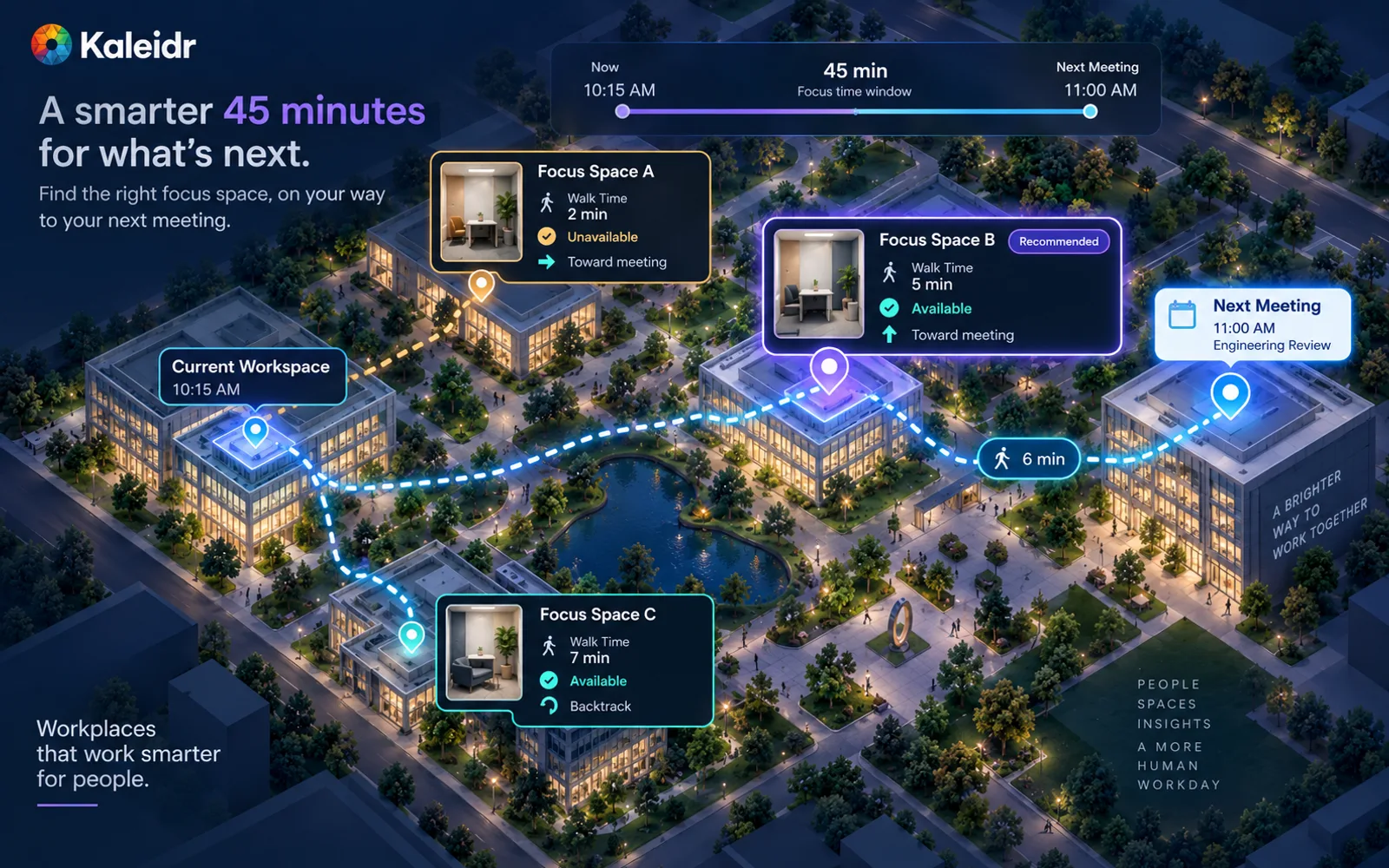
The best workplace amenity is often the one that fits the next task, not the one with the shortest straight-line distance.
How Should Authorization and Location Privacy Work?
Authenticate the user, determine which spaces and fields the role may see, retrieve only those records, and only then provide a compact context package to the AI layer. Kaleidr currently documents browser-origin and scope checks on publishable keys on the Chat attach page (Kaleidr, 2026). Session exchange and scoped runtime calls appear among the public Platform API endpoints. The Auth & scopes page is the contract for Kaleidr's own key and origin gates. Kaleidr's public auth pages do not replace the host's badge matrix or room ACL.
Employee coordinates are sensitive. Many tasks can use a selected office, floor, meeting room, or a short-lived "start here" point instead of continuous precise position. A workplace search product can often function with a current-task origin, a selected destination, and temporary route context. Do not persist a default trail of rooms passed, amenities visited, or all-day walking paths. Separate aggregate workplace analytics from individual movement surveillance. "Quiet" likewise needs a source: a verified space attribute, a booking type, or an explicit filter, not a model adjective.
How Is This Different From Mapping Local Amenities?
Kaleidr already publishes Local Amenities: How to Map Nearby Places, which covers categorizing and mapping nearby places around a location. The workplace article is a different B2B job: private internal spaces, access, availability, workday context, approved external services, and host-owned actions. Discovery is not booking. Booking commits a reservation in the system of record. Facilities management and space planning are also neighboring problems; real-time employee search should not be conflated with portfolio programming. A neighborhood café can appear in both products, but the workplace product still has to know whether the employee can leave the badge perimeter, whether the next meeting starts soon, and whether the host may offer a reservation.
Where Does Kaleidr Fit in a Workplace Stack?
Kaleidr currently positions Amenities as a Spatial AI vertical on the homepage (Kaleidr, 2026). The AI Map Chat for Customer Discovery page currently describes adding AI-powered search, recommendations, insights, and location-aware experiences to an existing map without rebuilding the host platform. The Chat attach page documents product="chat" as a conversational layer over a map the host already renders, plotting resolved places and framing the camera as the conversation identifies locations. The natural B2B pattern is an existing workplace application, map, and amenity systems plus a Kaleidr conversational spatial layer, not a replacement of workplace software.
The current public Platform API endpoints list includes SDK session exchange, streaming chat, route, POI enrichment, and design endpoints. The list does not currently publish dedicated /rooms, desk-booking, workplace-availability, or access-control routes. A workplace article should not imply that Kaleidr replaces room-booking software, badge systems, occupancy platforms, or facilities systems. Those remain host integrations unless a supported enterprise deployment states otherwise. The Location Intelligence APIs and Map SDK page currently describes SDKs, ranking, and analytics for spatial products. Depending on the configuration, Kaleidr can support a branded campus, visitor, or neighborhood surface while private actions still require host authentication. Public visitor layers and employee layers do not need to expose the same amenities.
How Should Teams Evaluate Workplace Spatial AI?
Kaleidr Analytics currently documents map and place engagement, place comparison, spatial patterns, and activity that product, inventory, and growth teams can act on (Kaleidr, 2026). Host systems still own booking and badges. Use that loop to find floors with focus-room searches and no eligible room, time windows that lose the employee, and sites with demand and missing attributes. Spatial Analytics vs. Web Analytics covers why pageviews alone cannot answer those questions. Suggested event names in this article are editorial recommendations, not documented automatic Kaleidr Analytics event names.
Useful outcome measures include valid-result rate, no-result reason, amenity selection, reservation or service handoff, repeated demand by site, and availability failures. Compare offices only after access rules, hours, and walking context are held constant. Privacy in workplace analytics means aggregate zones and task outcomes, not named employee trails.
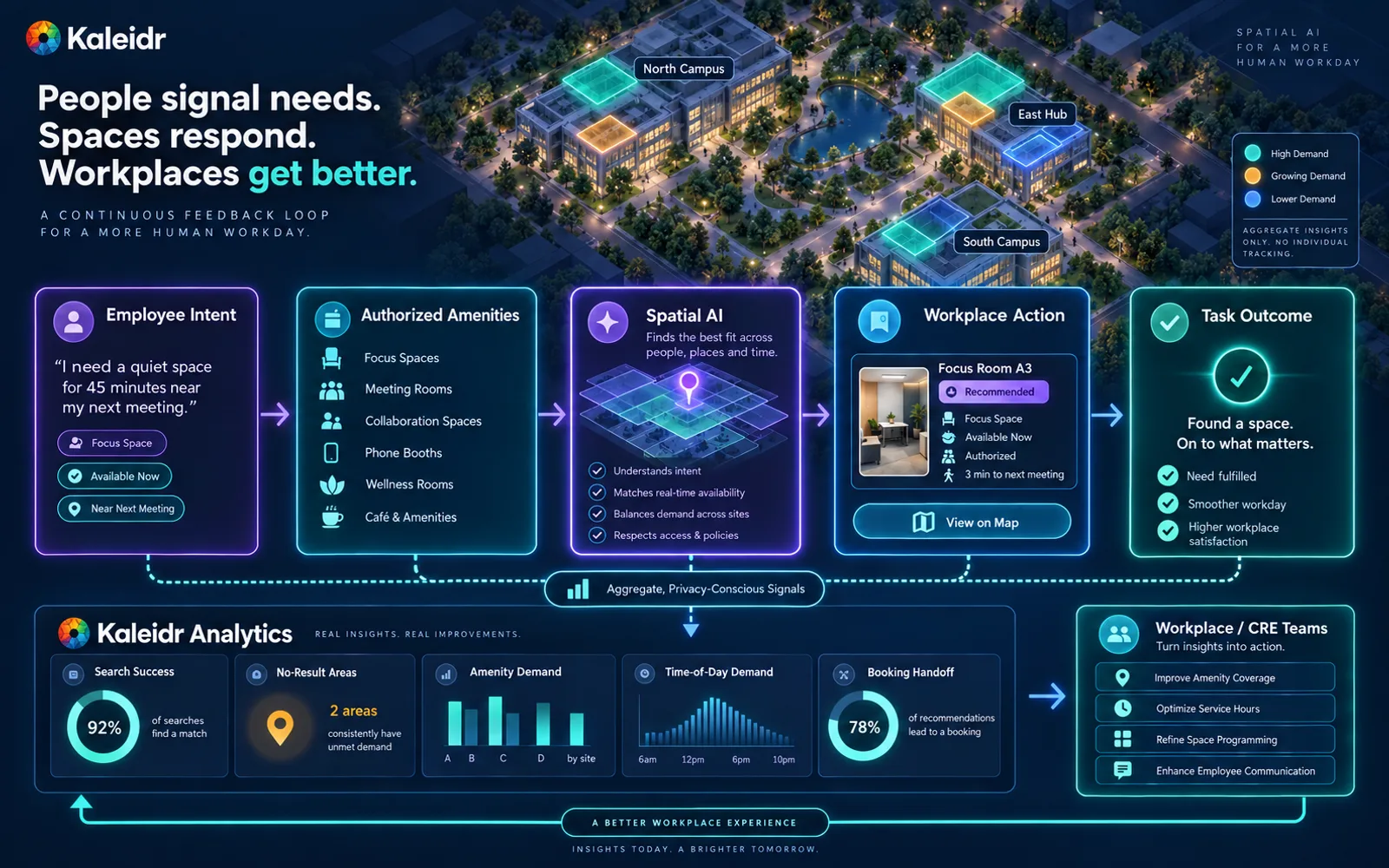
Workplace Spatial AI becomes more valuable when aggregate demand and no-result patterns help teams improve the experience without turning the map into an employee-surveillance system.
How Should a Workplace Pilot Start?
Start with one office and one high-value task, such as recommending an authorized focus room on the way to the next meeting. Keep identity, access, and reservations in the systems that already own them. Attach conversational map interaction to the existing map. Limit candidates to authorized spaces, require current availability, calculate walking relationship to the next stop, revalidate before booking, and measure selection plus the host action that follows. Expand amenity types, floors, and nearby external places only when that first window works.
Conversational discovery does not replace badge discipline, hours freshness, or reservation concurrency. Walking times remain estimates. Indoor positioning is optional. Attaching an assistant to an existing map is usually cheaper than replacing the renderer, but the host still has to own authorization and the next workplace action. Treat missing data as unknown rather than as a pass, and roll out by site rather than every campus at once.
Explore Kaleidr Spatial AI to add conversational location search on an existing map. Explore Kaleidr Enterprise to attach SDKs and ranking to the stack you already operate. Explore Kaleidr Analytics to measure place engagement and geographic demand around that journey. Confirm the current public pages before treating any example in this article as a shipping contract.
FAQs
What is Spatial AI for workplace amenities?
Spatial AI for workplace amenities uses natural-language intent and map context to help employees or visitors find usable workplace spaces, services, and nearby resources. Authoritative workplace systems still own access, availability, and reservations.
How is this different from an office directory?
A directory lists what exists. A Spatial AI experience can account for the user's current workplace, access, availability, travel relationship, time constraints, and next task before recommending an option.
Can Spatial AI find an available meeting room?
The assistant can help interpret the request and compare authorized room candidates when the host application provides current availability. The room-booking system should remain authoritative and revalidate the room before reservation.
Does Kaleidr replace workplace booking software?
No. Kaleidr can add conversational spatial intelligence around an existing map and workplace application, while booking, access, and facilities systems remain authoritative.
Can workplace AI include nearby restaurants and services?
Yes. A workplace experience can combine internal amenities with approved external place data so employees can ask compound questions about the office and surrounding neighborhood.
Does this require indoor positioning?
No. Many useful workflows can operate from a selected office, building, floor, meeting room, or manual origin. Precise indoor turn-by-turn navigation is a separate capability.
How should workplace access controls work with AI?
Authenticate the user, determine which spaces and fields they can access, retrieve only those records, and then provide the authorized context to the AI layer. The model should not perform authorization.
Should a workplace assistant track employee location continuously?
Not by default. Use the minimum location context required for the task. Many workflows can operate without persistent exact employee coordinates.
What workplace amenity metrics should a company measure?
Useful metrics include valid-result rate, no-result reason, amenity selection, reservation or service handoff, repeated demand by site or area, and availability failures. Measure outcomes rather than chat volume alone.
Can landlords use Spatial AI for tenant amenities?
Yes. A landlord or tenant-experience platform can use the same architecture for shared lounges, conference facilities, parking, visitor services, and nearby amenities, while access and reservation systems remain authoritative.
How is this different from Kaleidr's Local Amenities article?
The Local Amenities article explains how to categorize and map nearby places around a location. The workplace article focuses on the enterprise workplace workflow: private internal spaces, access, availability, workday context, external nearby services, and host-owned actions.
Where does Kaleidr fit?
Kaleidr currently positions Amenities as a Spatial AI business vertical, supports attaching conversational AI to an existing map, and offers Enterprise infrastructure for location-aware product stacks. Treat Kaleidr as the spatial intelligence and interaction layer around workplace systems rather than as the source of room, badge, or facilities truth.
References
- Kaleidr. Build Your Own Spatial AI with Kaleidr. Accessed 14 September 2026. https://kaleidr.com/
- Kaleidr. AI Map Chat for Customer Discovery. Accessed 14 September 2026. https://kaleidr.com/ai
- Kaleidr. Chat — attach AI to your map. Developer documentation. Accessed 14 September 2026. https://docs.kaleidr.com/sdk/chat-attach
- Kaleidr. Endpoints. Developer documentation. Accessed 14 September 2026. https://docs.kaleidr.com/platform-api/endpoints
- Kaleidr. Auth & scopes. Developer documentation. Accessed 14 September 2026. https://docs.kaleidr.com/platform-api/auth-and-scopes
- Kaleidr. Location Intelligence APIs and Map SDK. Accessed 14 September 2026. https://kaleidr.com/enterprise
- Kaleidr. Map Engagement and Location Analytics. Accessed 14 September 2026. https://kaleidr.com/analytics
- Cushman & Wakefield. Which Amenities Are Driving Leasing Activity? Analysis of large 2022 office leases. 2026. Accessed 14 September 2026. https://www.cushmanwakefield.com/en/united-states/insights/which-amenities-are-driving-leasing-activity
- Kaleidr. Local Amenities: How to Map Nearby Places. Accessed 14 September 2026. https://kaleidr.com/blog/what-are-local-amenities-how-to-map-them
@misc{kaleidr_workplace_home_2026,
  title  = {Build Your Own Spatial AI with Kaleidr},
  author = {{Kaleidr}},
  year   = {2026},
  note   = {Accessed 14 September 2026},
  url    = {https://kaleidr.com/}
}

@misc{kaleidr_workplace_ai_2026,
  title  = {AI Map Chat for Customer Discovery},
  author = {{Kaleidr}},
  year   = {2026},
  note   = {Accessed 14 September 2026},
  url    = {https://kaleidr.com/ai}
}

@misc{kaleidr_workplace_chat_attach_2026,
  title  = {Chat -- attach AI to your map},
  author = {{Kaleidr}},
  year   = {2026},
  note   = {Developer documentation; accessed 14 September 2026},
  url    = {https://docs.kaleidr.com/sdk/chat-attach}
}

@misc{kaleidr_workplace_endpoints_2026,
  title  = {Endpoints},
  author = {{Kaleidr}},
  year   = {2026},
  note   = {Developer documentation; accessed 14 September 2026},
  url    = {https://docs.kaleidr.com/platform-api/endpoints}
}

@misc{kaleidr_workplace_auth_2026,
  title  = {Auth \& scopes},
  author = {{Kaleidr}},
  year   = {2026},
  note   = {Developer documentation; accessed 14 September 2026},
  url    = {https://docs.kaleidr.com/platform-api/auth-and-scopes}
}

@misc{kaleidr_workplace_enterprise_2026,
  title  = {Location Intelligence APIs and Map SDK},
  author = {{Kaleidr}},
  year   = {2026},
  note   = {Accessed 14 September 2026},
  url    = {https://kaleidr.com/enterprise}
}

@misc{kaleidr_workplace_analytics_2026,
  title  = {Map Engagement and Location Analytics},
  author = {{Kaleidr}},
  year   = {2026},
  note   = {Accessed 14 September 2026},
  url    = {https://kaleidr.com/analytics}
}

@misc{cushman_amenities_leasing,
  title  = {Which Amenities Are Driving Leasing Activity?},
  author = {{Cushman \& Wakefield}},
  year   = {2026},
  note   = {Analysis of large 2022 office leases; page states no publication year; access year used for the parenthetical; accessed 14 September 2026},
  url    = {https://www.cushmanwakefield.com/en/united-states/insights/which-amenities-are-driving-leasing-activity}
}

@misc{kaleidr_local_amenities_2026,
  title  = {Local Amenities: How to Map Nearby Places},
  author = {{Kaleidr}},
  year   = {2026},
  note   = {Accessed 14 September 2026},
  url    = {https://kaleidr.com/blog/what-are-local-amenities-how-to-map-them}
}