
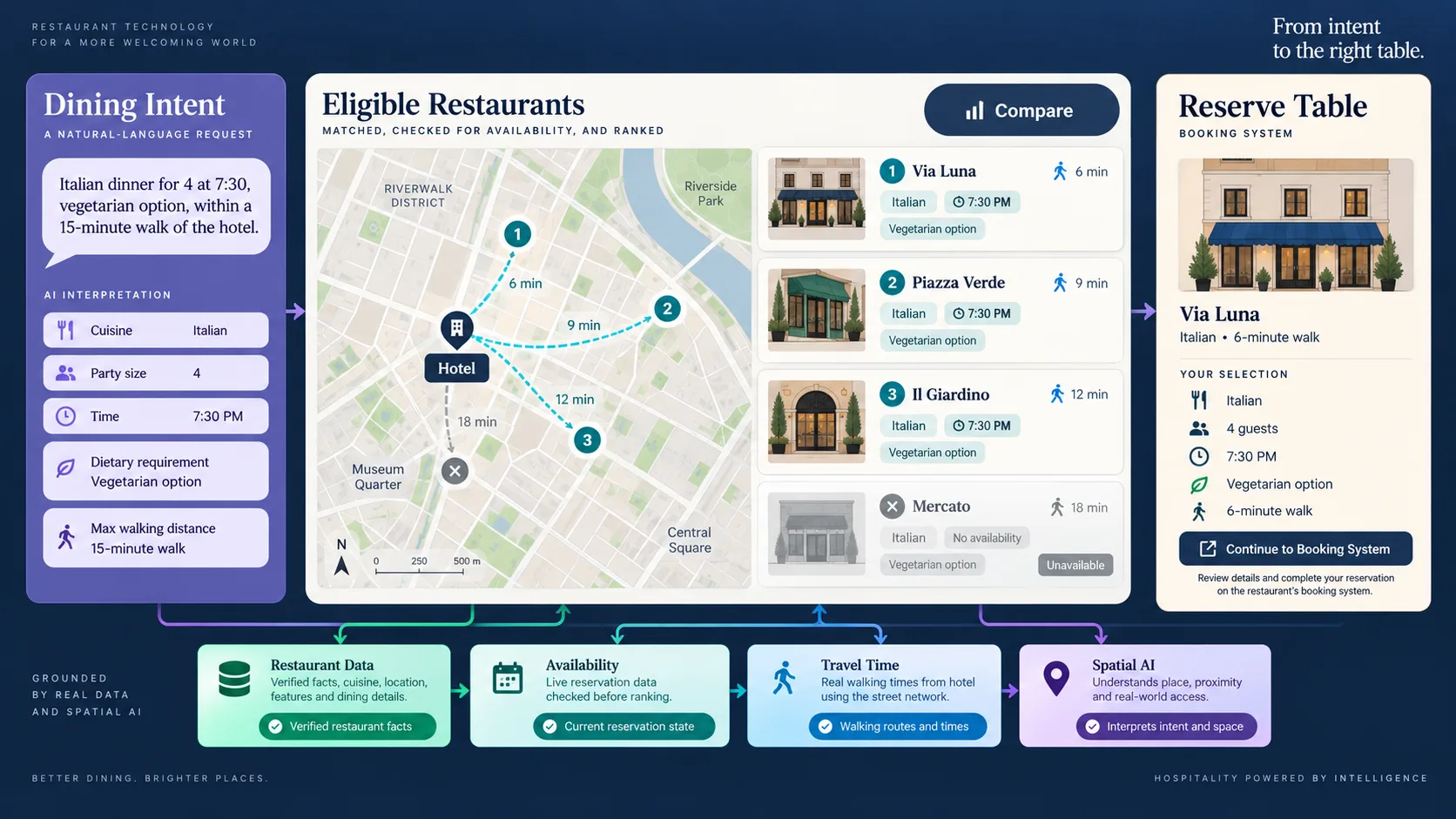
AI restaurant search combines restaurant catalogs, reservation availability, and geographic context so diners can discover, compare, and book a table against real constraints rather than a generated guess. A language model can interpret cuisine, party size, time, dietary needs, and travel context, while the restaurant system stays authoritative for hours, menus, and table inventory, and geospatial services calculate walking time, route detours, and search-area membership.
The sections below separate restaurant facts from spatial context, then cover eligibility, ranking, reservation authority, hospitality products, Kaleidr mapping, and measurement. Related reading includes Location-Aware Booking, AI Guest Concierge for Hotels, and How to Build a Map-Aware AI Assistant. Teams already choosing an implementation shape can skip to the Kaleidr mapping; teams still naming the data boundary should start with the restaurant-versus-context distinction.
AI restaurant search essentials
- Inventory first: Hours, menus, party size, and table availability stay in the restaurant or booking system.
- Context second: Walking time, venue anchors, route detours, and search areas come from spatial services.
- Hard filters before ranking: Closed, full, or incompatible restaurants are eligibility failures, not soft penalties.
- Visible criteria: Cuisine, slot, dietary flag, and travel minutes should appear as inspectable state on map and list.
- Measure outcomes: Reservation starts and completions beat marker clicks or map pans alone.
Why Is AI Restaurant Search a B2B Product Problem?
Restaurant marketplaces, hotel concierge products, destination platforms, and restaurant groups already hold substantial first-party dining inventory. Plotting those records as map markers is no longer the scarce capability. The product problem is helping a diner see which restaurant can actually serve the party at the requested time, inside a travel budget, and with the dietary constraint the diner named. A restaurant exists at one coordinate; a dining decision depends on opening hours, reservation state, menu facts, and a geographic relationship to a hotel, venue, office, or route.
Consequently, dining discovery is a strong Spatial AI use case rather than a mapping cosmetic. Kaleidr currently names Restaurant Search & Table Booking as an AI-driven customer journey for searching nearby restaurants, comparing options, and booking a table (AI-Powered Map Experiences for Business). Kaleidr also describes Food and Drinks matching as connecting customers with restaurants, cafés, and venues based on location, preferences, and context (AI Map Chat for Customer Discovery). Those pages are authoritative about Kaleidr's own positioning; they are not evidence that every dining product must buy a full conversational stack.
How Is Dining Discovery Becoming Conversational?
Dining search is increasingly offering natural-language interfaces beside the familiar filter grid. OpenTable currently reports that 44% of Americans plan to use AI more to discover restaurants and book reservations in 2026 (OpenTable, 2025). Toast currently reports that, in a survey of 850 U.S. diners, 50% of respondents said they would welcome AI assistance when discovering new restaurants (Toast, 2026). Those figures are each vendor's own research, not independent population estimates, and they do not describe Kaleidr traffic.
The hard part is grounding the conversation. Google's current AI Mode documentation describes a flow in which a diner can ask for a reservation with vegetarian options and then select Check for me, so the system gathers dining-reservation details rather than answering only from generated text (Google, 2026). The help page is evidence that at least one major search product treats reservation checking as a retrieval job. The help page is not evidence that a conversational panel attached to a map is sufficient.
A production dining assistant still has to keep the conversation attached to actual restaurant identifiers, location data, geographic calculations, inspectable criteria, and synchronized map state. Private Location Data for AI Map Workflows covers authorization for inventory the host does not expose publicly.
How Should Discover, Compare, and Book Stay Separate?
A useful dining path has three jobs. Discover retrieves restaurants that can satisfy hard constraints. Compare makes travel time, cuisine, price, and remaining preferences inspectable on a shared map and list. Book hands a stable restaurant identifier and a requested slot to the host's reservation workflow. Collapsing those jobs into one generated paragraph hides the moment when a restaurant stops being eligible.
Generating a recommendation first and checking business reality afterward inverts that order. The inverted path promotes restaurants the diner cannot actually use: closed at the requested time, unable to seat the party, missing a required dietary option, or outside the named walking budget. Location Intelligence Customer Experience covers the same Discover → Compare → Act shape for customer-facing location products.
Shared map and restaurant state keeps map, list, conversation, and booking UI on one canonical object. Selecting a restaurant card should highlight the same map feature; selecting a marker should open the same card; asking the assistant about the selected restaurant should resolve that restaurant identifier; changing a walking-time threshold should update map and list together. A second, invisible assistant-only result set breaks that contract.
Which Systems Should Own Restaurant Facts?
Restaurant data describes the venue. Spatial context describes the relationship between that venue and the diner's trip. Restaurant data includes hours, cuisine, menu items, party-size rules, reservation policy, and live table state. Spatial context includes walking time from a hotel, distance to a theater, detour on the way back, and membership in a drawn search area.
The distinction matters because the two classes have different owners. The restaurant or booking system should remain authoritative for availability, hours, menus, deposits, and seating rules. Place services own coordinates, category, and verified public attributes where supported. Geospatial services own route geometry, distance, and travel-time estimates. The language model interprets intent, extracts constraints, and explains results as transparent criteria; the language model does not become the reservation ledger.
| Diner question | Authoritative source |
|---|---|
| Is a table available at 7:00 for four? | Reservation or table-management system |
| Does the menu list vegetarian options? | Restaurant-owned menu data |
| How long is the walk from the hotel? | Routing service |
| Is the restaurant inside the selected area? | Geospatial containment |
| Which partners may the hotel recommend? | Host-approved dining catalog |
Exact geometry still belongs to a spatial engine. OGC Simple Feature Access, also published as ISO 19125-1, defines the common architecture for simple feature geometry and the spatial operations implementations expose for points, curves, surfaces, and collections (OGC, 2011). Production systems should let the language model interpret intent and choose an operation, while a geospatial engine calculates distance, route, intersection, and containment.
How Should Hard Requirements Differ From Dining Preferences?
Hard eligibility is binary: the restaurant is open at the requested time, the party size is supported, a compatible reservation slot exists, the required dietary constraint is listed, or the venue sits inside the selected area. Soft preference is comparative: shorter walking time, a preferred cuisine, quieter ambience, outdoor seating, or a smaller detour among eligible options. The system should apply hard constraints before ranking preferences. A convenient coordinate for a full or closed restaurant is not a good first result.
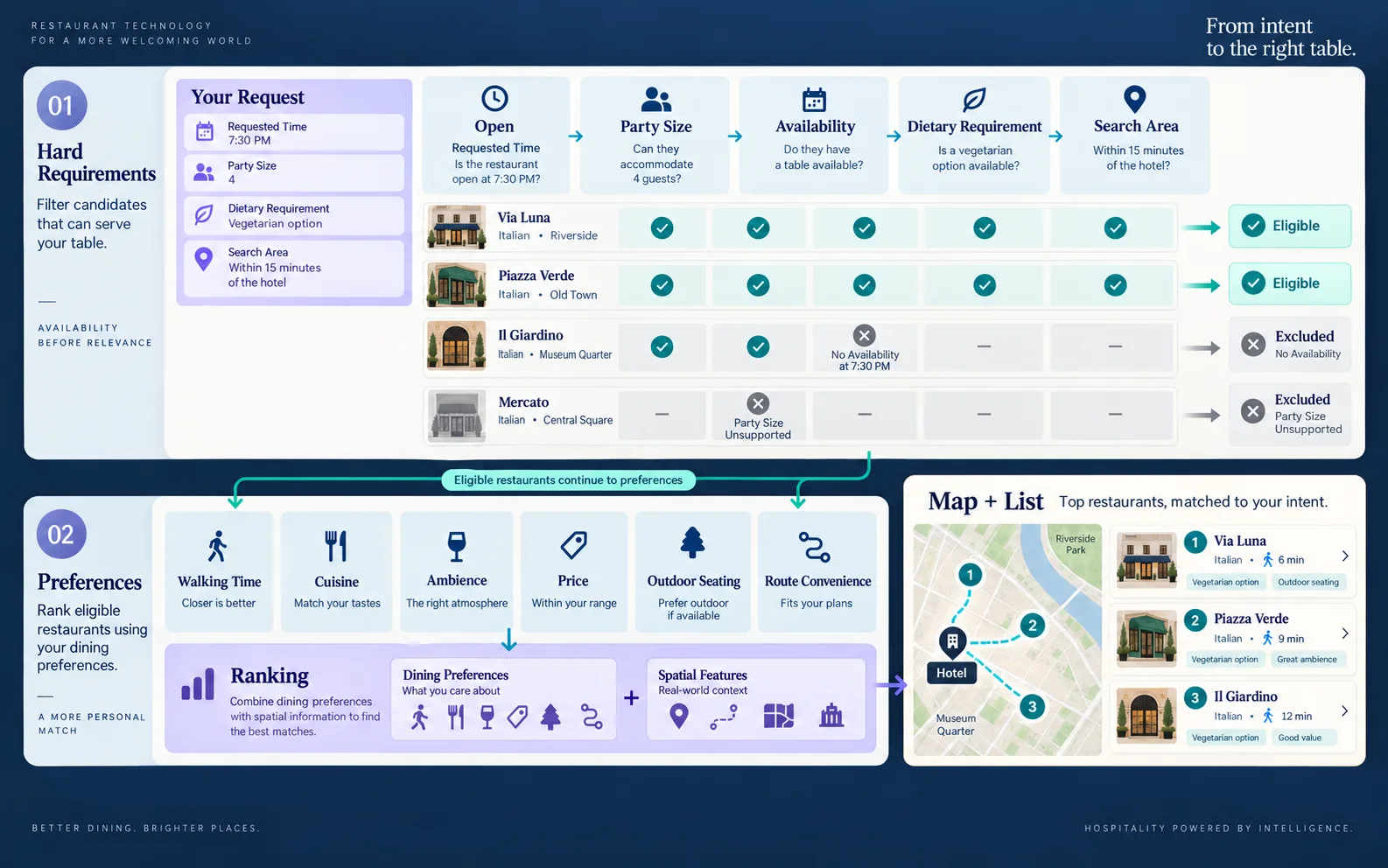
Natural-language dining search mixes the two classes in one sentence. A request such as “Japanese near my hotel for four tonight around 7, vegetarian options, no more than a 15-minute walk” should become visible filters the diner can edit: cuisine, party size, time, dietary requirement, walking budget, and hotel anchor. Hidden interpretation is harder to trust than inspectable state. Place Ranking API covers eligibility-before-preference in the programmable form.
Ambience labels such as quiet, romantic, or good for a client dinner are harder to verify than hours or cuisine. A product should know whether a tag comes from restaurant-controlled attributes, an editorial taxonomy, or structured feedback, and should not present a subjective classification as an objective fact without provenance. Dietary claims need a stricter boundary. Allergy, gluten, nut, and shellfish statements should rest on explicit restaurant-provided information; the discussion here is descriptive of product data, not medical or food-safety advice for a specific diner.
Why Is Restaurant Search More Than a Near-Me Radius?
Location is not synonymous with nearest-neighbor search. The relevant anchor may be a hotel, event venue, conference center, office, theater, airport, attraction, or route destination rather than the diner's current coordinate. “Dinner near the theater, not near me” changes the candidate set even when the restaurant catalog stays the same. The product should calculate the relationship the decision requires and show that relationship as a reason on the card.
Travel time is often more useful than radius because street layout, bridges, pedestrian access, and venue entrances change convenience. A restaurant 0.7 miles away can be worse than one 1.2 miles away when the shorter coordinate sits across a highway from the hotel entrance. Along-route dining is a different relationship again: the diner already has a path back to the hotel, and ranking should reflect added travel cost rather than distance from the current pin.
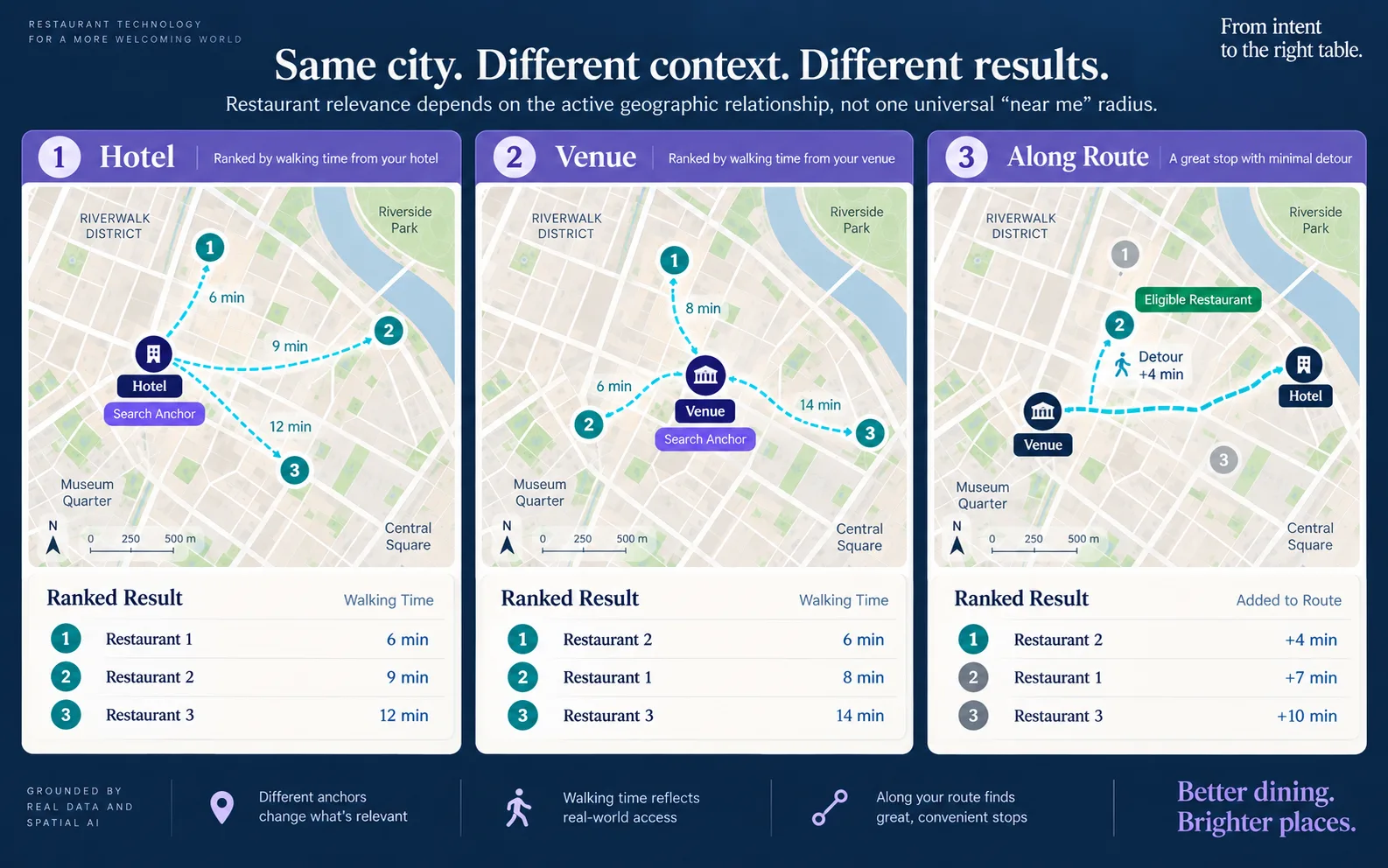
Multi-anchor dining asks whether a restaurant is convenient to several places, such as an office and a hotel, or a conference venue and an airport afterward. Radius search around one pin cannot express that intersection. A useful comparison view keeps the same restaurant identifiers on the map, the list, and any matrix, with walking minutes or detour minutes as editable criteria rather than a hidden composite score.
How Should Availability Stay Authoritative?
A conversational dining assistant should not invent a table, a reservation time, waitlist status, seating availability, or a deposit requirement. Those facts belong to the reservation provider or restaurant system. The correct flow is suggestion, then a live availability check, then a verified slot the diner can see. The incorrect flow is a confident generated claim that the booking system later contradicts.
Reservation availability is time-sensitive. Between search and booking, another party may take the slot, the diner may change party size or time, or the restaurant may modify inventory. Before the transaction, the selected restaurant, slot, party size, and policy should be revalidated. The product should not silently substitute another restaurant. Google's AI Mode documentation reinforces the same distinction by describing a system that checks dining reservations rather than answering only from model memory (Google, 2026).
Menus are structured restaurant data, not cuisine stereotypes. “Italian” does not guarantee vegetarian pasta. A question such as “which of these restaurants has vegetarian pasta and outdoor seating?” should read current menu and attribute records. No-result is a normal state: if nothing matches 7:00, the product can offer controlled relaxation such as 7:30 or a longer walk, rather than dropping a hard requirement in silence.
Which Hospitality Products Benefit From AI Restaurant Search?
The same architecture applies across several inventory owners, with different candidate sets. A reservation marketplace can keep live table inventory authoritative while adding travel-time comparison and inspectable dining constraints. A hotel concierge can search an approved partner catalog from the active property, compare walking time, and hand the guest into a reservation workflow the hotel already uses. AI Guest Concierge for Hotels covers the property-anchored version of that pattern.
A restaurant group can limit the candidate set to its own locations and still need Spatial AI for “which of our restaurants fits tonight's walk, party, and dietary constraint.” Destination, mall, and resort products can search a governed catalog of on-site or partner venues rather than the open web. In each case the host still owns checkout, loyalty, and customer account; the spatial layer returns stable restaurant identifiers, inspectable reasons, and a structured next action the host already supports. Location-Aware Booking covers the same availability-first handoff outside dining.
Commercial priority is a policy, not a relevance score. Featured partners, hotel-preferred restaurants, and sponsored placements should be labeled and governed separately from eligibility. Ranking a closed restaurant first because it is a commercial partner still fails the diner.
How Does Kaleidr Map Onto Restaurant Search?
A Kaleidr implementation can attach a conversational spatial layer to a restaurant platform the host already operates. Kaleidr currently documents Chat as a product that mounts over a map the host already renders, plots resolved places, and frames the camera as the conversation resolves locations (Chat attach). Depending on the configuration, that pattern supports an existing restaurant catalog, an existing map, host-owned reservation data, and a Kaleidr conversational map layer rather than a replacement dining stack.
The host still owns restaurant catalog, menu data, reservation data, checkout, loyalty, and customer account. Kaleidr's current public product and developer pages do not document a direct universal integration with OpenTable, Resy, SevenRooms, Toast reservations, or restaurant POS table-management systems. A correct implementation article therefore says: connect the conversational map layer to the reservation workflow the product already uses. Do not imply Kaleidr itself is the reservation source unless a specific integration is documented for the deployment.
Browser and application-layer boundaries still apply. Public restaurant name, hours, cuisine, and location can be browser-safe; reservation credentials, private guest data, unreleased offers, and payment state belong behind the application layer. Kaleidr currently documents a publishable key for browser SDK use and a server key for trusted application-layer calls, and states that a publishable key presented as a bearer is rejected (Auth & scopes). Server credentials belong in the application layer.
Kaleidr currently describes a hospitality template with curated destinations and trips on a designed basemap and tap-to-ask place summaries; the live starter is Kaleidr Hospitality. Confirm current plan allowances on Pricing & Plans before depending on a specific production workflow. Treat the current developer documentation as the integration contract; marketing pages describe the use case, not the endpoint list.
What Should Teams Measure?
The business KPI is not the marker click. A dining funnel should connect search to eligible restaurants, comparison, restaurant selection, availability revalidation, reservation started, and reservation completed. Spatial diagnostics belong beside that funnel: search anchor, travel-time band, no-result reason, restaurant coverage, and requery. Map Engagement and Location Analytics currently describes measuring how audiences discover, explore, and engage with places rather than stopping at page views.
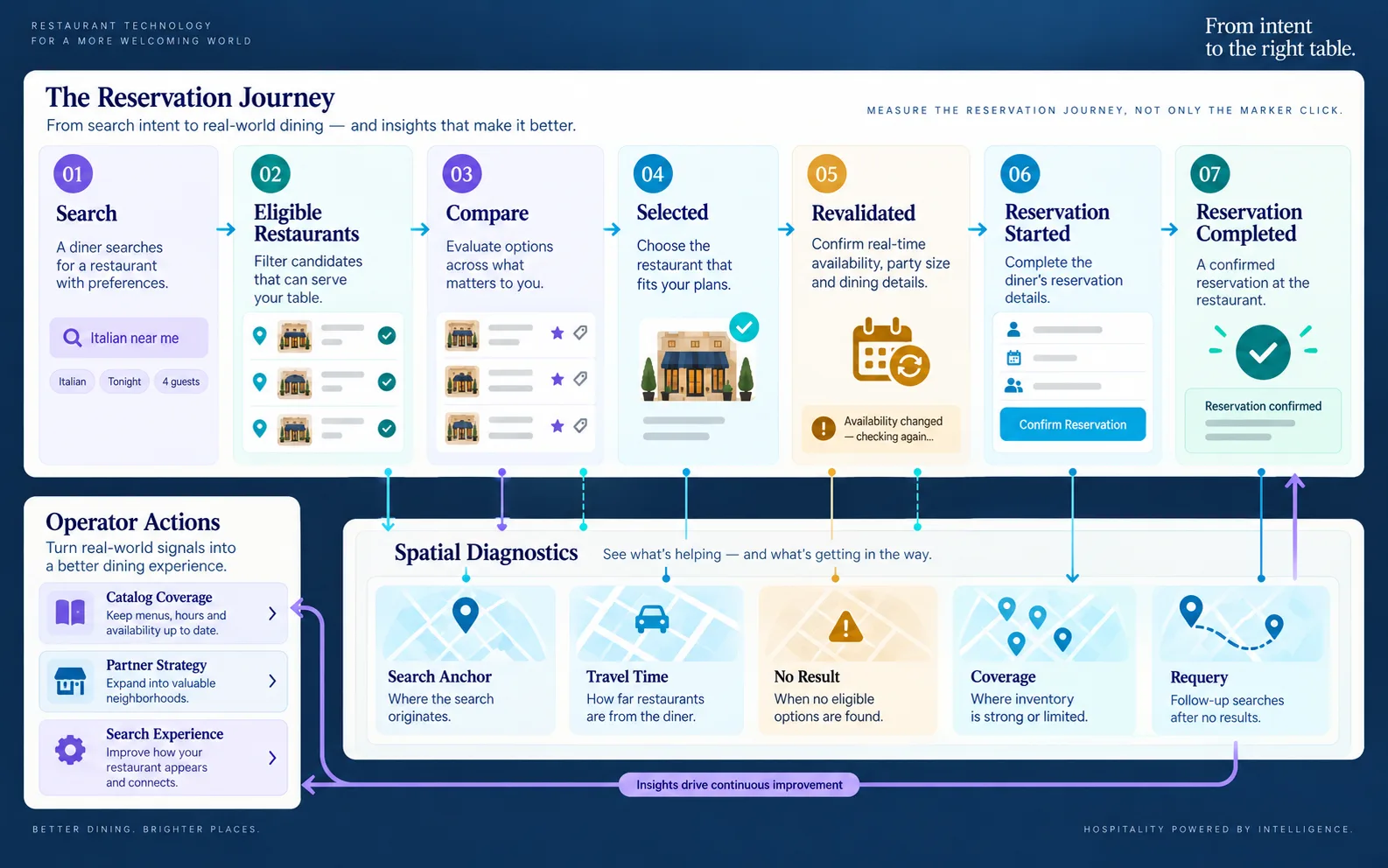
Geography can reveal operational gaps. High dining demand near a hotel with weak partner coverage, repeated no-results after an event, or strong discovery with weak booking conversion are actionable for restaurant groups, hotels, and destination operators. Grouping outcomes by walking-time bands can show how geographic friction affects selection and reservation completion. Search geography and user geography can also differ: a diner at the airport searching dinner near the hotel should be measured against the hotel anchor, not the airport pin.
What Limitations Should Teams Expect?
Conversational dining search does not replace restaurant quality, photos, or reservation discipline. Travel-time estimates depend on mode, time of day, and network data, and they remain estimates rather than guarantees. Menu and dietary claims are only as good as the restaurant-owned records behind them. Ambience tags are often weaker evidence than hours or availability.
Attaching an assistant to an existing map is usually cheaper than replacing the renderer, but the host still has to own authorization, restaurant identity, and the booking handoff. Live availability adds latency and failure modes that a static place list does not have. Those constraints are product choices, not reasons to skip the spatial layer. Location Intelligence APIs and Map SDK currently describes SDKs, inference APIs, ranking, and analytics as infrastructure around a host stack rather than a replacement for that stack.
How Should Teams Start a B2B Pilot?
Start with one restaurant catalog, one diner journey, and one measurable outcome such as reservation starts or completed bookings. Define canonical restaurant IDs, hard dining constraints, approved spatial signals, reservation revalidation, and analytics events before expanding to additional cities or booking providers. A practical pilot includes catalog sync, travel-time or along-route comparison for at least one use case, editable assistant-interpreted constraints, mobile list-and-map parity, host-controlled booking handoff, and documented data sources.
Explore Kaleidr Spatial AI to add conversational restaurant discovery on an existing map. Explore Kaleidr Enterprise for SDKs, inference APIs, analytics, and deployment support around a current dining or hospitality stack. Confirm the current public pages before treating any example in this article as a shipping contract.
FAQs
What is AI restaurant search?
AI restaurant search is a dining-discovery flow in which a language model interprets natural-language constraints and a map shows restaurants that satisfy location, availability, and other restaurant-owned facts.
How is AI restaurant search different from a restaurant listing?
A listing describes the venue. AI restaurant search connects that listing to travel context, inspectable constraints, and a booking handoff so the diner can compare options that can actually be used.
Should availability be a ranking signal or a filter?
Availability, party size, opening hours, and required dietary constraints should filter the candidate set. Preferences such as walking time and cuisine can rank the restaurants that remain.
Should AI decide whether a table is available?
No. Reservation availability should come from the restaurant or booking system that owns the current inventory.
Can AI restaurant search use walking time instead of distance?
Yes. Walking or driving time can be more useful than straight-line distance when actual travel convenience matters.
What is along-route restaurant search?
Along-route search finds restaurants that fit an existing journey, such as dinner on the way back to a hotel, and can rank options by added travel time or detour.
Can restaurant search use more than one location anchor?
Yes. A diner can ask for a restaurant convenient to several places, such as an office and a hotel.
Should an assistant infer allergy safety?
No. Allergy and food-safety claims should be based on explicit restaurant-provided information and the restaurant's own preparation policies. The product should not infer allergen safety from a dish name or cuisine category.
Can restaurant groups use this only for their own locations?
Yes. A brand can limit the candidate set to its own restaurants and use Spatial AI to help customers choose the most suitable location.
Can hotels use restaurant search for concierge experiences?
Yes. A hotel can search an approved partner catalog, compare walking time or route context, and hand the guest into a reservation workflow.
Can Kaleidr attach to an existing restaurant map?
Yes. Kaleidr's current Chat documentation supports attaching the conversational layer to a map the host already renders.
Does Kaleidr replace OpenTable, Resy, SevenRooms, or a restaurant reservation system?
Replacement is not the recommended architecture. The reservation system should remain authoritative for live availability and booking. Kaleidr can add conversational spatial intelligence and map interaction around that workflow.
What should a B2B restaurant-search product measure?
Measure search success, eligible restaurants, no-result reasons, restaurant selection, route views, booking-slot views, reservation starts, reservation completions, and conversion by geographic context such as travel-time bands.
References
- Kaleidr. AI-Powered Map Experiences for Business. Accessed 5 September 2026. https://kaleidr.com/
- OpenTable. 2026 Dining Trends Report: Top Restaurant Insights. 18 November 2025. https://www.opentable.com/blog/press/page/dining-trends-2026/
- Toast. Restaurant Dining Trends: Top Insights 2026. 30 July 2026. https://pos.toasttab.com/blog/data/restaurant-trends
- Google Search Help. Use AI Mode to check local availability and pricing. Accessed 5 September 2026. https://support.google.com/websearch/answer/17104441
- Kaleidr. AI Map Chat for Customer Discovery. Accessed 5 September 2026. https://kaleidr.com/ai
- Open Geospatial Consortium. Simple Feature Access — Part 1: Common Architecture. OGC 06-103r4 / ISO 19125-1. 2011. Accessed 5 September 2026. https://www.ogc.org/standards/sfa/
- Kaleidr. Chat attach. Developer documentation. Accessed 5 September 2026. https://docs.kaleidr.com/sdk/chat-attach
- Kaleidr. Auth & scopes. Developer documentation. Accessed 5 September 2026. https://docs.kaleidr.com/platform-api/auth-and-scopes
- Kaleidr. Kaleidr Hospitality. Template. Accessed 5 September 2026. https://template.kaleidr.com/customize/?template=hospitality
- Kaleidr. Map Engagement and Location Analytics. Accessed 5 September 2026. https://kaleidr.com/analytics
- Kaleidr. Location Intelligence APIs and Map SDK. Accessed 5 September 2026. https://kaleidr.com/enterprise
@misc{kaleidr_restaurant_home_2026_09_05,
  title  = {AI-Powered Map Experiences for Business},
  author = {{Kaleidr}},
  note   = {Accessed 5 September 2026},
  url    = {https://kaleidr.com/}
}

@misc{opentable_dining_trends_2026_09_05,
  title  = {2026 Dining Trends Report: Top Restaurant Insights},
  author = {{OpenTable}},
  year   = {2025},
  month  = nov,
  url    = {https://www.opentable.com/blog/press/page/dining-trends-2026/}
}

@misc{toast_restaurant_trends_2026_09_05,
  title  = {Restaurant Dining Trends: Top Insights 2026},
  author = {{Toast}},
  year   = {2026},
  month  = jul,
  url    = {https://pos.toasttab.com/blog/data/restaurant-trends}
}

@misc{google_ai_mode_dining_2026_09_05,
  title  = {Use AI Mode to check local availability and pricing},
  author = {{Google Search Help}},
  note   = {Accessed 5 September 2026},
  url    = {https://support.google.com/websearch/answer/17104441}
}

@misc{kaleidr_ai_restaurant_2026_09_05,
  title  = {AI Map Chat for Customer Discovery},
  author = {{Kaleidr}},
  note   = {Accessed 5 September 2026},
  url    = {https://kaleidr.com/ai}
}

@misc{ogc_sfa_part1_2026_09_05,
  title  = {Simple Feature Access -- Part 1: Common Architecture},
  author = {{Open Geospatial Consortium}},
  year   = {2011},
  note   = {OGC 06-103r4 / ISO 19125-1; accessed 5 September 2026},
  url    = {https://www.ogc.org/standards/sfa/}
}

@misc{kaleidr_chat_attach_restaurant_2026_09_05,
  title  = {Chat attach},
  author = {{Kaleidr}},
  note   = {Developer documentation; accessed 5 September 2026},
  url    = {https://docs.kaleidr.com/sdk/chat-attach}
}

@misc{kaleidr_auth_scopes_restaurant_2026_09_05,
  title  = {Auth \& scopes},
  author = {{Kaleidr}},
  note   = {Developer documentation; accessed 5 September 2026},
  url    = {https://docs.kaleidr.com/platform-api/auth-and-scopes}
}

@misc{kaleidr_hospitality_template_2026_09_05,
  title  = {Kaleidr Hospitality},
  author = {{Kaleidr}},
  note   = {Template; accessed 5 September 2026},
  url    = {https://template.kaleidr.com/customize/?template=hospitality}
}

@misc{kaleidr_analytics_restaurant_2026_09_05,
  title  = {Map Engagement and Location Analytics},
  author = {{Kaleidr}},
  note   = {Accessed 5 September 2026},
  url    = {https://kaleidr.com/analytics}
}

@misc{kaleidr_enterprise_restaurant_2026_09_05,
  title  = {Location Intelligence APIs and Map SDK},
  author = {{Kaleidr}},
  note   = {Accessed 5 September 2026},
  url    = {https://kaleidr.com/enterprise}
}