
An AI guest concierge is a hotel-facing assistant that answers property questions, recommends approved nearby places, and guides guests toward directions, reservations, service requests, or staff help. A map-aware version uses the active property, amenities, partner catalog, and travel context so answers can highlight places and routes on an interactive map. Hotel systems remain authoritative for reservations, policies, and guest records; a language model interprets intent against those sources.
The sections below cover the guest job, the four information layers, eligibility and shared map state, booking and privacy boundaries, a low-risk pilot, and where Kaleidr currently fits. Related reading includes Location Intelligence Customer Experience Maps, How to Build a Map-Aware AI Assistant, and How to Build an AI-Powered Tourism Map.
AI guest concierge essentials
- Property first: Keep one active hotel as the spatial and content anchor.
- Approved catalog: Recommend partners the hotel actually wants guests to see.
- Hard filters before ranking: Open, reachable, and in-policy beat “nearby” or “best.”
- AI interprets intent: Geospatial services calculate routes; hotel systems own facts.
- Hand off early: Service, safety, payments, and reservation changes belong to staff or host systems.
What Is an AI Guest Concierge?
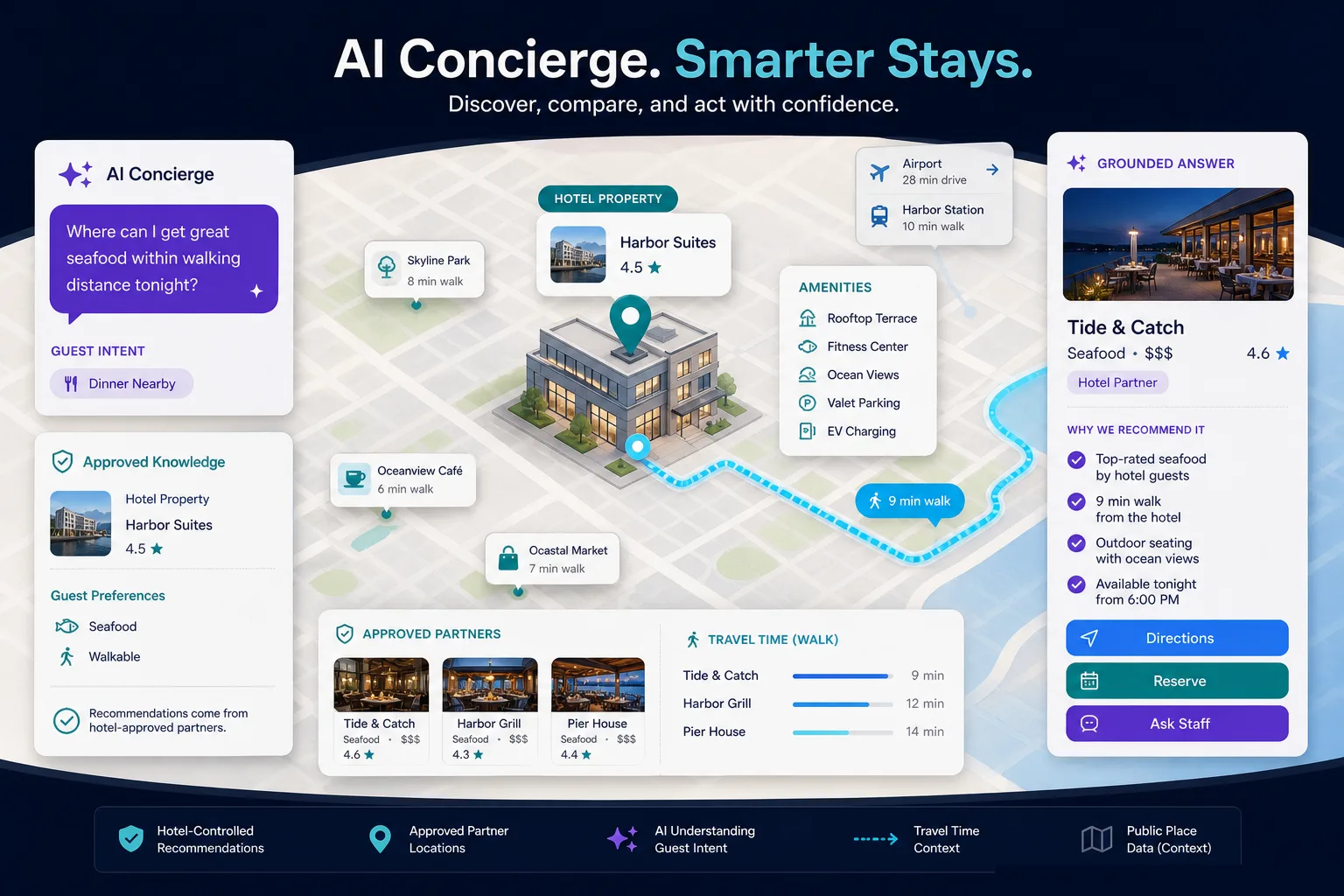
An AI guest concierge is a conversational interface designed around hotel workflows rather than generic web search. Guests ask when breakfast starts, where the gym is, which restaurant the hotel recommends, how to reach the property from the airport, or whom to contact about a room issue. Some products stop at FAQ retrieval. Others add messaging, service tickets, upsells, or booking links. The map-aware form adds property geography, an approved nearby catalog, travel relationships, and live map state so the assistant can answer where as well as what.
Kaleidr’s current Spatial AI page names hospitality as an AI guest concierge that helps travelers explore properties, amenities, and nearby partners with map-aware AI, and it states that answers can be grounded on a business’s catalog, brand voice, and policies rather than generic web search alone (AI Map Chat for Customer Discovery). That page is authoritative about Kaleidr’s own positioning. The architecture below is a product contract for hotels: the language model interprets the request; hotel, booking, and spatial systems remain the sources of truth.
A useful test is a compound question. “I have two hours before dinner. What can I walk to from the hotel that is good for kids and still open now?” encodes an origin, a walking mode, a time budget, an audience, and an operating-status constraint. The language model can recover those fields as inspectable state. Place identity, hours, partner approval, and route time still have to come from systems that own those facts.
Why Is Hospitality a Spatial Problem?
Hotels concentrate location-dependent decisions in a small area and a short stay. A guest may need an entrance, a parking area, an amenity on the grounds, a partner restaurant within a walking budget, a venue on the way to another destination, or a practical stop before checkout. A text-only answer such as “the museum is on Main Street” still leaves the guest to infer distance, mode, and whether the place is reachable before the next hotel commitment. A spatially grounded answer can report a walking time the routing service calculated, highlight the place on the property-centered map, and offer directions or a staff handoff.
Customer-facing location intelligence uses the same Discover → Compare → Act shape. Discover retrieves eligible amenities or partners. Compare makes travel time, hours, and hotel approval inspectable. Act is directions, a booking link, a service request, or a human escalation. Straight-line distance is often the wrong metric around a hotel: roads, water, restricted grounds, and walking entrances change what “nearby” means. The product should calculate the relationship the question actually requires, then show that relationship as a reason.
Indoor turn-by-turn navigation is a separate capability. A property map can highlight a gym, spa, or reception when the hotel has coordinates or a floor plan for those amenities. Claiming indoor routing without an indoor mapping and positioning system overstates the spatial layer. Match map actions to the geometry the property actually publishes.
How Does a Map-Aware Concierge Differ From an FAQ Assistant?
A traditional hotel FAQ assistant follows a short path: guest question, search against hotel copy, text answer. A map-aware concierge adds property and guest context, approved hotel knowledge, approved nearby places, spatial calculation, eligibility, ranking, a grounded answer, and then a map action, hotel action, or human handoff. The extra steps exist because hospitality questions are often compound and because the useful next step is usually a place, a route, or a staff member rather than another paragraph.
The hotel should own its recommendation layer. A generic place database can list restaurants near a coordinate. A concierge often needs to answer which restaurants this property recommends, for which guest situations, and with which exclusions. Approved partners, preferred categories, accessibility notes, brand fit, and seasonal lists belong in a hotel-controlled catalog even when the public map still supplies streets and travel time. Ranking should disclose why a result appears: hotel-approved, open at the requested time, reachable within the stated walk, or matching a recovered preference. An undefined “best nearby” hides the policy.
Hard eligibility runs before preference. For “a hotel-recommended restaurant within a 15-minute walk that is open now,” the hard set is approved by the hotel, related to the active property, in the restaurant category, open at the requested time, and reachable within the walk budget. Soft ranking can then consider cuisine, family fit, hotel priority, or accessibility. Ranking first and checking eligibility afterward promotes closed or off-policy places because a description scored well.
How Does Spatial AI Fit the Guest Journey?
The guest journey is a better starting point than a feature list. Pre-arrival questions cover airport-to-hotel routing, parking, property comparison, walkability to an event, and published check-in rules. Arrival questions cover entrance, parking, reception, shuttle stop, and building assignment. In-stay questions cover amenities, hours, and on-property wayfinding. Local discovery covers approved dining and attractions. Hotel service covers towels, maintenance, late checkout, and transport. Departure covers checkout, luggage storage, and time to the airport. Each phase uses the same property anchor and a different mix of public facts, spatial calculation, and authenticated guest data.
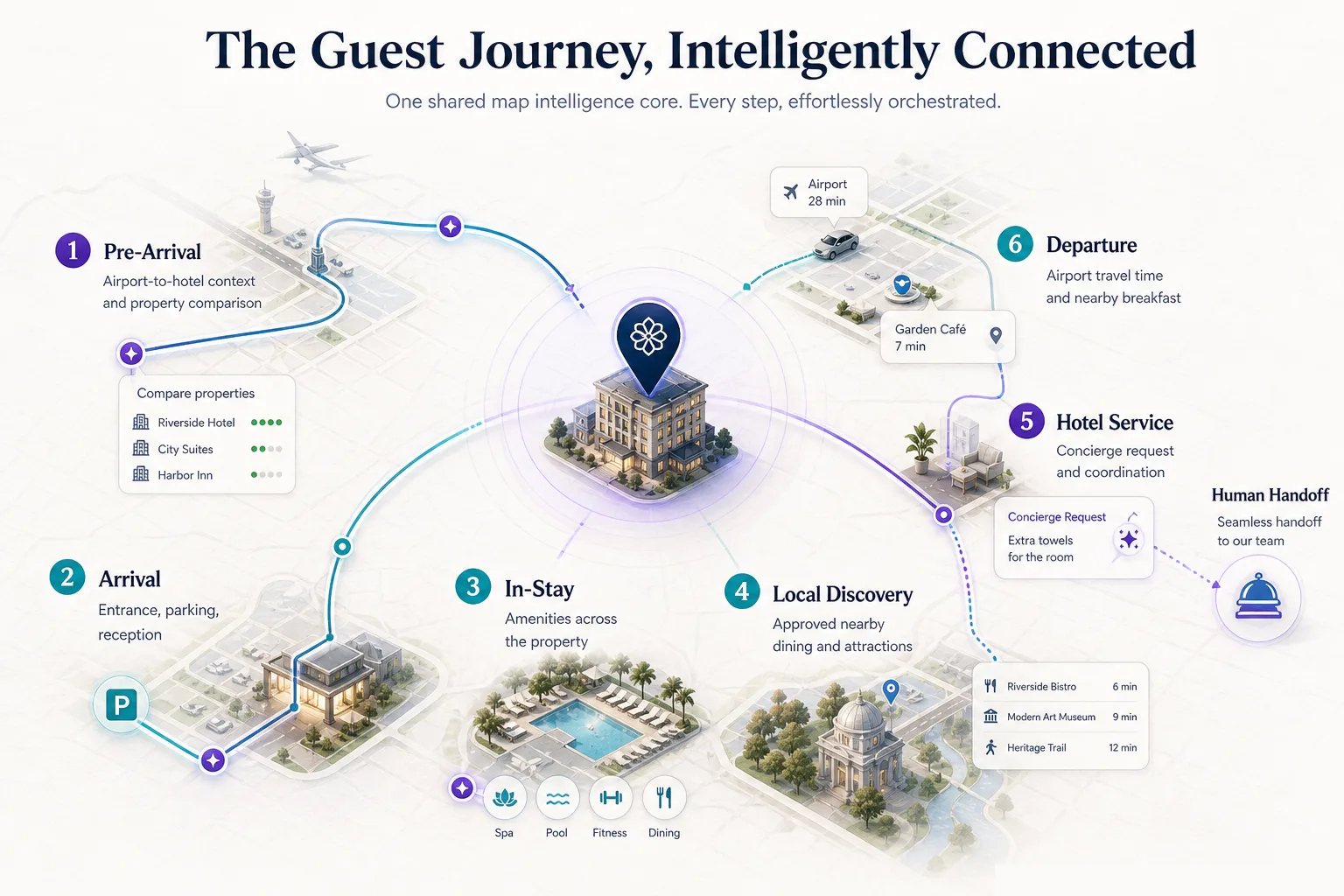
Guest-specific claims such as “your room is ready” or “building B is your assignment” must come from the reservation or property-management system after the host authenticates the guest. Public property facts and approved partner lists can serve unauthenticated visitors. The same assistant should not mix those modes: an unauthenticated session stays inside published hotel content; a stay-specific workflow retrieves the minimum authorized fields and nothing else.
Hotel service is not primarily a map job. A request for towels, a broken air conditioner, a payment dispute, or a locked-out guest should create an operational ticket or a staff handoff rather than another generated paragraph. The spatial layer still helps when the request has a place: which entrance, where the shuttle stops, how long the airport run will take. The assistant’s job in those cases is to stop recommending and to route the workflow to front desk, housekeeping, maintenance, or the reservation system.
Which Systems Should Own Hotel Facts?
A production concierge typically reads four information layers with different owners. Property knowledge covers amenities, hours, policies, and contact details. The hotel-approved place catalog covers partners, attractions, and preferred transport. Public spatial context covers coordinates, route time, and street geometry. Guest-specific context covers reservation, stay dates, property assignment, and service eligibility. The fourth layer needs the strongest access controls. The language model should not invent values that live in any of those systems.
| Guest question | Authoritative source |
|---|---|
| What time is breakfast? | Hotel property content |
| Is the spa open? | Hotel operations source |
| Which restaurant does the hotel recommend? | Approved partner catalog |
| How long is the walk? | Routing service |
| Is my room ready? | Property-management or reservation system |
| Can I book this room? | Booking engine |
| Where is the property? | Verified property record |
| What is near the hotel? | Approved catalog plus spatial services |
| Can I access this area? | Hotel policy or guest entitlement |
Exact geometry still belongs to a spatial engine. OGC Simple Feature Access, also published as ISO 19125, defines the common architecture for simple feature geometry and the spatial operations implementations expose for points, curves, surfaces, and collections (Simple Feature Access — Part 1). The W3C and OGC Spatial Data on the Web Best Practices separately emphasize using web architecture so geographic objects remain discoverable and reusable. The language model can select an operation; a geospatial engine or database should calculate distance, route, intersection, and containment.
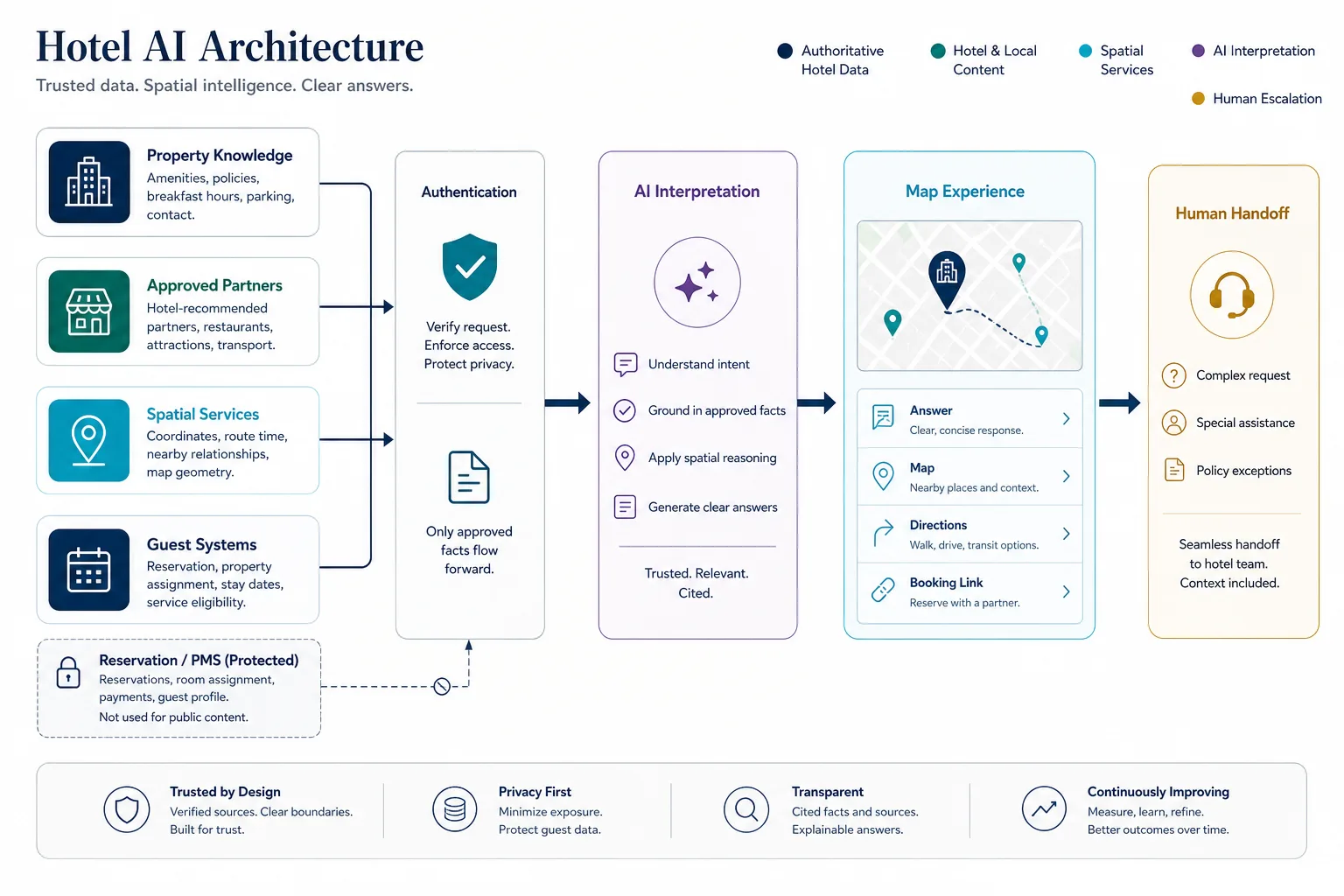
A compact rule follows from that split. The language model owns interpretation and explanation. Source systems own hotel facts. Spatial systems own geography. The application layer validates proposed actions before anything reaches a reservation, payment, or room-access system.
How Should Properties, Partners, and Eligibility Be Modeled?
A multi-property group needs stable hotel records, not free-form names as join keys. Each property should carry a durable identifier, verified coordinates, timezone, amenity list, status, and booking link. Partner places should relate to one or more property IDs with an explicit relationship such as recommended partner, plus category, coordinates, and an approval flag. Downstream queries then filter on activePropertyId rather than on a display name that marketing copy can change.
Property selection is first-class session state. Changing from Hotel A to Hotel B must change amenities, policies, partner list, booking link, and map camera together. Chat that answers for the new property while the map still shows the previous partner list is a shared-state bug, not a styling issue. The same principle appears in the broader map-aware assistant pattern: conversation, list, and map share one set of candidate IDs, filters, and a selected place.
A hotel group can still present one brand experience. The useful flow is choose property, show overview and amenities, load approved nearby recommendations, accept a guest question, then update the map and the action. Each property keeps its own coordinates, policies, and local catalog. The assistant always needs to know which property context is active before it retrieves or ranks.
How Should Map, List, and Conversation Share State?
A concierge surface often contains chat, a map, place cards, a property selector, and filters. Those widgets should read one shared state: the active property, approved nearby places, current constraints, visible result IDs, and the selected place. When the guest asks “which of these is closer?” or “show something like the second one but nearer the hotel,” the assistant needs structured identifiers from that state rather than a prose recap of the last answer.
Keep the action vocabulary small and explicit: show property, show amenity, show places, open place, fit places, show route, open booking link, open directions, request human help. The language model can propose an action. The host product validates the action against policy and then executes it. The model should not emit arbitrary script or write reservation records. OWASP’s OWASP Top 10 for LLM Applications 2025 describes Excessive Agency as damaging actions taken from unexpected, ambiguous, or manipulated model output when a system grants too much functionality, too many permissions, or too much autonomy (OWASP Top 10 for LLM Applications 2025). A hotel concierge that can modify bookings, issue refunds, or unlock doors from a generated tool call is the hospitality form of that risk.
Prompt injection is the related failure mode when a guest prompt, or content retrieved from a partner page, alters model behavior in unintended ways. OWASP LLM01:2025 records that injections can lead to unauthorized access to functions and to execution of commands in connected systems, and it lists constraining model behavior, validating output formats, least-privilege tool access, and human approval for high-risk actions among the mitigations (LLM01:2025 Prompt Injection). Permissions belong in the application and infrastructure, never in the model.
Where Do Booking, Guest Data, and Privacy Boundaries Sit?
A concierge may guide a guest toward a booking. Booking state still belongs to the booking engine. The assistant can say that a property appears to fit a location preference and can open the hotel’s booking page so the guest can check current rates and availability. Invented room availability, rates, cancellation rules, confirmation numbers, or reservation modifications are out of scope unless an authorized integration returned those values and the host validated the write.
Property-management systems hold guest names, room assignments, stay dates, contact details, payment state, and service notes. A public hotel concierge does not need that whole record. Authenticate the guest in the host system, identify the stay, authorize the required fields, retrieve the minimum context, then answer the stay-specific question. Do not upload an unrestricted PMS extract to a model. Private Location Data for AI Map Workflows covers the same retrieve-after-authorize pattern for internal catalogs.
Device location is optional context. The W3C Geolocation specification, a Candidate Recommendation Snapshot dated 26 March 2026, provides access to device location only after express permission, and the specification states that the API gives no guarantee of the device’s actual location. Many hotel questions can use the active property, a selected map point, a typed address, or a known entrance instead. NIST’s Privacy Framework treats data minimization as a core processing principle: collect and retain the elements the task needs, and prefer processing that limits identification and unnecessary inference (NIST Privacy Framework: A Tool for Improving Privacy through Enterprise Risk Management, Version 1.0). Treat those sources as descriptions of platform and risk-management rules, not as legal advice for a specific hotel or jurisdiction.
A guest-facing page should never contain a privileged server credential. Kaleidr’s current developer model uses publishable browser keys and server keys for trusted backends, with capability scopes (Auth & Scopes). Map API Authentication covers origin restrictions and key separation.
When Should the Concierge Hand Off to Staff?
Human handoff is a core feature, not a fallback for demo failure. Escalate immediately for emergencies, safety concerns, medical issues, security incidents, payment disputes, sensitive complaints, and lock-out flows the hotel already routes to staff. Escalate after triage for maintenance, housekeeping, booking changes, late checkout, accessibility accommodations, and transportation requests. Handle automatically only when the answer is grounded: breakfast hours, amenity location, an approved nearby restaurant, walking directions from a routing service, published contact details, or a published policy.
Multilingual guests are a natural concierge audience, but translation quality is only part of the problem. Property names, branded amenities, room categories, policy language, and partner names need consistent handling. For high-impact policy or safety copy, use approved translations rather than relying entirely on ad hoc model translation. The same restraint applies to accessibility language: describe published hotel facts; do not invent an accommodation the operations system has not confirmed.
How Should a Hotel Measure the Concierge?
A concierge is valuable when it reduces friction or helps the guest act. Useful events include the assistant opening, a question submitted, a property or amenity selected, a nearby place selected, a route opened, a booking link opened, a human handoff requested, a question resolved, and a no-result. Those names are editorial recommendations for host instrumentation, not documented automatic Kaleidr Analytics events. Kaleidr Analytics currently focuses on map and place engagement, including sessions, views, interactions, audience activity, and spatial trends (Map Engagement and Location Analytics).
Guest-resolution metrics include grounded-answer rate, no-result rate, handoff rate, and time to a useful answer. Spatial metrics include nearby-recommendation selection, directions opened, amenity map interaction, and property comparison. Business metrics include booking-link opens, partner referral, inquiry started, and service-request completion. Message count is a supporting signal. The north star is whether the guest completed the location-dependent task.
No-result questions are a product backlog, not only a quality defect. Repeated asks for an unmapped amenity, a missing partner category, missing transport copy, or a too-narrow recommendation area tell the hotel which content or catalog to fix. Review those topics against the property record and the partner list rather than adding more generated prose.
What Does a Low-Risk Pilot Include?
A hotel does not need every operational system on day one. A practical first deployment can use one property, verified FAQ and amenities, an approved nearby catalog, map-aware chat, directions or booking links, human handoff, and measurement of questions and outcomes. Leave reservation modification, payments, room-access credentials, automated compensation, and emergency decisions outside the first boundary. Sensitive integrations can wait until the grounded public path is stable.
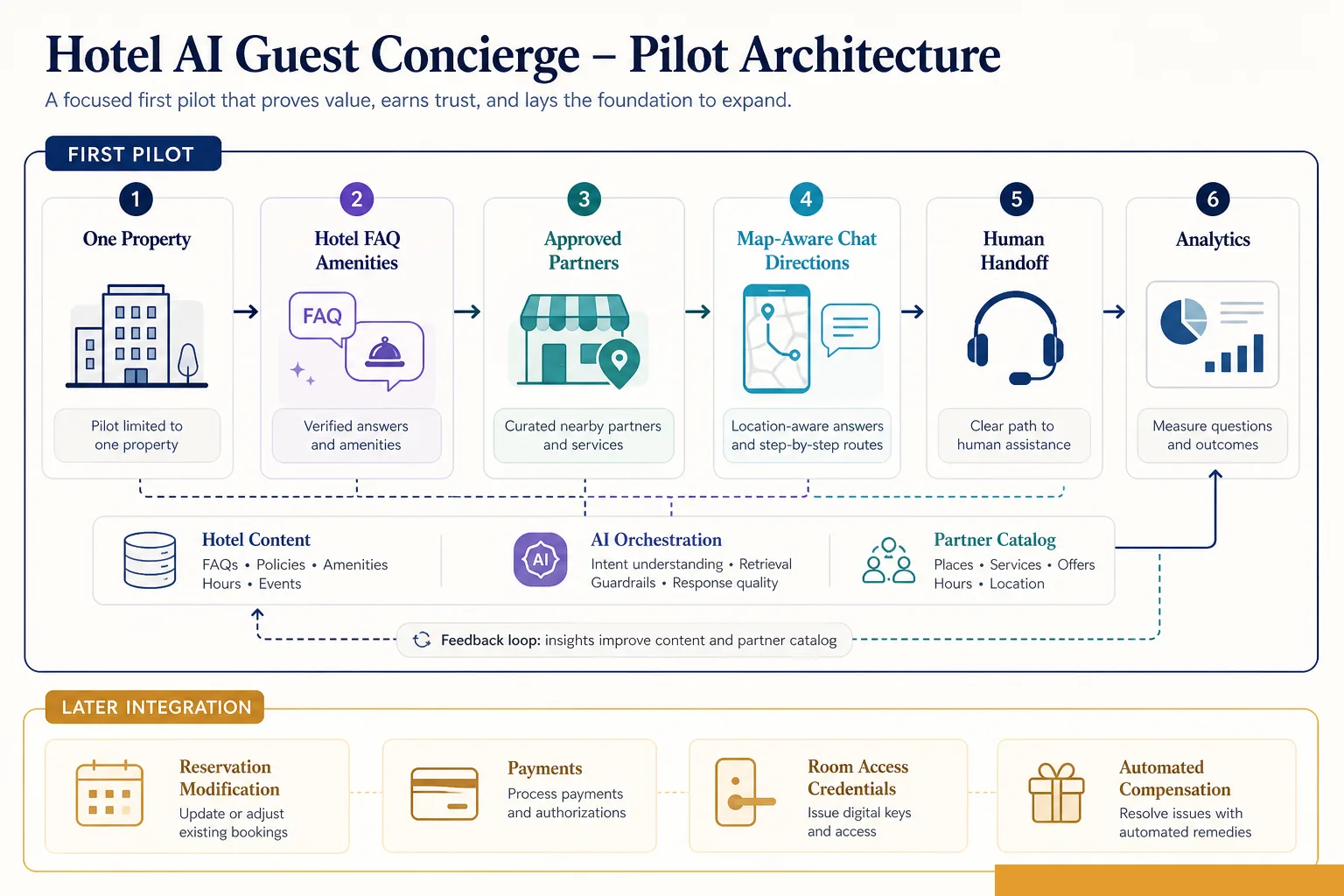
Collect real recurring questions from front desk, concierge staff, site search, guest messages, and review themes where the hotel already has permission to use them. Build a test set across property facts, amenities, arrival, dining, attractions, directions, transport, service requests, escalation, and unsupported questions. Include prompts that should refuse: early check-in when policy does not guarantee it, “best restaurant nearby” when the product has not defined best, and property switching (“what about here?” after a hotel change). Expected behavior on an unguaranteed early check-in is to return the published policy or contact path, not to convert uncertainty into a promise.
Where Does Kaleidr Fit in a Hospitality Stack?
Kaleidr currently describes a three-step implementation on the Spatial AI page: connect places, ground the AI on the business catalog and policies, and deploy on the host website, app, or guest-facing map (AI Map Chat for Customer Discovery). For hospitality, connecting places can include properties, amenities, approved partners, and a destination catalog. Grounding is the difference between a hotel-controlled recommendation and a generic web list. Deployment should leave the existing renderer and hotel systems in place.
A hotel or booking product that already renders a map can attach Chat to that live instance. Kaleidr’s current developer documentation describes Chat as a mount over Mapbox, MapLibre, Google Maps, or Leaflet while the host keeps the renderer (Chat attach). How to Add AI Chat to a Map covers the per-renderer pattern. Studio fits curated neighborhood guides, partner maps, resort maps, and event maps that do not need live reservation state (AI Map Maker for Branded Interactive Maps). The hospitality template at template.kaleidr.com is a starting point for that curated path. Live booking, identity, or PMS workflows still belong in a developer integration.
Kaleidr Enterprise currently packages location-intelligence infrastructure, inference APIs, ranking, analytics, SDK integration, and deployment support (Location Intelligence APIs and Map SDK). A hospitality team may need that path for multiple properties, private catalogs, custom usage, or contractual deployment support. The host hotel system remains authoritative for reservations, guest identity, and sensitive operational workflows in every configuration.
Which Mistakes Should Hotel Teams Avoid?
Building only an FAQ assistant leaves geography to the guest. Letting the model invent policy creates false promises. Recommending any nearby place cedes the hotel’s recommendation layer. Treating nearest as best ignores route time and eligibility. Mixing properties in one session shows the wrong amenities and links. Giving the model unrestricted PMS data expands privacy and injection risk. Letting the model modify reservations is excessive agency. Skipping human handoff strands sensitive cases. Measuring chat volume mistakes activity for value. Claiming indoor navigation without infrastructure overpromises the map.
| Mistake | Result | Better approach |
|---|---|---|
| FAQ-only assistant | Guest still infers geography | Add property and map context |
| Model-invented hotel policy | False promises | Use the approved hotel source |
| Any nearby place | Hotel loses recommendation control | Maintain an approved catalog |
| Nearest wins automatically | Spatial fit is oversimplified | Use route time, eligibility, and intent |
| Mixed property context | Wrong amenities and links | Make active property explicit |
| Unrestricted PMS to the model | Privacy and injection risk | Authorize and minimize guest fields |
| Model-controlled reservation writes | Consequential error risk | Keep the booking system authoritative |
| No human handoff | Sensitive cases stall | Define escalation paths |
| Chat-volume metrics only | Usage looks like success | Measure resolved guest tasks |
| Indoor routing without infrastructure | Product overpromises | Match map actions to published geometry |
Build a Map-Aware Guest Concierge
See how a conversational map, approved hotel catalogs, and enterprise spatial APIs fit an existing hospitality stack without replacing the renderer or the property-management system. Explore Kaleidr Enterprise for current APIs, SDK surfaces, and deployment support.
FAQs
What is an AI guest concierge?
An AI guest concierge is a hotel-specific digital assistant that answers guest questions, provides property information, recommends places or services, and guides guests toward actions such as directions, booking, service requests, or human help.
What makes an AI hotel concierge map-aware?
A map-aware concierge receives structured property and geographic context, such as the active hotel, selected amenity, nearby places, route information, and current map state. The assistant can return both an answer and a map action.
Is an AI guest concierge the same as a hotel chatbot?
Not necessarily. A basic hotel FAQ assistant may only answer FAQs. A guest concierge can combine property information, hotel-approved recommendations, spatial context, actions, and human escalation across the guest journey.
Should the AI concierge replace hotel staff?
No. The assistant is well suited to routine, grounded questions and place discovery. Sensitive, consequential, ambiguous, or service-recovery issues should have a clear human handoff path.
Can an AI concierge recommend nearby restaurants?
Yes. A strong implementation can combine hotel-approved recommendations with current place data and travel-time calculations. The hotel should define whether recommendations are hotel-curated, algorithmic, or both.
Should the concierge use the guest's exact location?
Only when needed and with appropriate user consent. Many questions can use the hotel property, a selected place, or a typed origin instead of precise device location.
Can the concierge access a hotel PMS?
The host can integrate PMS data into authenticated workflows, but the host hotel system should authenticate the guest, enforce authorization, and provide only the fields required for the task. The model should not receive unrestricted PMS data.
Can an AI concierge change a reservation?
Only through an explicitly authorized workflow connected to the booking or property-management system. The assistant should not invent availability, rates, cancellation rules, or reservation state.
What should a hotel measure after launching an AI concierge?
Measure grounded-answer rate, question resolution, no-result rate, directions opened, recommendation selection, booking or service actions, human handoff, and return usage. Chat volume alone is not a business outcome.
Can Kaleidr work with an existing hotel map?
Yes. Kaleidr’s current developer documentation supports attaching Chat to an existing live map instance while the host application keeps its own map renderer and business workflow.
What can Kaleidr Studio do for hospitality?
Studio can be used to create and publish branded interactive maps such as destination guides, property maps, partner maps, and curated hotel-area experiences. Live booking or guest-specific workflows should remain integrated with the appropriate host systems.
References
- Kaleidr. AI Map Chat for Customer Discovery. Accessed 23 August 2026. https://kaleidr.com/ai
- Kaleidr. AI Map Maker for Branded Interactive Maps. Accessed 23 August 2026. https://kaleidr.com/studio
- Kaleidr. Auth & Scopes. Kaleidr Developer Docs. Accessed 23 August 2026. https://docs.kaleidr.com/platform-api/auth-and-scopes
- Kaleidr. Chat attach. Kaleidr Developer Docs. Accessed 23 August 2026. https://docs.kaleidr.com/sdk/chat-attach
- Kaleidr. Location Intelligence APIs and Map SDK. Accessed 23 August 2026. https://kaleidr.com/enterprise
- Kaleidr. Map Engagement and Location Analytics. Accessed 23 August 2026. https://kaleidr.com/analytics
- National Institute of Standards and Technology. NIST Privacy Framework: A Tool for Improving Privacy through Enterprise Risk Management, Version 1.0. NIST.CSWP.01162020. 16 January 2020. https://nvlpubs.nist.gov/nistpubs/CSWP/NIST.CSWP.01162020.pdf
- Open Geospatial Consortium. Simple Feature Access — Part 1: Common Architecture. OGC 06-103r4 / ISO 19125. Accessed 23 August 2026. https://www.ogc.org/standards/sfa/
- OWASP Gen AI Security Project. LLM01:2025 Prompt Injection. Accessed 23 August 2026. https://genai.owasp.org/llmrisk/llm01-prompt-injection/
- OWASP Gen AI Security Project. OWASP Top 10 for LLM Applications 2025. Accessed 23 August 2026. https://owasp.org/www-project-top-10-for-large-language-model-applications/assets/PDF/OWASP-Top-10-for-LLMs-v2025.pdf
- W3C. Geolocation. W3C Candidate Recommendation Snapshot, 26 March 2026. Accessed 23 August 2026. https://www.w3.org/TR/geolocation/
- W3C and OGC. Spatial Data on the Web Best Practices. W3C Group Draft Note, 19 September 2023. Accessed 23 August 2026. https://www.w3.org/TR/sdw-bp/
@misc{kaleidr_ai_hospitality_2026_08_23,
  title  = {AI Map Chat for Customer Discovery},
  author = {{Kaleidr}},
  note   = {Accessed 23 August 2026},
  url    = {https://kaleidr.com/ai}
}

@misc{kaleidr_studio_hospitality_2026_08_23,
  title  = {AI Map Maker for Branded Interactive Maps},
  author = {{Kaleidr}},
  note   = {Accessed 23 August 2026},
  url    = {https://kaleidr.com/studio}
}

@misc{kaleidr_auth_scopes_2026_08_23,
  title  = {Auth \& Scopes},
  author = {{Kaleidr}},
  note   = {Kaleidr Developer Docs; accessed 23 August 2026},
  url    = {https://docs.kaleidr.com/platform-api/auth-and-scopes}
}

@misc{kaleidr_chat_attach_2026_08_23,
  title  = {Chat attach},
  author = {{Kaleidr}},
  note   = {Kaleidr Developer Docs; accessed 23 August 2026},
  url    = {https://docs.kaleidr.com/sdk/chat-attach}
}

@misc{kaleidr_enterprise_hospitality_2026_08_23,
  title  = {Location Intelligence APIs and Map SDK},
  author = {{Kaleidr}},
  note   = {Accessed 23 August 2026},
  url    = {https://kaleidr.com/enterprise}
}

@misc{kaleidr_analytics_hospitality_2026_08_23,
  title  = {Map Engagement and Location Analytics},
  author = {{Kaleidr}},
  note   = {Accessed 23 August 2026},
  url    = {https://kaleidr.com/analytics}
}

@techreport{nist_privacy_framework_2020,
  title       = {NIST Privacy Framework: A Tool for Improving Privacy through Enterprise Risk Management, Version 1.0},
  author      = {{National Institute of Standards and Technology}},
  number      = {NIST.CSWP.01162020},
  institution = {National Institute of Standards and Technology},
  year        = {2020},
  month       = jan,
  url         = {https://nvlpubs.nist.gov/nistpubs/CSWP/NIST.CSWP.01162020.pdf}
}

@misc{ogc_sfa_hospitality_2026_08_23,
  title  = {Simple Feature Access -- Part 1: Common Architecture},
  author = {{Open Geospatial Consortium}},
  note   = {OGC 06-103r4 / ISO 19125; accessed 23 August 2026},
  url    = {https://www.ogc.org/standards/sfa/}
}

@misc{owasp_llm01_prompt_injection_2025,
  title  = {LLM01:2025 Prompt Injection},
  author = {{OWASP Gen AI Security Project}},
  note   = {Accessed 23 August 2026},
  url    = {https://genai.owasp.org/llmrisk/llm01-prompt-injection/}
}

@misc{owasp_llm_top10_2025,
  title  = {OWASP Top 10 for LLM Applications 2025},
  author = {{OWASP Gen AI Security Project}},
  note   = {Accessed 23 August 2026},
  url    = {https://owasp.org/www-project-top-10-for-large-language-model-applications/assets/PDF/OWASP-Top-10-for-LLMs-v2025.pdf}
}

@misc{w3c_geolocation_2026_03_26,
  title  = {Geolocation},
  author = {{W3C}},
  note   = {W3C Candidate Recommendation Snapshot, 26 March 2026; accessed 23 August 2026},
  url    = {https://www.w3.org/TR/geolocation/}
}

@misc{w3c_ogc_sdw_bp_2023,
  title  = {Spatial Data on the Web Best Practices},
  author = {{W3C and OGC}},
  note   = {W3C Group Draft Note, 19 September 2023; accessed 23 August 2026},
  url    = {https://www.w3.org/TR/sdw-bp/}
}