
Location-aware booking combines bookable inventory with geographic context so customers can choose the option that fits where they are, where they are going, and what they need to do next. Ranking can use travel time, route context, service area, availability, and host business rules rather than price or straight-line distance alone. A language model interprets natural-language intent; the booking system remains authoritative for inventory, pricing, and reservation state.
The sections below cover sources of truth, Discover → Compare → Book, eligibility before ranking, multi-anchor and along-route geography, shared state and revalidation, industry patterns, measurement, and where Kaleidr currently fits. Related reading includes Location Intelligence Customer Experience Maps, How to Build a Map-Aware AI Assistant, and AI Guest Concierge for Hotels.
Location-aware booking essentials
- Availability first: Never rank an option the booking engine cannot actually reserve.
- Discover → Compare → Book: Eligible inventory, inspectable spatial tradeoffs, then a host-owned checkout.
- Travel relationship, not radius: Rank the journey the customer named—time, route, service area, or several anchors.
- The language model interprets intent: Geospatial services calculate routes; the booking system owns price and reservation state.
- Revalidate before checkout: Availability and price can change between recommendation and the booking action.
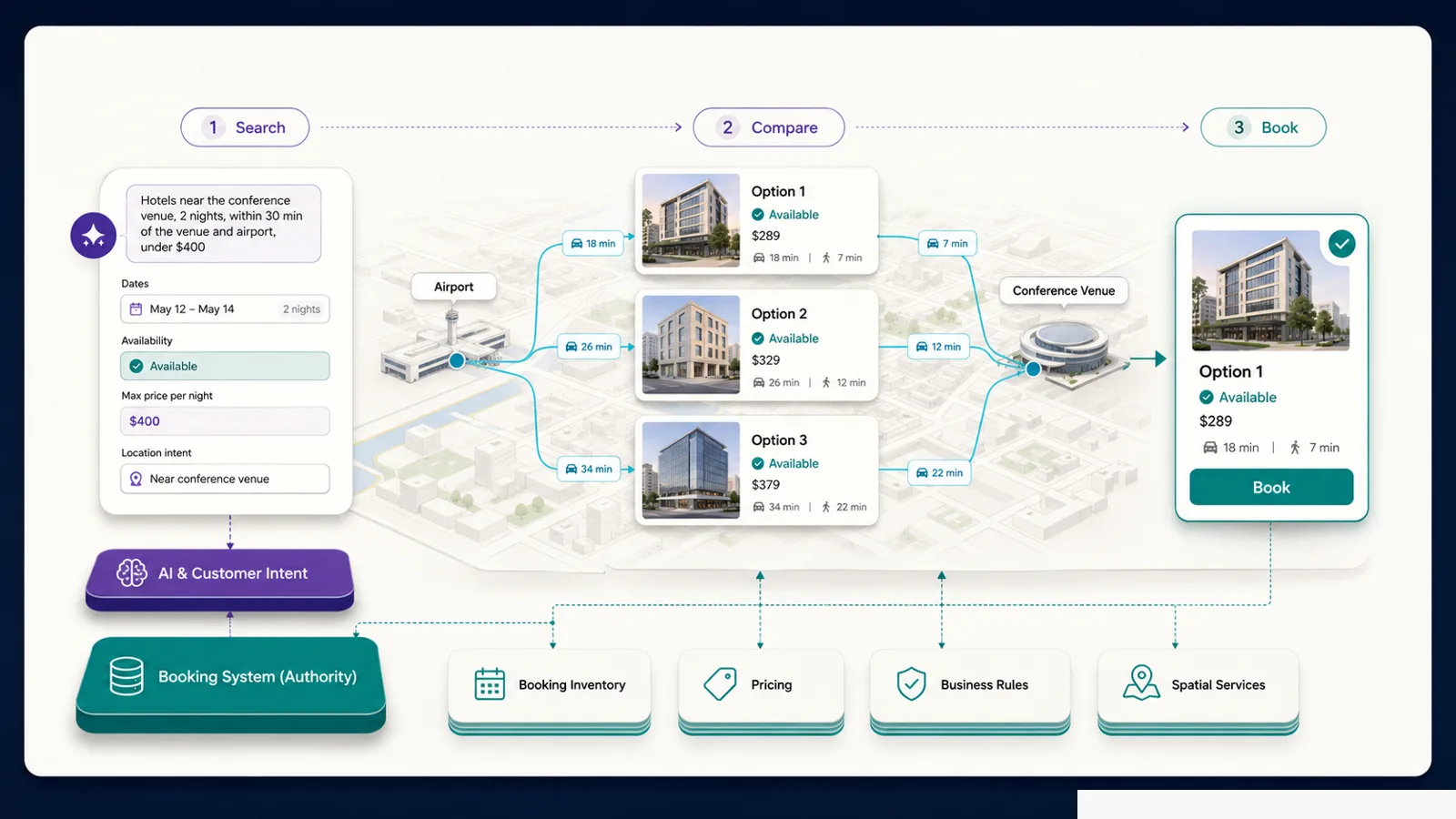
What Is Location-Aware Booking?
Location-aware booking is a customer-facing search and reservation flow in which geography is part of eligibility, comparison, or ranking rather than a map drawn beside a finished list. A conventional booking path often collects destination, dates, and party size, returns available options, and only then plots markers. Customers still have to infer whether an “available” result is reachable from the airport, convenient to a venue, or a small detour on an existing itinerary. A location-aware product keeps live inventory, spatial calculation, and the booking action in one shared state.
Kaleidr’s current homepage lists booking among AI-driven customer journeys and describes booking and marketplace experiences in which location, availability, and customer intent influence decisions (AI-Powered Map Experiences for Business). That page is authoritative about Kaleidr’s own positioning. The architecture below is a product contract for hosts: the language model interprets the request; inventory, pricing, and reservation systems remain the sources of truth.
A useful test is a compound question. “Find an available hotel that is easy from the airport but still close to the conference, with parking, under our budget” encodes dates, availability, two anchors, an amenity, and a price cap. The language model can recover those fields as inspectable constraints. Travel time, inventory, and the right to complete a reservation still have to come from systems that own those facts.
Why Is Booking a Location Decision?
Many booking products already show a map. Showing pins does not make ranking spatial. Customers rarely choose a room, appointment, venue, activity, or service provider in isolation. They choose it relative to an airport, office, conference, neighborhood, another reservation, a route, a home address, or a service area. Straight-line distance can hide rivers, one-way approaches, walking entrances, and transit transfers that change the trip.
Customer-facing location intelligence uses the same Discover → Compare → Act shape. Discover retrieves eligible bookable options. Compare makes travel time, price, and policy inspectable. Act is checkout, a hold, directions, or a staff handoff. The business outcome is the reservation, not the marker click. A map that only visualizes a list still leaves the customer to reconstruct the journey.
Exact geometry still belongs to a spatial engine. OGC Simple Feature Access, also published as ISO 19125, defines the common architecture for simple feature geometry and the spatial operations implementations expose for points, curves, surfaces, and collections (Simple Feature Access — Part 1). The W3C and OGC Spatial Data on the Web Best Practices separately emphasize using web architecture so geographic objects remain discoverable and reusable. Production booking stacks should therefore let the language model interpret intent and choose an operation, while a geospatial engine calculates distance, route, intersection, and containment.
Which Systems Own Availability, Price, and Geography?
A production booking assistant coordinates several systems and should not collapse them into generated prose. Inventory and reservation state belong to the booking engine. Price belongs to the pricing system. Coordinates and identities belong to location data. Travel duration belongs to a routing or geospatial service.
Eligibility and ranking policy belong to the host. Intent interpretation belongs to the language-model layer. Outcomes belong to analytics. Moving those responsibilities into the model produces confident recommendations the checkout cannot honor.
| Question | Authoritative source |
|---|---|
| Is it bookable? | Inventory / booking engine |
| What does it cost? | Pricing system |
| Where is it? | Location data |
| How long does the trip take? | Routing / geospatial service |
| Does it match the request? | Eligibility + ranking |
| What did the customer mean? | Language-model intent layer |
| May this customer book it? | Host business rules |
| What happened after recommendation? | Analytics |
Device location is optional context, not a prerequisite. The W3C Geolocation specification, a Candidate Recommendation Snapshot dated 26 March 2026, provides access to device location only after express permission, and the specification states that the API gives no guarantee of the device’s actual location. A typed address, a selected map point, or a saved origin is often enough for travel-time comparison and avoids collecting precise coordinates the product does not need.
How Should Discover, Compare, and Book Stay Separate?
A location-aware booking journey can be organized into three stages that share one search state. Discover translates the request into eligible bookable options. Compare explains spatial and operational tradeoffs among those options. Book carries the selected identifier into the authoritative reservation or transaction system. The map is useful at every stage, but for a different reason: geographic filtering in Discover, travel-time tradeoffs in Compare, and confidence about the selected place in Book.
Discover is where structured controls still earn their place. Dates, party size, price caps, and service category are faster as filters than as chat. Natural-language interpretation helps when the customer combines several constraints that would otherwise become four separate controls. The language model should return those constraints as visible state so the customer can correct a misread of “close,” “convenient,” or “on the way.”
Compare is where the map earns its keep. A flat list can sort by price and still hide that two available hotels sit on opposite sides of a venue, outside a walking budget, or on the wrong side of an airport run. Cards, markers, and explanations should share stable option identifiers. Reasons shown on a card should map to retrieved or calculated facts—availability the booking engine reported, a price the pricing system reported, or a duration the routing service calculated.
Book is not a marker click. The host application owns checkout, payment, and reservation writes. The spatial layer should return a stable option identifier, enough context to explain the choice, and a structured action the host already supports. The map-aware assistant guide covers shared map state and validated actions for that handoff.
Why Must Eligibility Run Before Spatial Ranking?
Never recommend an option the customer cannot actually book. Availability depends on date, time, inventory, party size, service type, customer eligibility, and host rules, and those facts change. A recommendation should preserve the relationship between check time, the availability snapshot, and the booking action. The language model should not turn a stale snapshot into a confident reservation pitch.
Hard eligibility is binary: available on the requested dates, correct service, customer allowed to book, inside the service area, open at the requested time, required capacity met. Ranking signals are comparative: travel time, price fit, neighborhood, route convenience, amenities, and host priority. The pipeline should run inventory, then hard eligibility, then spatial calculation, then ranking, then explanation. A high relevance score should never override an availability failure.
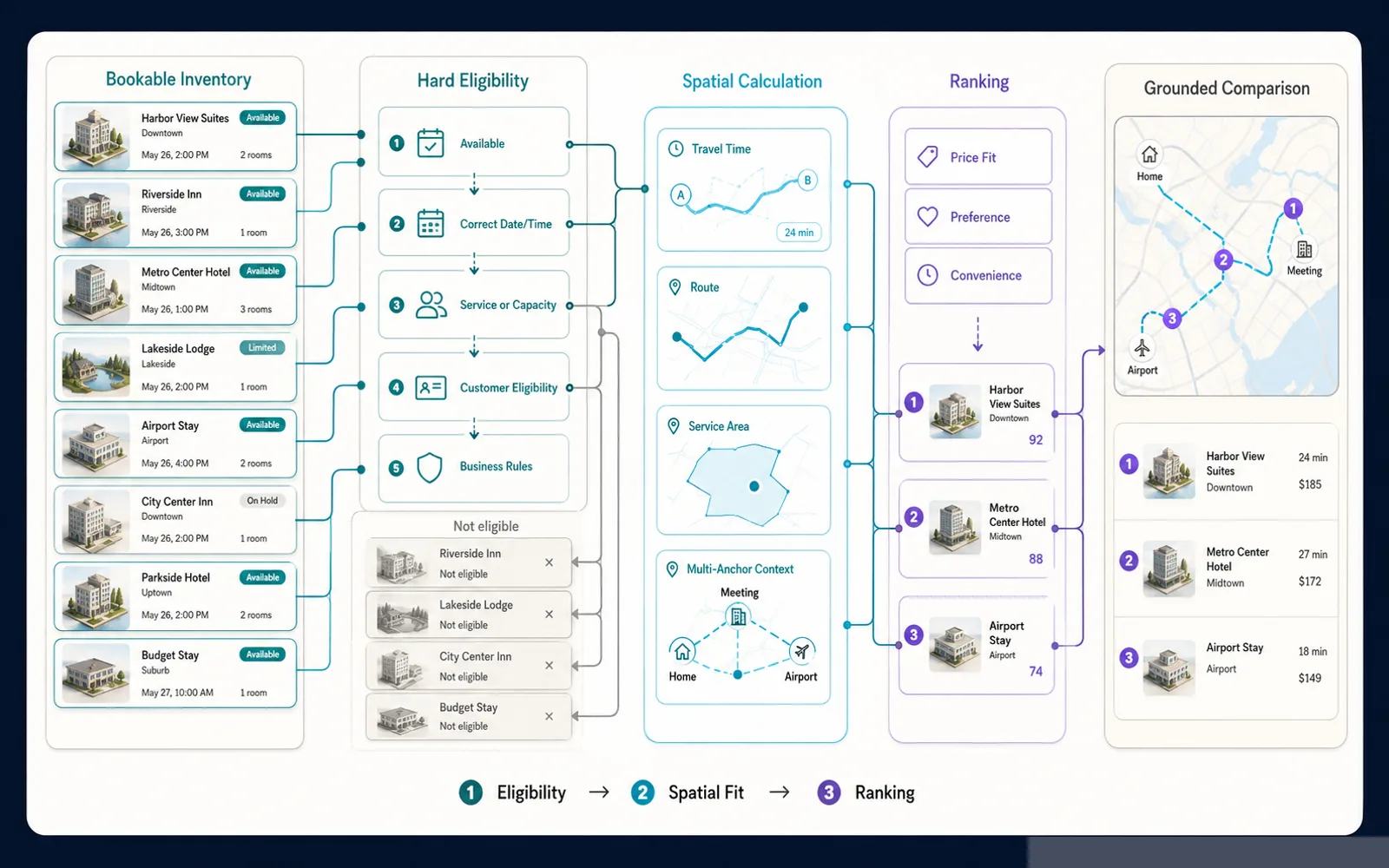
The inverted pattern—generate a place first, then ask the booking engine whether it is free—creates friction exactly when the customer expects confidence. Google Maps Platform’s current Places API can attach routing summaries to place-search results, including travel duration and distance from an origin (Calculate routing summary). That documentation is authoritative about Google’s own API. The transferable design rule is independent of vendor: calculate the travel relationship the customer named, and only after the option has already passed bookability checks.
Which Geographic Relationships Should a Booking Ranker Use?
Customers move through networks, not circles. Two hotels can share a straight-line distance to a conference and differ sharply in walking time, driving time, transit access, or barriers. Do not reduce every booking query to a radius. Choose the relationship the request actually requires.
| Booking case | Useful spatial relationship |
|---|---|
| Hotel near an event | Travel time to the event |
| Appointment location | Travel time from the customer origin |
| Activity during an itinerary | Detour plus schedule window |
| Home service | Service-area containment |
| Venue | Access from multiple origins |
| Tour | Proximity to a planned route |
| Rental | Neighborhood plus destination access |
| Marketplace service | Provider coverage plus arrival estimate |
Location context is often multi-point. “Find a hotel convenient for both the airport and our office” is not a nearest-neighbor query. One ranking function can weight travel time to each anchor. Another can minimize the worse leg. The language model can recover that the customer named two anchors; a deterministic function should compute the result. Along-route booking is a second pattern: a restaurant or hotel that adds the smallest detour on the way to the airport, or a stay roughly between two cities.
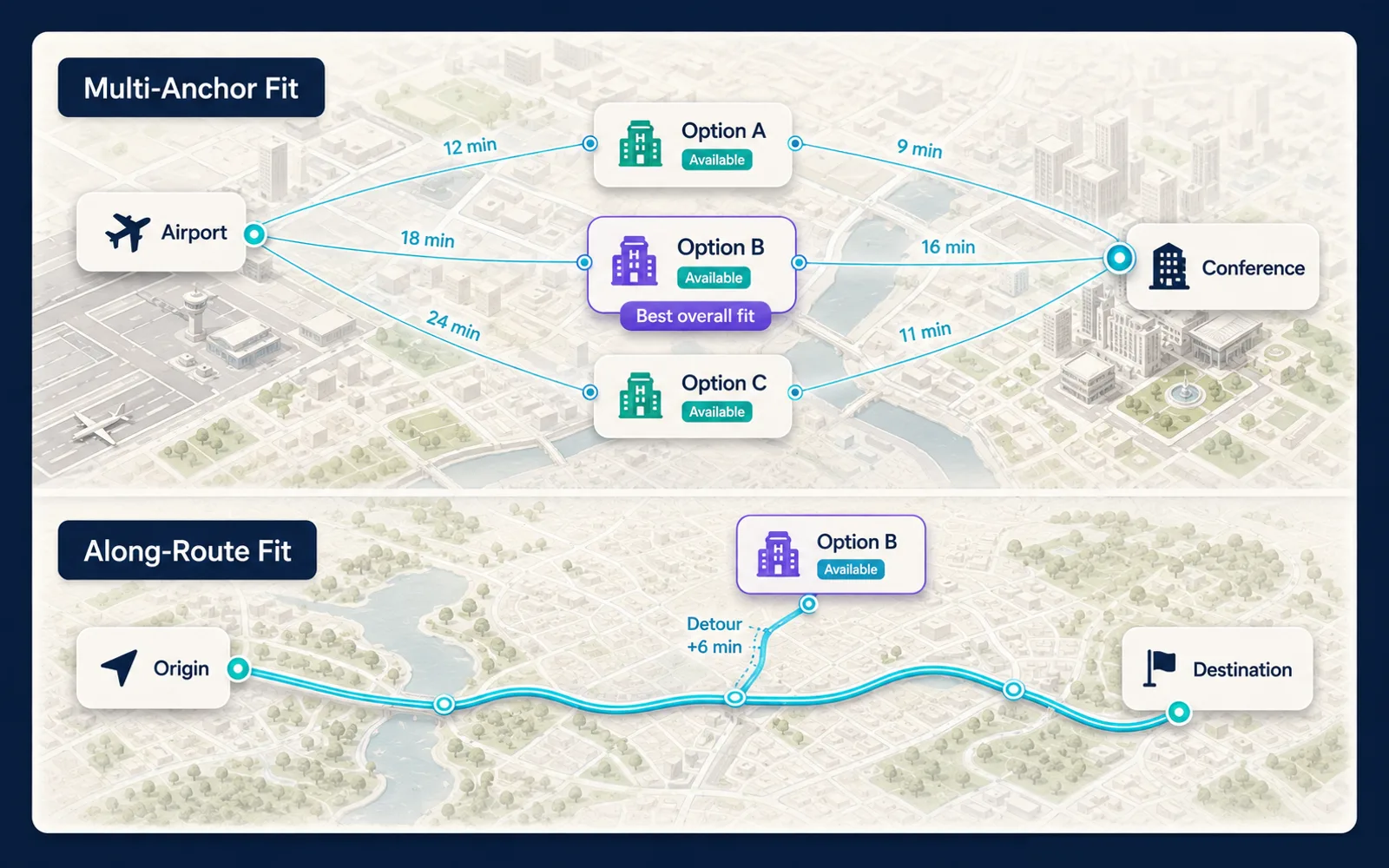
Google Maps Platform’s current Search Along Route workflow combines a route polyline with place search and routing summaries, including duration and distance to identified places (Search along route guide). That guide is authoritative about Google’s own APIs. A booking product can use the same general sequence—existing itinerary, candidate inventory, detour calculation, availability, ranking—without copying a provider interface. Availability still has to be checked against the host booking engine, not inferred from a public place database.
How Should Intent, Shared State, and Revalidation Work?
Customer language is often geographic without naming coordinates. “Somewhere convenient for the conference but not right in the busiest area” implies a venue, an acceptable travel budget, and a neighborhood preference. “A clinic appointment after work without going far out of my way” implies a work origin, a time window, a route, and detour cost. The language model adds value when it recovers those fields so the customer does not have to fill five filters. The recovered constraints should be visible: conference within a stated travel budget, price cap, parking, available for the selected dates. Visible state is how the customer corrects a misread of “close.”
Map, list, conversation, and checkout should share one canonical state: dates, party size, origin or anchors, filters, eligible option identifiers, and the selected identifier. The map should not invent a second result set. The assistant should not keep discussing an option the filters removed. Checkout should use the same selected ID that the card and marker used. Stable identifiers prevent errors when properties share similar names or when one venue contains several bookable spaces.
Revalidate before the booking action. Availability and price can change between comparison and checkout. Show a changed price before payment. If the selected option is no longer bookable, offer remaining verified options rather than completing a stale hold.
Permissions for reservation writes belong to the application and infrastructure, never to the language model. OWASP’s LLM01:2025 Prompt Injection describes how user or retrieved text can alter model behavior, including influence over connected functions. The OWASP Top 10 for LLM Applications 2025 separately lists LLM06:2025 Excessive Agency: damaging actions from unexpected or manipulated model output when a system is granted too much functionality, permission, or autonomy. A booking assistant should propose a selected option; the host booking engine should execute the reservation after authorization and revalidation.
How Does Location-Aware Booking Apply Across Industries?
Hospitality is the clearest illustration because guests already think in trips: airport to hotel, hotel to venue, hotel to a dinner reservation. An AI guest concierge can help with property questions and approved nearby places; a booking flow still has to ask the reservation system whether the room exists for those dates. Appointment products care about openings after a given time and travel from an office or home. Activity and experience booking cares about a window between two other commitments. Venue booking often needs access from several guest origins. Marketplace booking cares whether a provider can reach the customer inside a requested time window.
In each case the same contract holds. The host catalog or booking API supplies bookable inventory. Spatial services calculate the relationship the customer named. Ranking applies host policy after eligibility.
Conversation helps when the request is compound. Structured filters remain faster for dates, party size, and price. Conversation should not become a required step for customers who already know what they want.
Kaleidr Studio can publish branded destination or property maps that sit beside a host booking flow (AI Map Maker for Branded Interactive Maps). A hospitality site can start from the hospitality template. Live inventory, payment, and reservation writes should remain integrated with the systems that already own those transactions.
How Does Kaleidr Fit an Existing Booking Stack?
Kaleidr is designed to add location-aware interaction on top of an existing product rather than replace the booking engine. The current Spatial AI page describes a business pattern of connecting places, grounding answers on inventory, brand voice, and policies, and deploying on the host platform (AI Map Chat for Customer Discovery). For booking products, the important split is unchanged: the host inventory and booking system remain authoritative, and Kaleidr can add conversational map interaction and spatial explanation.
Kaleidr Chat can attach to a map the host already renders rather than requiring a renderer replacement (Chat attach). Enterprise surfaces describe APIs, SDKs, and deployment support for putting that layer inside an existing stack (Location Intelligence APIs and Map SDK). A Kaleidr implementation can coordinate retrieval, geospatial services, map behavior, and analytics depending on the deployment configuration. The booking engine still owns availability, price, and reservation state.
Browser and backend credentials should stay separated. Kaleidr’s current authentication model uses publishable browser keys and secret server keys for trusted backend calls (Auth & Scopes). Booking systems should likewise keep inventory credentials, payment credentials, and reservation tokens off the browser unless a client-side flow is explicitly designed for them.
What Should Analytics Measure in a Spatial Booking Funnel?
Measure whether spatial context helps customers reach a valid booking, not only whether they pan the map or open conversation. A practical funnel runs from search, through eligible inventory and spatial comparison, to selection, revalidation, checkout, and completed booking. Geographic diagnostics belong underneath that funnel: region, anchor, travel-time band, and supply coverage. Failure modes such as no availability, no result, revalidation failure, and time-to-selection explain where the product stalled.
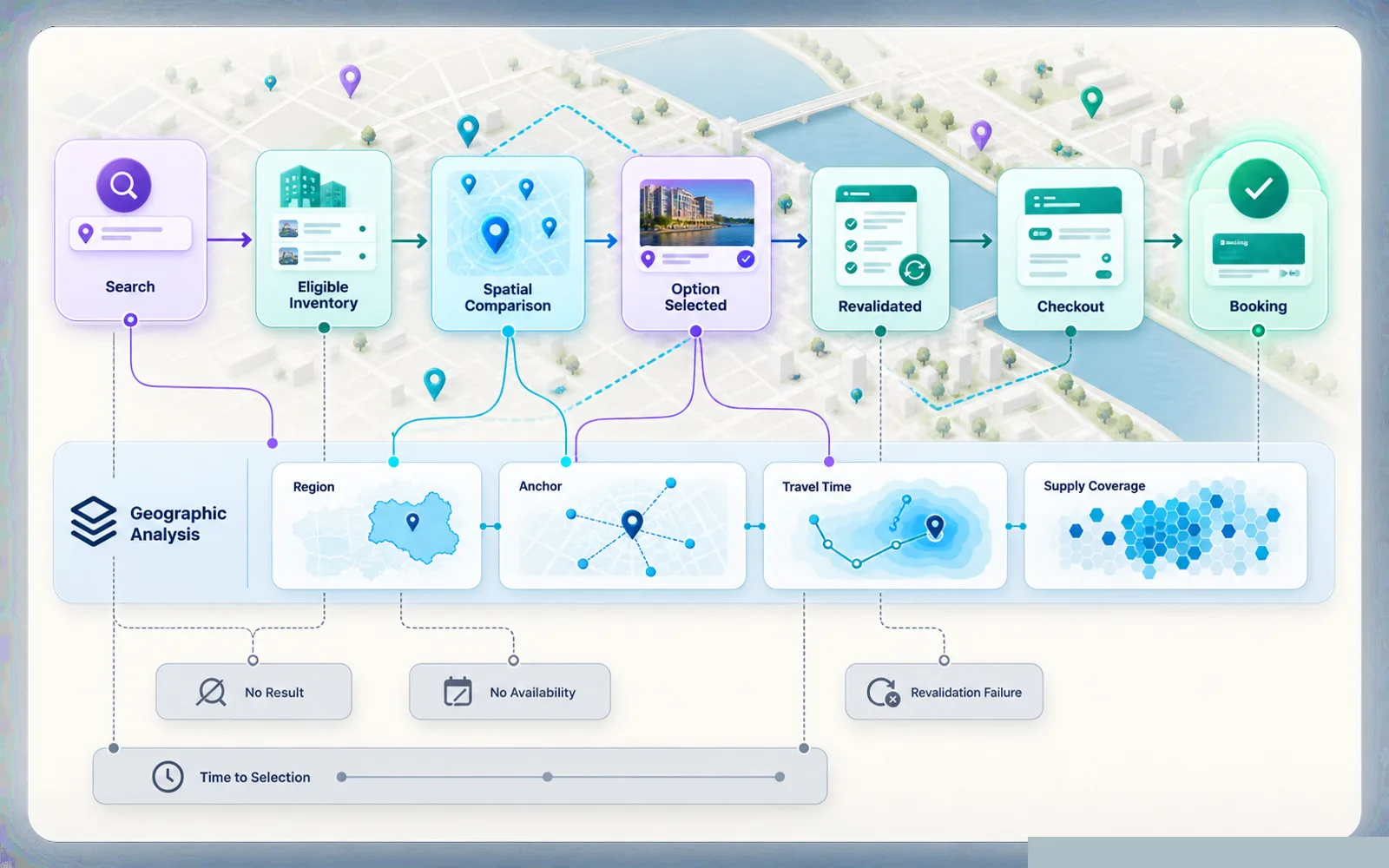
Editorial event ideas include search started, location context added, options ranked, map option selected, route context viewed, revalidation succeeded or failed, checkout started, and booking completed. Those names are product-design suggestions, not documented automatic Kaleidr Analytics events. Kaleidr Analytics currently frames measurement around map and place engagement—sessions, views, interactions, and audience activity tied to places rather than only URLs (Map Engagement and Location Analytics). Host booking completion still has to be joined from the reservation system if the business outcome is a paid stay, appointment, or order.
Prioritize task completion over raw interaction volume. A session that compared three eligible hotels by airport and venue travel time and completed checkout is a better outcome than a long conversation that never reached a bookable option. Test ranking with real tasks: multi-anchor convenience, along-route detours, sold-out dates, routing outages, and ambiguous phrases such as “convenient” or “not too far.” Chat-only metrics hide those failures.
What Limits and Failure Modes Should Product Teams Expect?
Travel dates, home and work origins, medical appointments, and event attendance are sensitive. The NIST Privacy Framework (NIST.CSWP.01162020, 16 January 2020) treats privacy as enterprise risk management: identify what is collected, why, and for how long. Prefer data minimization. Do not permanently store exact origins only because a route comparison used them. Separate session context from account history. Personalization should prefer user-declared preferences over inferred sensitive traits, and the customer should be able to change or reset those preferences.
Failure states should stay specific. When no option matches, say that no bookable option matches the selected constraints, then offer controlled relaxation such as a wider area, a different time, or a higher price cap. When routing is unavailable, keep booking results and explain that travel-time comparison is temporarily down. When price or availability changes, show the new fact before checkout. When the language-model layer is unavailable, keep deterministic search and filters usable.
Do not invent scarcity, ratings, or “only three left” copy the inventory system did not supply. Do not disguise paid or partner ranking as neutral relevance. Do not make conversation a required step. Indoor turn-by-turn and live traffic are separate capabilities; claiming them without the matching spatial services overstates the product. Match map actions to the geometry and booking APIs the host actually publishes.
| Failure mode | What goes wrong | Safer contract |
|---|---|---|
| Rank before availability | Customers select sold-out options | Filter inventory first |
| Radius-only ranking | “Nearby” ignores the real trip | Calculate the named travel relationship |
| Model-owned checkout | Unauthorized or stale reservations | Host engine revalidates and writes |
| Hidden ranking policy | Paid placement looks like relevance | Disclose host priority where required |
| Conversation as the only UI | Simple searches get slower | Keep dates, price, and party filters |
| Chat-volume metrics only | Usage looks like conversion | Measure completed bookings |
Build a Location-Aware Booking Experience
See how a conversational map, spatial comparison, and enterprise APIs can sit on an existing booking engine without replacing the renderer or the reservation system. Explore Kaleidr Enterprise for current APIs, SDK surfaces, and deployment support.
FAQs
What is location-aware booking?
Location-aware booking combines live bookable inventory with spatial context such as travel time, route, service area, customer origin, or proximity to important destinations.
How is it different from showing a map in a booking app?
A map can simply visualize results. A location-aware booking system uses geography as part of eligibility, comparison, or ranking.
Should location-aware booking rank the nearest option first?
Not automatically. The best option may depend on travel time, route, destination context, availability, price, or several locations rather than straight-line distance.
What should AI do in a booking workflow?
The language model is most useful for interpreting complex intent, follow-up questions, and comparison criteria. The model should not invent availability, pricing, or reservation state.
What system should own availability?
The authoritative booking, inventory, scheduling, or marketplace system should own availability.
Why should availability be checked before ranking?
An unavailable option should not be recommended regardless of how relevant it appears spatially or semantically.
Can the map use travel time instead of distance?
Yes. Travel-time comparison is often more useful because it reflects the network and travel mode.
What is multi-anchor booking search?
Multi-anchor search ranks or filters an option relative to more than one important location—for example, a hotel convenient to both an airport and a conference venue.
Can AI help with itinerary-based bookings?
Yes. The assistant can interpret a request such as “find something bookable on the way to the airport,” while a routing or geospatial service calculates the actual detour.
Should booking conversation replace filters?
No. Structured filters remain faster for dates, price, party size, and other explicit requirements.
How should booking recommendations be explained?
Use grounded reasons such as availability, travel time, price fit, a required amenity, or route convenience.
Can Kaleidr replace a booking engine?
A booking-engine replacement is not the intended architecture. The booking system should remain authoritative for availability, price, reservation state, and the transaction.
Can Kaleidr work with an existing map?
Yes. Kaleidr’s current Chat documentation supports attaching its conversational layer to existing compatible map implementations rather than requiring the host to replace the renderer.
References
- Google Maps Platform. Calculate routing summary. Places API (New) documentation. Accessed 24 August 2026. https://developers.google.com/maps/documentation/places/web-service/routing-summary
- Google Maps Platform. Search along route guide. Accessed 24 August 2026. https://developers.google.com/maps/architecture/search-along-route-places-and-routes-api
- Kaleidr. AI Map Chat for Customer Discovery. Accessed 24 August 2026. https://kaleidr.com/ai
- Kaleidr. AI Map Maker for Branded Interactive Maps. Accessed 24 August 2026. https://kaleidr.com/studio
- Kaleidr. AI-Powered Map Experiences for Business. Accessed 24 August 2026. https://kaleidr.com/
- Kaleidr. Auth & Scopes. Kaleidr Developer Docs. Accessed 24 August 2026. https://docs.kaleidr.com/platform-api/auth-and-scopes
- Kaleidr. Chat attach. Kaleidr Developer Docs. Accessed 24 August 2026. https://docs.kaleidr.com/sdk/chat-attach
- Kaleidr. Location Intelligence APIs and Map SDK. Accessed 24 August 2026. https://kaleidr.com/enterprise
- Kaleidr. Map Engagement and Location Analytics. Accessed 24 August 2026. https://kaleidr.com/analytics
- National Institute of Standards and Technology. NIST Privacy Framework: A Tool for Improving Privacy through Enterprise Risk Management, Version 1.0. NIST.CSWP.01162020. 16 January 2020. https://nvlpubs.nist.gov/nistpubs/CSWP/NIST.CSWP.01162020.pdf
- Open Geospatial Consortium. Simple Feature Access — Part 1: Common Architecture. OGC 06-103r4 / ISO 19125. Accessed 24 August 2026. https://www.ogc.org/standards/sfa/
- OWASP Gen AI Security Project. LLM01:2025 Prompt Injection. Accessed 24 August 2026. https://genai.owasp.org/llmrisk/llm01-prompt-injection/
- OWASP Gen AI Security Project. OWASP Top 10 for LLM Applications 2025. Accessed 24 August 2026. https://owasp.org/www-project-top-10-for-large-language-model-applications/assets/PDF/OWASP-Top-10-for-LLMs-v2025.pdf
- W3C. Geolocation. W3C Candidate Recommendation Snapshot, 26 March 2026. Accessed 24 August 2026. https://www.w3.org/TR/geolocation/
- W3C and OGC. Spatial Data on the Web Best Practices. W3C Group Draft Note, 19 September 2023. Accessed 24 August 2026. https://www.w3.org/TR/sdw-bp/
@misc{google_places_routing_summary_2026_08_24,
  title  = {Calculate routing summary},
  author = {{Google Maps Platform}},
  note   = {Places API (New) documentation; accessed 24 August 2026},
  url    = {https://developers.google.com/maps/documentation/places/web-service/routing-summary}
}

@misc{google_search_along_route_2026_08_24,
  title  = {Search along route guide},
  author = {{Google Maps Platform}},
  note   = {Accessed 24 August 2026},
  url    = {https://developers.google.com/maps/architecture/search-along-route-places-and-routes-api}
}

@misc{kaleidr_ai_booking_2026_08_24,
  title  = {AI Map Chat for Customer Discovery},
  author = {{Kaleidr}},
  note   = {Accessed 24 August 2026},
  url    = {https://kaleidr.com/ai}
}

@misc{kaleidr_studio_booking_2026_08_24,
  title  = {AI Map Maker for Branded Interactive Maps},
  author = {{Kaleidr}},
  note   = {Accessed 24 August 2026},
  url    = {https://kaleidr.com/studio}
}

@misc{kaleidr_home_booking_2026_08_24,
  title  = {AI-Powered Map Experiences for Business},
  author = {{Kaleidr}},
  note   = {Accessed 24 August 2026},
  url    = {https://kaleidr.com/}
}

@misc{kaleidr_auth_scopes_2026_08_24,
  title  = {Auth \& Scopes},
  author = {{Kaleidr}},
  note   = {Kaleidr Developer Docs; accessed 24 August 2026},
  url    = {https://docs.kaleidr.com/platform-api/auth-and-scopes}
}

@misc{kaleidr_chat_attach_2026_08_24,
  title  = {Chat attach},
  author = {{Kaleidr}},
  note   = {Kaleidr Developer Docs; accessed 24 August 2026},
  url    = {https://docs.kaleidr.com/sdk/chat-attach}
}

@misc{kaleidr_enterprise_booking_2026_08_24,
  title  = {Location Intelligence APIs and Map SDK},
  author = {{Kaleidr}},
  note   = {Accessed 24 August 2026},
  url    = {https://kaleidr.com/enterprise}
}

@misc{kaleidr_analytics_booking_2026_08_24,
  title  = {Map Engagement and Location Analytics},
  author = {{Kaleidr}},
  note   = {Accessed 24 August 2026},
  url    = {https://kaleidr.com/analytics}
}

@techreport{nist_privacy_framework_2020,
  title       = {NIST Privacy Framework: A Tool for Improving Privacy through Enterprise Risk Management, Version 1.0},
  author      = {{National Institute of Standards and Technology}},
  number      = {NIST.CSWP.01162020},
  institution = {National Institute of Standards and Technology},
  year        = {2020},
  month       = jan,
  url         = {https://nvlpubs.nist.gov/nistpubs/CSWP/NIST.CSWP.01162020.pdf}
}

@misc{ogc_sfa_booking_2026_08_24,
  title  = {Simple Feature Access -- Part 1: Common Architecture},
  author = {{Open Geospatial Consortium}},
  note   = {OGC 06-103r4 / ISO 19125; accessed 24 August 2026},
  url    = {https://www.ogc.org/standards/sfa/}
}

@misc{owasp_llm01_prompt_injection_2025,
  title  = {LLM01:2025 Prompt Injection},
  author = {{OWASP Gen AI Security Project}},
  note   = {Accessed 24 August 2026},
  url    = {https://genai.owasp.org/llmrisk/llm01-prompt-injection/}
}

@misc{owasp_llm_top10_2025,
  title  = {OWASP Top 10 for LLM Applications 2025},
  author = {{OWASP Gen AI Security Project}},
  note   = {Accessed 24 August 2026},
  url    = {https://owasp.org/www-project-top-10-for-large-language-model-applications/assets/PDF/OWASP-Top-10-for-LLMs-v2025.pdf}
}

@misc{w3c_geolocation_2026_03_26,
  title  = {Geolocation},
  author = {{W3C}},
  note   = {W3C Candidate Recommendation Snapshot, 26 March 2026; accessed 24 August 2026},
  url    = {https://www.w3.org/TR/geolocation/}
}

@misc{w3c_ogc_sdw_bp_2023,
  title  = {Spatial Data on the Web Best Practices},
  author = {{W3C and OGC}},
  note   = {W3C Group Draft Note, 19 September 2023; accessed 24 August 2026},
  url    = {https://www.w3.org/TR/sdw-bp/}
}