
AI event discovery uses natural-language intent, trusted event records, venue location, schedule, ticket state, and travel fit to help a customer find an event that is still possible to attend. The product retrieves real events, applies hard eligibility, calculates spatial fit, ranks valid options, and hands the selected event to the host's ticketing flow. The event platform remains authoritative for schedules, inventory, pricing, and cancellations; Spatial AI interprets intent and coordinates the map experience.
The sections below separate event discovery from venue wayfinding and things-to-do search, then cover entity modeling, space-time eligibility, where Kaleidr fits, B2B jobs, measurement, and a narrow pilot. Related reading includes AI Venue Map for Events, AI Things to Do Recommendations, Traffic-Aware Journey Planning, and Grounded Spatial AI for Business Data. Teams that already own a catalog and checkout can skip to Kaleidr's fit; teams still naming the data boundary should start with event, venue, attraction, and offer.
AI event discovery essentials
- The catalog stays authoritative: Recommend events the host actually offers or is licensed to sell.
- Entities stay separate: Event, venue, attraction, and ticket offer keep their own IDs.
- Eligibility before ranking: Cancelled, sold-out, unauthorized, and infeasible events do not compete on similarity.
- Attendance is a space-time test: Travel time and an arrival buffer matter more than a radius.
- The host owns the side effect: Map, list, calendar, and chat share one selected event; ticketing still executes checkout.
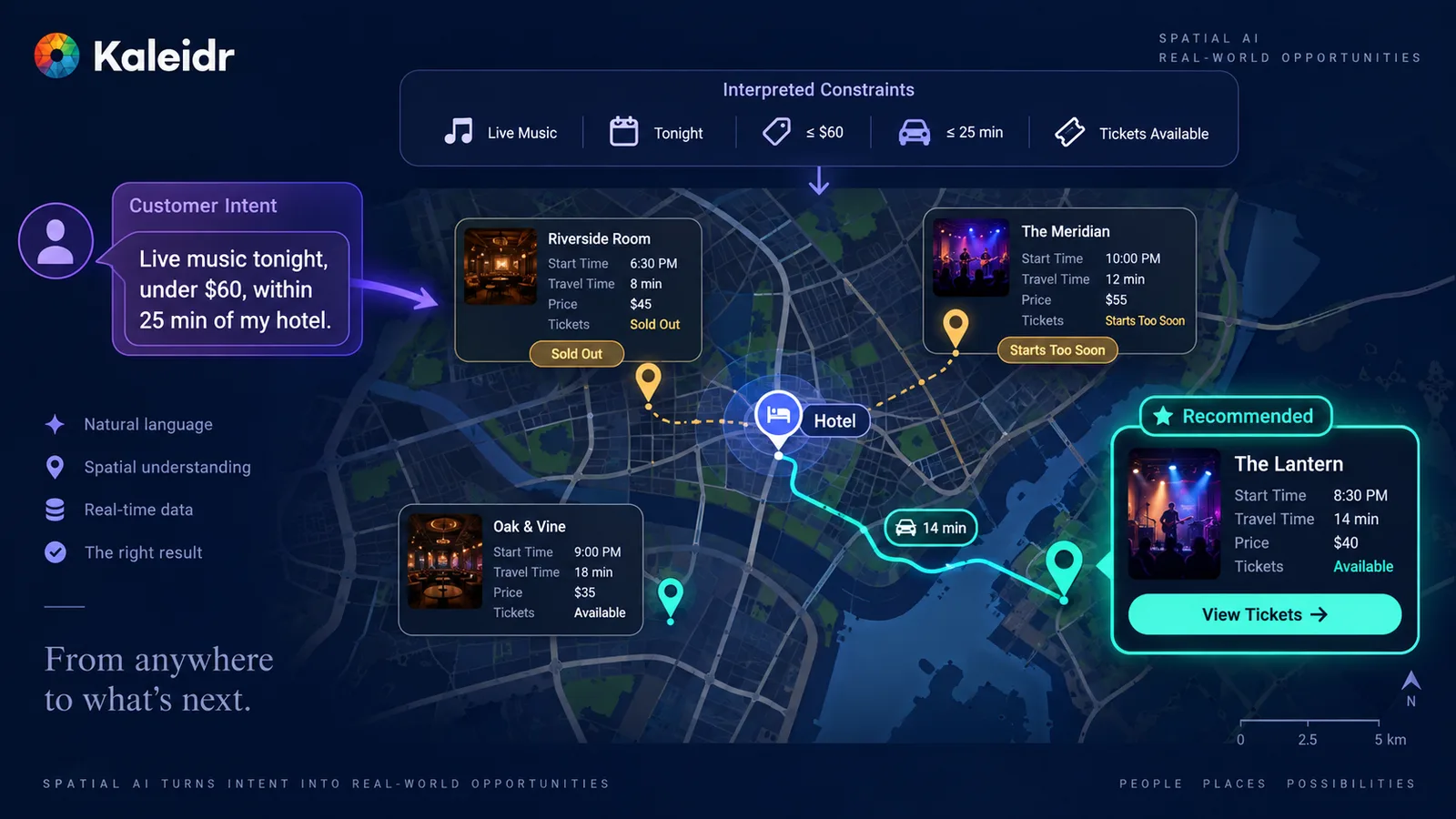
Event discovery is a space-time decision: the event must match the customer's intent and still be possible to attend.
Why Is AI Event Discovery a B2B Spatial AI Problem?
Event platforms, venue groups, destination organizations, hotels, campuses, and conference products already hold first-party context such as a catalog, a ticket inventory, a member calendar, or a booked property. Plotting events as markers is no longer the scarce capability. The product problem is helping a customer choose a real event that fits the remaining evening, the next commitment, and the host's rules, without asking a language model to invent the listing.
Kaleidr currently lists Events as an AI-driven customer journey that connects customers with relevant events and experiences through intelligent, location-aware discovery (Kaleidr, 2026). The Spatial AI page currently describes adding search, insights, recommendations, and location-aware experiences to maps without rebuilding the existing platform. The same page is authoritative about Kaleidr's own positioning and is not evidence that Kaleidr operates a ticketing inventory, a cancellation desk, or a city-wide event feed.
A useful test is a compound request. “Live music tonight, under a stated budget, within 25 minutes of the hotel, with tickets still available” encodes category, time window, price, origin, travel budget, and offer state. The language model can recover those fields as inspectable constraints. Start time, venue coordinates, cancellation status, and current availability still have to come from systems that own those facts.
How Does AI Event Discovery Differ From Venue Maps and Things to Do?
An AI venue map answers where a hall, booth, or amenity sits after a destination is chosen. Event discovery answers which event to attend before that commitment. Wayfinding, where routing infrastructure exists, then moves the visitor from an origin to the selected venue. A complete journey can run discover → buy or reserve → route to venue → navigate the building, but those systems should remain separable so a sold-out listing and a closed entrance are not one confused state.
AI things to do recommendations cover activities that may be flexible, open-ended, or bookable across a time window. Events are usually more rigid: a specific start time, a venue, a ticket state, an event status, a duration or estimated end, and one or more performers, speakers, teams, or organizers. A museum visit can often move from 2 PM to 3 PM. A concert that starts at 8 PM cannot. Time eligibility is therefore more central here than in open-ended local search.
Location intelligence for customer experience still uses Discover → Compare → Act. Discover retrieves eligible event records. Compare makes schedule fit, travel relationship, price context, and availability inspectable. Act is a ticket handoff, a save, directions, or a calendar add. The business outcome is that the customer attends a valid event, not that a pin was tapped.
Why Should Event, Venue, Attraction, and Offer Stay Separate?
One venue can host many events. One event can involve multiple attractions or performers. One event can carry several ticket offers. Flattening those facts into a single “place card” makes ranking and revalidation brittle: a sold-out balcony can look like a cancelled night, and a renamed show can look like a new venue. The useful contract is a stable event identity whose geometry, performers, and offers can change without minting a new object every time a field updates.
Ticketmaster's current Discovery API searches events, attractions, or venues as separate resources, exposes classifications, and supports event search by location, date, and availability (Ticketmaster Developer Portal, 2026). The takeaway is not to copy one provider's schema. The takeaway is to preserve the major entities instead of asking the language model to infer them from marketing copy.
Schema.org describes an Event as an occurrence at a certain time and location, with ticketing added through offers, and with repeated events structured as separate objects (Schema.org, 2026). Google's Event structured-data documentation uses the same boundary in public pages: name, start date, location, event status, offers, and performer where applicable (Google Search Central, 2026). Conversational discovery and searchable event pages should read the same governed records rather than two invented catalogs.
{
  "eventId": "evt_8421",
  "venueId": "venue_104",
  "name": "Downtown Jazz Night",
  "startDate": "2026-09-22T20:00:00-04:00",
  "eventStatus": "scheduled",
  "ticketStatus": "available"
}
The exact schema belongs to the host. The important contract is that the event exists independently of the conversation, and that a recurring weekly market keeps instance identity (this Saturday) separate from series identity (the market). Virtual-only events should not be forced onto a city map simply because the catalog contains them; spatial ranking applies to the in-person component of an in-person or hybrid event.
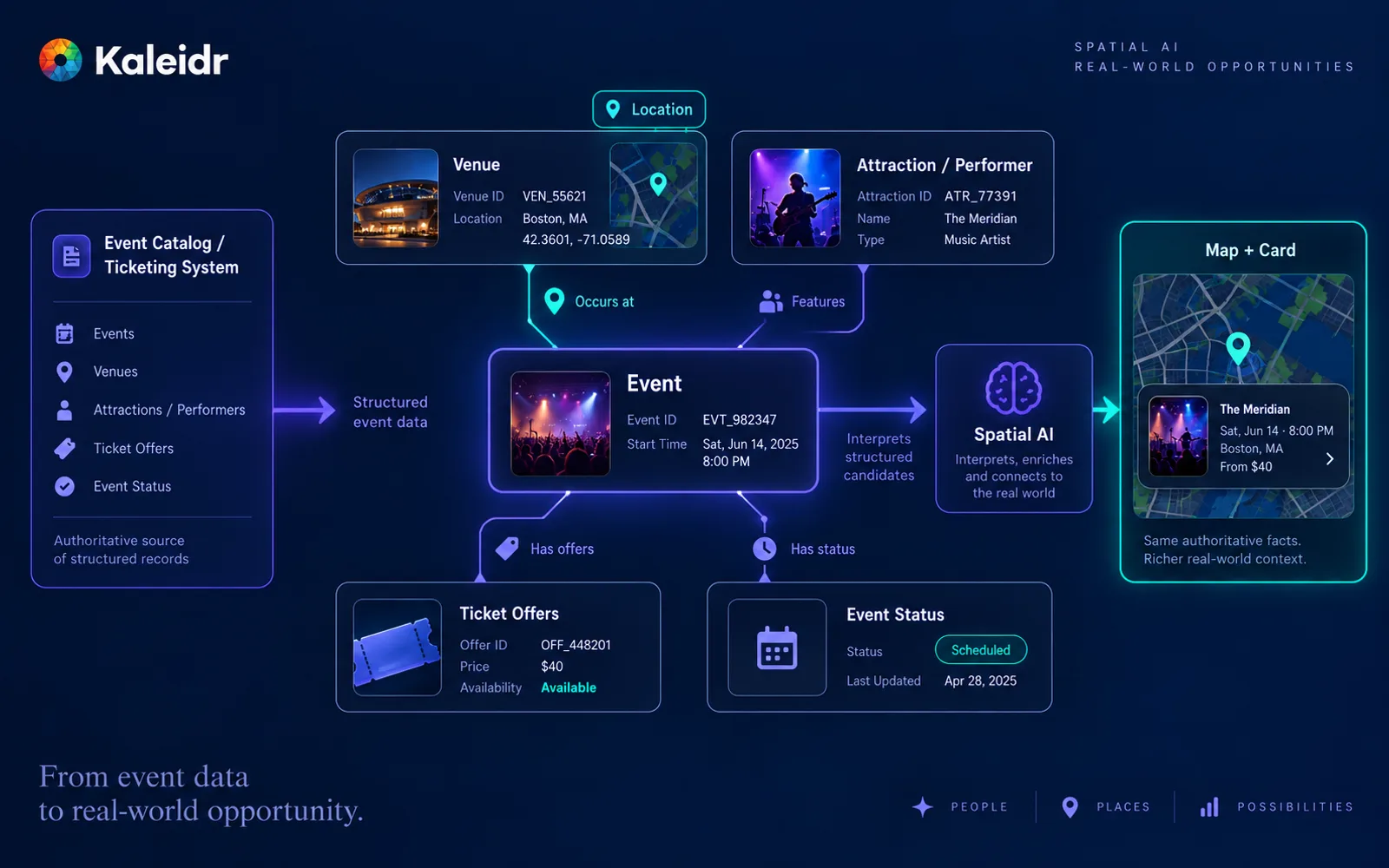
Event, venue, performer, and ticket offer are separate entities; keeping them separate makes ranking and revalidation more reliable.
How Should Time, Travel, and Eligibility Filter Events Before Ranking?
An event should not rank if the customer cannot use it. Hard filters include active status, not cancelled, a still-feasible start, tickets available when ticketing is required, allowed geography, and entitlement for member or private events. Retrieval, authorization, hard constraints, spatial and time fit, ranking, and explanation is the production sequence. Semantic similarity first, with hope that the top result is valid, is the sequence that surfaces a sold-out concert because the description matched the prompt.
Natural-language time phrases such as tonight, this evening, later, this weekend, after dinner, or before a flight are ambiguous until the product converts them into a visible window the customer can edit. A simplified attendance test is dinner end plus travel time plus buffer versus event start. A 20-minute drive to an 8 PM show does not mean leaving at 7:40 PM is always safe; parking, security, ticket scanning, seating, or check-in may need an arrival buffer. The host's data should set that buffer. A universal invented rule should not.
A radius can retrieve candidates. A radius does not always represent the trip. A nearby event can require a long journey; a farther event can be easier by transit. When the question is “can I make it?”, travel time from the relevant origin or along an existing route is the better signal, as traffic-aware journey planning covers for other trip products. Multi-anchor requests such as hotel → event → hotel, or conference → event → airport, need both legs. A nearby evening event is still invalid if the onward trip to a 10 PM flight fails.
Ranking then compares valid events on intent fit, time fit, travel fit, price fit, explicit preference, and separately modeled business policy such as a partner venue or membership benefit. Popularity is one signal, not a substitute for budget, schedule, or availability. Click history alone can freeze a shortlist on whatever already received impressions. After eligibility, a broader shortlist by category, venue, neighborhood, or format is often more useful than three near-identical tribute shows when the prompt was broad. Explicit intent still outranks variety for its own sake.
Price and availability need the source's semantics. “From $42 before fees” is not the same as “$42 total.” Possible ticket states include available, limited, sold out, waitlist, and unknown; unknown should remain unknown. Before ticket handoff, the application should reconfirm event status, current offer, and current availability. If the event sold out during the conversation, the product should say so rather than silently substitute another listing. A venue change is a spatial invalidation, not a text-only correction: travel time, parking, and transit can all break.
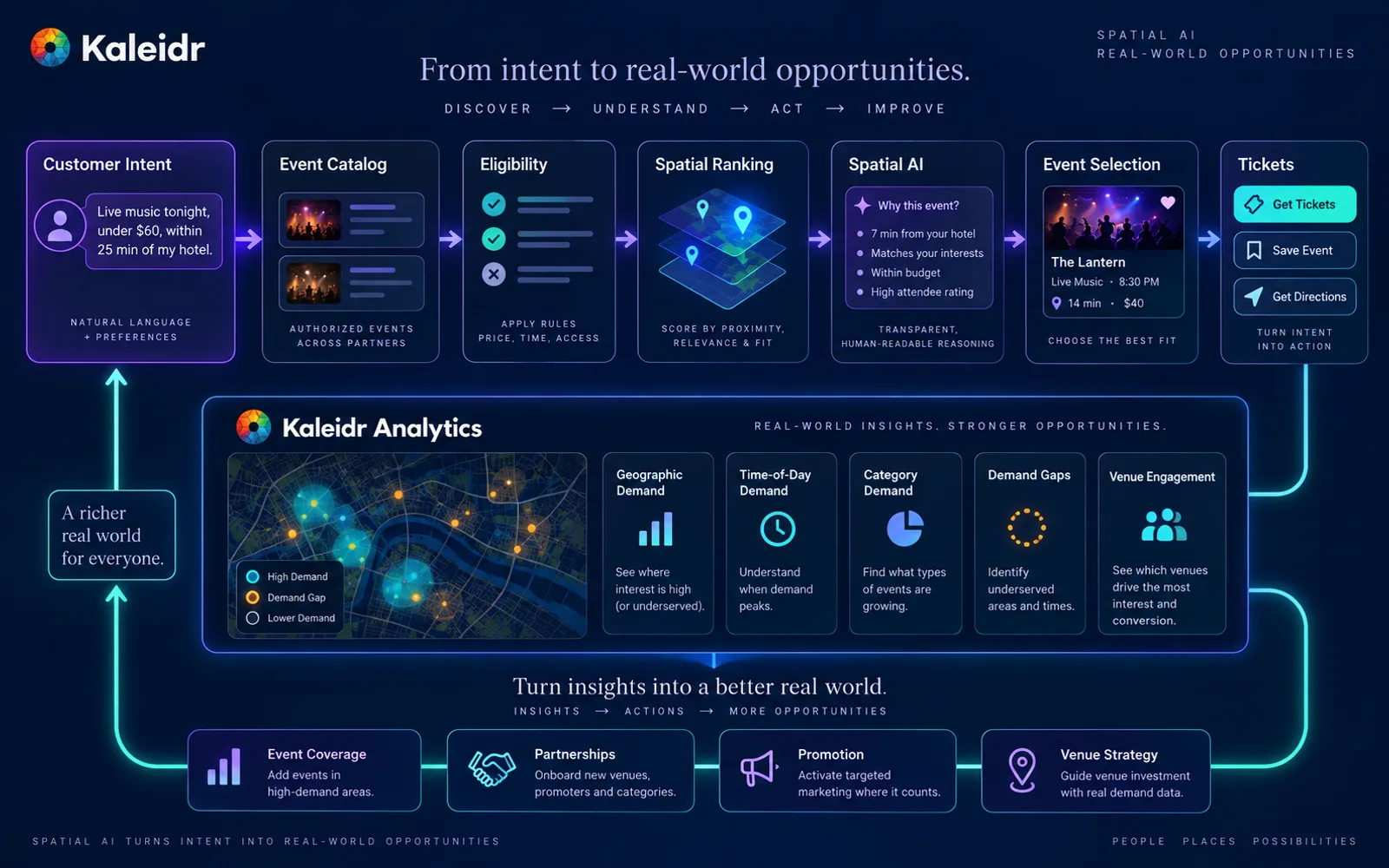
A relevant event is not useful if the customer cannot reach it before the start time.
Where Does Kaleidr Fit Without Replacing the Event Catalog?
Kaleidr is designed so businesses can add AI-powered search, insights, recommendations, and location-aware experiences to maps without rebuilding the existing platform. Events is one of the named customer journeys on that Spatial AI surface. Current Chat documentation describes product="chat" as attaching the conversational layer to a live map the host already renders, currently detecting Mapbox, MapLibre, and Google Maps (Kaleidr, 2026).
The practical architecture is an existing event platform, event database, ticketing flow, and map, plus a Kaleidr conversational spatial layer. The event system remains the source of schedules, inventory, pricing, and cancellations; Kaleidr interprets intent, coordinates geographic context, explains a grounded shortlist, and proposes map actions such as focusing an event or showing a route. The host application validates those actions. Arbitrary client-side code from the language model is not a production interface.
Kaleidr Studio, currently titled AI Map Maker for Branded Interactive Maps, fits curated festival, campus, city, conference, or cultural-district guides where teams want branded basemaps, layers, locations, content, and publishing (Kaleidr, 2026). Use Studio-first when the work is a governed event map the audience can browse. Use a deeper product integration when event status, ticketing, account access, or itinerary state changes live. Permissions stay in the application and infrastructure. The language model does not become the access-control layer for member, employee, campus, or VIP events.
Map, event cards, date selector, calendar, chat, ticket button, and saved events should share the same event IDs. Selecting a card highlights the same event on the map; selecting a marker opens the same card; “how far is this one?” resolves the selected identifier; changing the date refreshes list, map, and chat together. No-result is a valid outcome. Controlled relaxation—expand travel time, raise the budget, include a neighboring category—beats inventing an event to avoid an empty state. Sponsored or partner priority can exist, but it should be labeled and should not override hard customer constraints.
Which B2B Products Need This Kind of Event Discovery?
A ticketing marketplace can keep inventory, price, offer state, and checkout while Spatial AI interprets “something live tonight near downtown under a stated budget that ends before midnight.” A venue group can answer which of its theaters or clubs still has something after work, from a first-party candidate set. A hotel can combine a property anchor, approved event sources, a guest time window, and travel time, then hand off to the event or ticket system, in the same family as AI guest concierge for hotels.
Destination organizations can move past a published calendar toward what fits a visitor's trip right now. Conference products can recommend a networking event after the last session, or a meetup before a keynote, while the agenda remains authoritative for attendee commitments. Campuses can answer which public events sit near the arts center after 5 PM, with student-only records remaining behind authorization. In each case the design layer can stay consistent: inspectable constraints, a map and card that share state, and a host-owned next action.
Discovery should end in an action the host already owns: view tickets, reserve, save, add to calendar, get directions, share, or open the venue. Place ranking is a related pattern for choosing among valid candidates once eligibility is done. Event discovery adds a hard clock that ordinary nearby-place ranking can often treat as a preference instead of a filter.
How Should Teams Measure, Govern, and Pilot Event Discovery?
Kaleidr Analytics currently focuses on map and place engagement, audience activity, place comparison, spatial patterns, and actionable signals (Kaleidr, 2026). An event product can pair those spatial signals with host-owned outcomes such as search started, candidates returned, no-result, event selected, saved, route opened, ticket handoff, and purchase where the host can measure it. Those names are editorial recommendations, not documented automatic Kaleidr Analytics events. Spatial analytics versus web analytics covers why a session count cannot tell whether the customer found a feasible event.
No-result reasons are more actionable than one empty-state count: no event in category, no event in the date window, sold out, cancelled, too far, outside budget, unauthorized, starts too soon, or an infeasible onward journey. Geographic demand gaps, time-of-day demand, and category demand versus eligible inventory then inform partnerships, venue strategy, and curation. Private event feeds need authentication and membership authorization before retrieval, not a prompt that sees everything and is asked to hide rows. Many discovery tasks can work from a temporary origin, an explicit category, and a time window without storing a persistent movement profile.
Event data is perishable. Venue coordinates and category can be relatively stable; ticket inventory, dynamic price, cancellation, venue change, and status are not. One cache policy for all fields will either serve stale tickets or refetch the whole catalog on every keystroke. Structured event pages remain useful public artifacts: Google currently describes how Event markup can make pages eligible for richer discovery in Search and Maps (Google Search Central, 2026). Conversational discovery should complement those pages, not replace them.
A practical pilot is one job: find one ticketed event tonight within 25 minutes of a hotel. Connect a bounded catalog, require date, status, ticket state, and coordinates, calculate travel time, then accept a natural-language request, share IDs across map and chat, and add view-tickets, save, and directions. Measure valid-result rate, selection, ticket handoff, and no-result reason before expanding cities, categories, or personalization. Chat length is a poor success metric; a long failure can look busy.
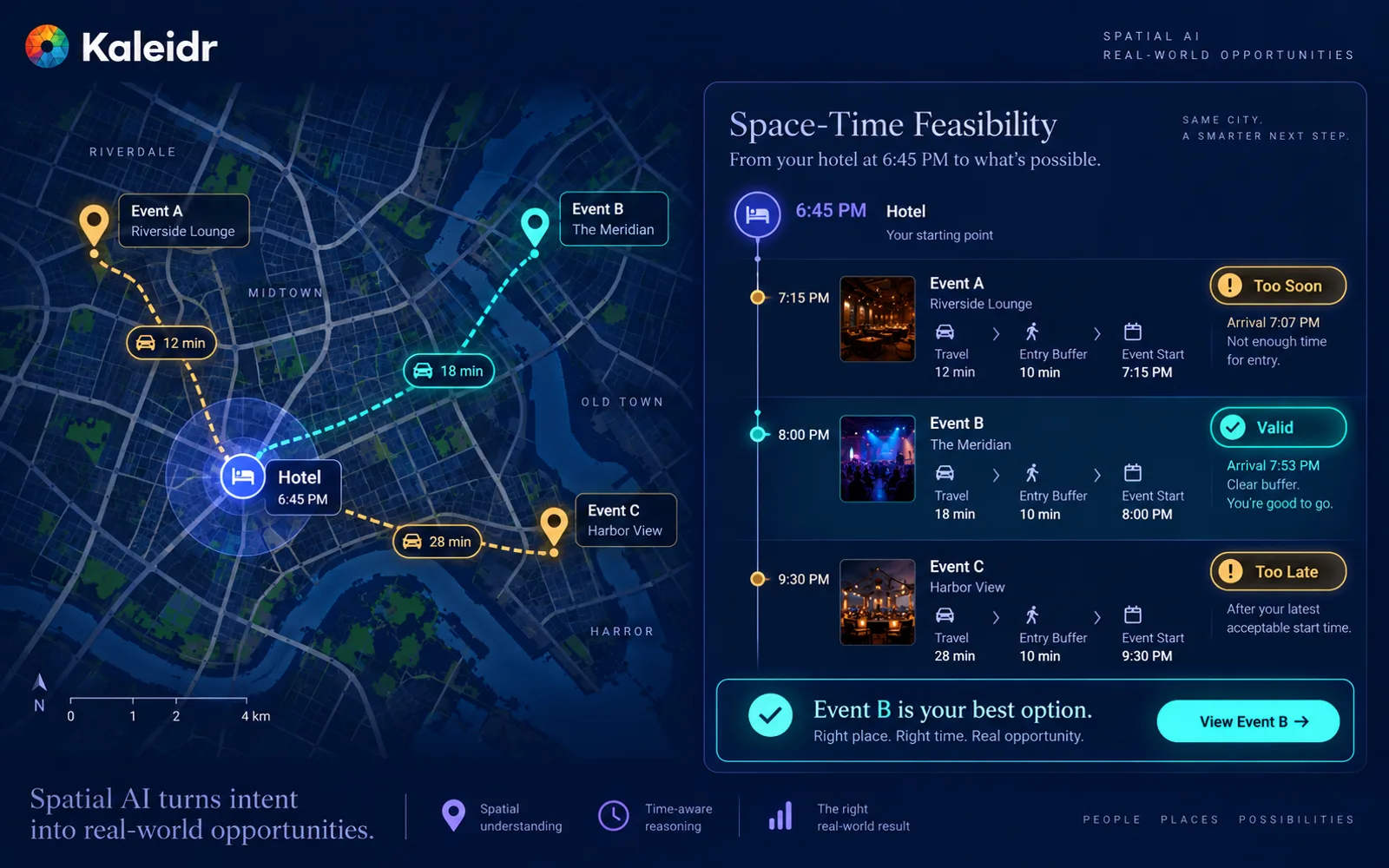
Event discovery becomes more valuable when customer behavior informs inventory, partnerships, venue strategy, and future recommendations.
The following mistakes are editorial. Real deployments should fill the same columns from the catalog and checkout they already operate.
| Mistake | Result | Better approach |
|---|---|---|
| Ask the language model to invent events | Hallucinated or stale listings | Start from an authoritative catalog |
| Treat event and venue as one ID | Ticket and schedule joins break | Model them separately |
| Rank before availability | Sold-out results win | Filter hard constraints first |
| Use radius only | Practical travel is misranked | Use travel time when relevant |
| Hide the interpretation of “tonight” | Time logic feels arbitrary | Show the time window |
| Let the language model own checkout | Transaction integrity weakens | Hand off to the ticket system |
| Mix sponsored and organic ranking | Trust weakens | Disclose business priority |
| Retrieve private events before authorization | Data can leak | Authorize before retrieval |
Explore Kaleidr Spatial AI to attach conversational event discovery to a map the host already renders. Explore Kaleidr Analytics to measure which places and journeys customers actually use after the map is live.
FAQs
What is AI event discovery?
AI event discovery uses natural language to interpret what a customer wants, then matches that intent against real event records using date, time, location, availability, travel context, and other explicit constraints.
How is AI event discovery different from an AI venue map?
Event discovery helps the customer choose an event. A venue map helps the visitor understand or navigate the venue after an event or destination is selected.
How is AI event discovery different from things-to-do recommendations?
Things-to-do discovery can include flexible activities and attractions. Event discovery usually centers on fixed-time scheduled events with venue, status, and ticket state.
Should the language model generate event listings?
No. Production recommendations should come from an authoritative or approved event catalog. The language model should interpret intent and explain valid results.
Why is location important for event discovery?
Distance alone does not show whether the customer can arrive on time. Travel time, route context, and the next destination can change which event is practical.
Should sold-out events appear in recommendations?
Only if the product intentionally supports a sold-out or waitlist state. A normal ticketable recommendation should filter unavailable inventory before ranking.
How should rescheduled events be handled?
The event system should update the start time, venue, and status. The spatial and ranking layers should recompute if those changes affect travel or eligibility.
Can an AI event product recommend sponsored events?
Yes, but sponsored or partner priority should be disclosed and should not override hard customer constraints.
Can Kaleidr work with an existing event map?
Yes. Current Kaleidr Chat documentation supports attaching the conversational layer to a compatible map the host already renders.
Does Kaleidr replace a ticketing platform?
The recommended architecture keeps event and ticket systems authoritative for catalog, availability, pricing, and checkout. Kaleidr can add conversational spatial discovery around those systems.
Can Kaleidr Studio be used for event maps?
Yes. Studio can fit curated festival, campus, city, conference, or cultural-district maps where teams want branded interactive publishing. Live ticketing and authorization generally require deeper product integration.
What should a B2B event product measure?
Measure valid-result rate, no-result reasons, event selection, saves, directions, ticket handoff, purchase outcomes where available, and geographic or time-based demand gaps.
References
- Kaleidr. AI Map Chat for Customer Discovery. Accessed 21 September 2026. https://kaleidr.com/ai
- Ticketmaster Developer Portal. Discovery API. Accessed 21 September 2026. https://developer.ticketmaster.com/products-and-docs/apis/discovery-api/v2/
- Schema.org. Event. Accessed 21 September 2026. https://schema.org/Event
- Google Search Central. Event (
Event) structured data. Accessed 21 September 2026. https://developers.google.com/search/docs/appearance/structured-data/event - Kaleidr. Chat — attach AI to your map. Developer documentation. Accessed 21 September 2026. https://docs.kaleidr.com/sdk/chat-attach
- Kaleidr. AI Map Maker for Branded Interactive Maps. Accessed 21 September 2026. https://kaleidr.com/studio
- Kaleidr. Map Engagement and Location Analytics. Accessed 21 September 2026. https://kaleidr.com/analytics
- Kaleidr. AI Venue Map for Events. Accessed 21 September 2026. https://kaleidr.com/blog/ai-venue-map-for-events
- Kaleidr. AI Things to Do Recommendations. Accessed 21 September 2026. https://kaleidr.com/blog/ai-things-to-do-recommendations
- Kaleidr. Traffic-Aware Journey Planning. Accessed 21 September 2026. https://kaleidr.com/blog/traffic-aware-journey-planning
- Kaleidr. Location Intelligence Customer Experience Maps. Accessed 21 September 2026. https://kaleidr.com/blog/location-intelligence-customer-experience
- Kaleidr. Place Ranking API for Customer Intent. Accessed 21 September 2026. https://kaleidr.com/blog/place-ranking-api
- Kaleidr. Spatial Analytics vs. Web Analytics. Accessed 21 September 2026. https://kaleidr.com/blog/spatial-analytics-vs-web-analytics
- Kaleidr. AI Guest Concierge for Hotels. Accessed 21 September 2026. https://kaleidr.com/blog/ai-guest-concierge-hotels
- Kaleidr. Grounded Spatial AI for Business Data. Accessed 21 September 2026. https://kaleidr.com/blog/grounded-spatial-ai-business-data
@misc{kaleidr_ai_event_discovery_2026,
  title  = {AI Map Chat for Customer Discovery},
  author = {{Kaleidr}},
  year   = {2026},
  note   = {Accessed 21 September 2026},
  url    = {https://kaleidr.com/ai}
}

@misc{ticketmaster_discovery_api_2026,
  title  = {Discovery API},
  author = {{Ticketmaster Developer Portal}},
  year   = {2026},
  note   = {Accessed 21 September 2026},
  url    = {https://developer.ticketmaster.com/products-and-docs/apis/discovery-api/v2/}
}

@misc{schema_event_2026,
  title  = {Event},
  author = {{Schema.org}},
  year   = {2026},
  note   = {Accessed 21 September 2026},
  url    = {https://schema.org/Event}
}

@misc{google_event_structured_data_2026,
  title  = {Event (`Event`) structured data},
  author = {{Google Search Central}},
  year   = {2026},
  note   = {Accessed 21 September 2026},
  url    = {https://developers.google.com/search/docs/appearance/structured-data/event}
}

@misc{kaleidr_chat_attach_event_discovery_2026,
  title  = {Chat -- attach AI to your map},
  author = {{Kaleidr}},
  year   = {2026},
  note   = {Developer documentation; accessed 21 September 2026},
  url    = {https://docs.kaleidr.com/sdk/chat-attach}
}

@misc{kaleidr_studio_event_discovery_2026,
  title  = {AI Map Maker for Branded Interactive Maps},
  author = {{Kaleidr}},
  year   = {2026},
  note   = {Accessed 21 September 2026},
  url    = {https://kaleidr.com/studio}
}

@misc{kaleidr_analytics_event_discovery_2026,
  title  = {Map Engagement and Location Analytics},
  author = {{Kaleidr}},
  year   = {2026},
  note   = {Accessed 21 September 2026},
  url    = {https://kaleidr.com/analytics}
}

@misc{kaleidr_venue_map_events_2026,
  title  = {AI Venue Map for Events},
  author = {{Kaleidr}},
  year   = {2026},
  note   = {Accessed 21 September 2026},
  url    = {https://kaleidr.com/blog/ai-venue-map-for-events}
}

@misc{kaleidr_things_to_do_2026,
  title  = {AI Things to Do Recommendations},
  author = {{Kaleidr}},
  year   = {2026},
  note   = {Accessed 21 September 2026},
  url    = {https://kaleidr.com/blog/ai-things-to-do-recommendations}
}

@misc{kaleidr_traffic_aware_2026,
  title  = {Traffic-Aware Journey Planning},
  author = {{Kaleidr}},
  year   = {2026},
  note   = {Accessed 21 September 2026},
  url    = {https://kaleidr.com/blog/traffic-aware-journey-planning}
}

@misc{kaleidr_location_intelligence_cx_2026,
  title  = {Location Intelligence Customer Experience Maps},
  author = {{Kaleidr}},
  year   = {2026},
  note   = {Accessed 21 September 2026},
  url    = {https://kaleidr.com/blog/location-intelligence-customer-experience}
}

@misc{kaleidr_place_ranking_2026,
  title  = {Place Ranking API for Customer Intent},
  author = {{Kaleidr}},
  year   = {2026},
  note   = {Accessed 21 September 2026},
  url    = {https://kaleidr.com/blog/place-ranking-api}
}

@misc{kaleidr_spatial_vs_web_analytics_2026,
  title  = {Spatial Analytics vs. Web Analytics},
  author = {{Kaleidr}},
  year   = {2026},
  note   = {Accessed 21 September 2026},
  url    = {https://kaleidr.com/blog/spatial-analytics-vs-web-analytics}
}

@misc{kaleidr_guest_concierge_2026,
  title  = {AI Guest Concierge for Hotels},
  author = {{Kaleidr}},
  year   = {2026},
  note   = {Accessed 21 September 2026},
  url    = {https://kaleidr.com/blog/ai-guest-concierge-hotels}
}

@misc{kaleidr_grounded_spatial_ai_2026,
  title  = {Grounded Spatial AI for Business Data},
  author = {{Kaleidr}},
  year   = {2026},
  note   = {Accessed 21 September 2026},
  url    = {https://kaleidr.com/blog/grounded-spatial-ai-business-data}
}