
What is Kaleidr? Kaleidr is a Spatial AI platform for conversational maps, map publishing, analytics, and developer embeds. One browser loader exposes Chat, Viewer, Tile, and Editor. Studio is the place you author and publish a map. Editor is the in-page editing tool, and those two are not the same product.
What is Kaleidr?
Kaleidr AI is the conversational layer for place questions. Studio is where a map is created, styled, given data, and published. Analytics is the product area for understanding how maps are used. Enterprise is the organization path for custom usage, contracts, and business data in AI answers.
The four names beside those areas are the products a web page can load. Chat is not the whole of Kaleidr AI, and Editor is not Studio. A published map can carry the Ask Kaleidr panel with no API key in the page, and that path is still Viewer plus the map's own switches. The top row answers what the company offers, and the bottom row answers what the page embeds.
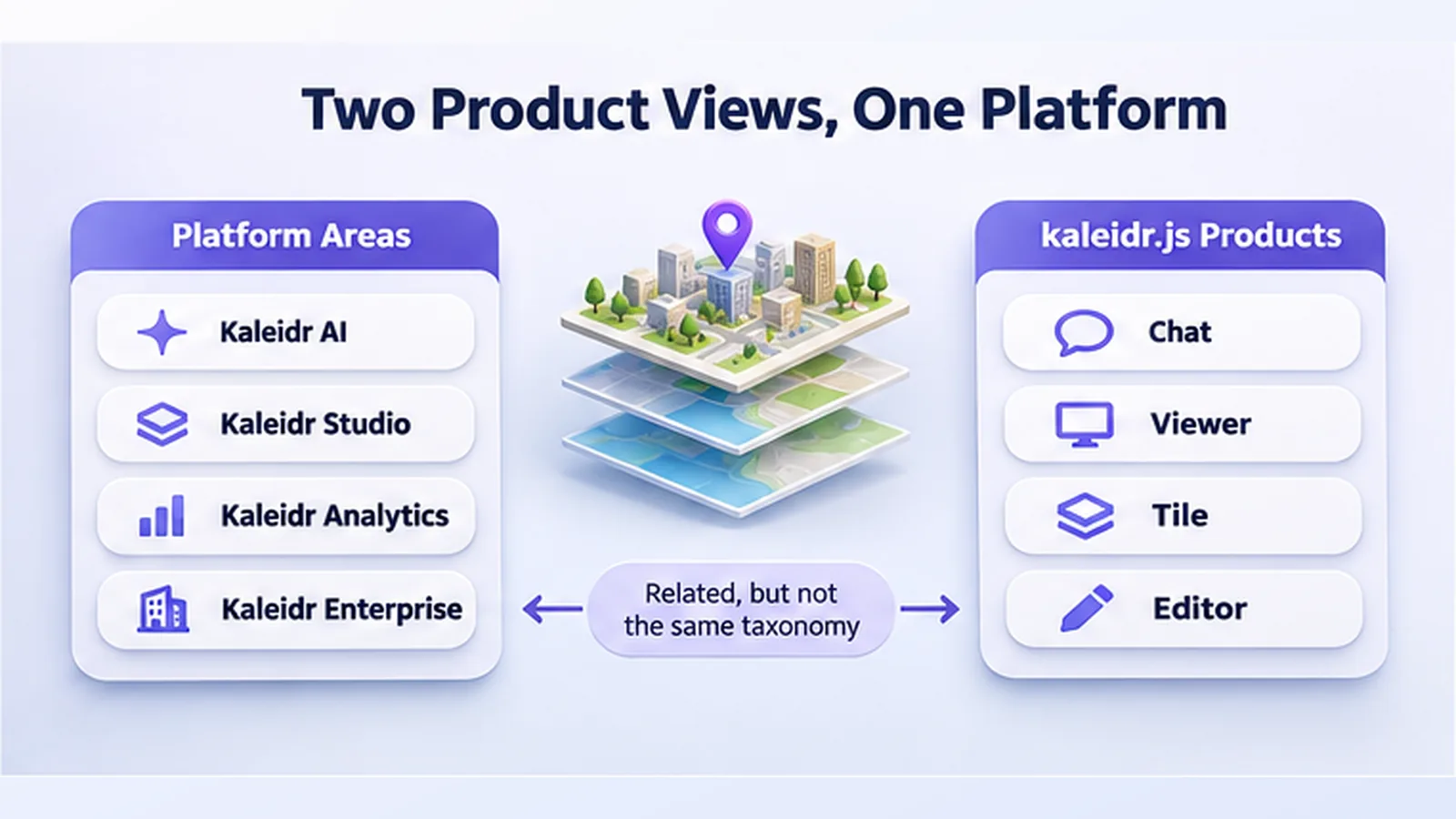
The two columns are related and are not the same list. Kaleidr AI is not a synonym for Chat, and Studio is not a synonym for Editor. The center stack is a map, not a fifth product.
Which Kaleidr product fits the job?
Pick the product from the job, not from the brand name. A site that already has a map uses Chat on that map, on Free, with a publishable key. A map designed in Studio is embedded with Viewer, with no key, also on Free. A designed basemap is Tile, on Free, with a publishable key.
In-page editing tools are Editor, on Free, with a publishable key. Answers, places, and routes from a backend are the Server API, which needs a server key and starts on Pro. Private business data that should ground AI answers is an Enterprise upload, not a file dropped onto a map. Chat can also run with no map at all, still on Free, when the page only needs a place-aware panel (Kaleidr, 2026).
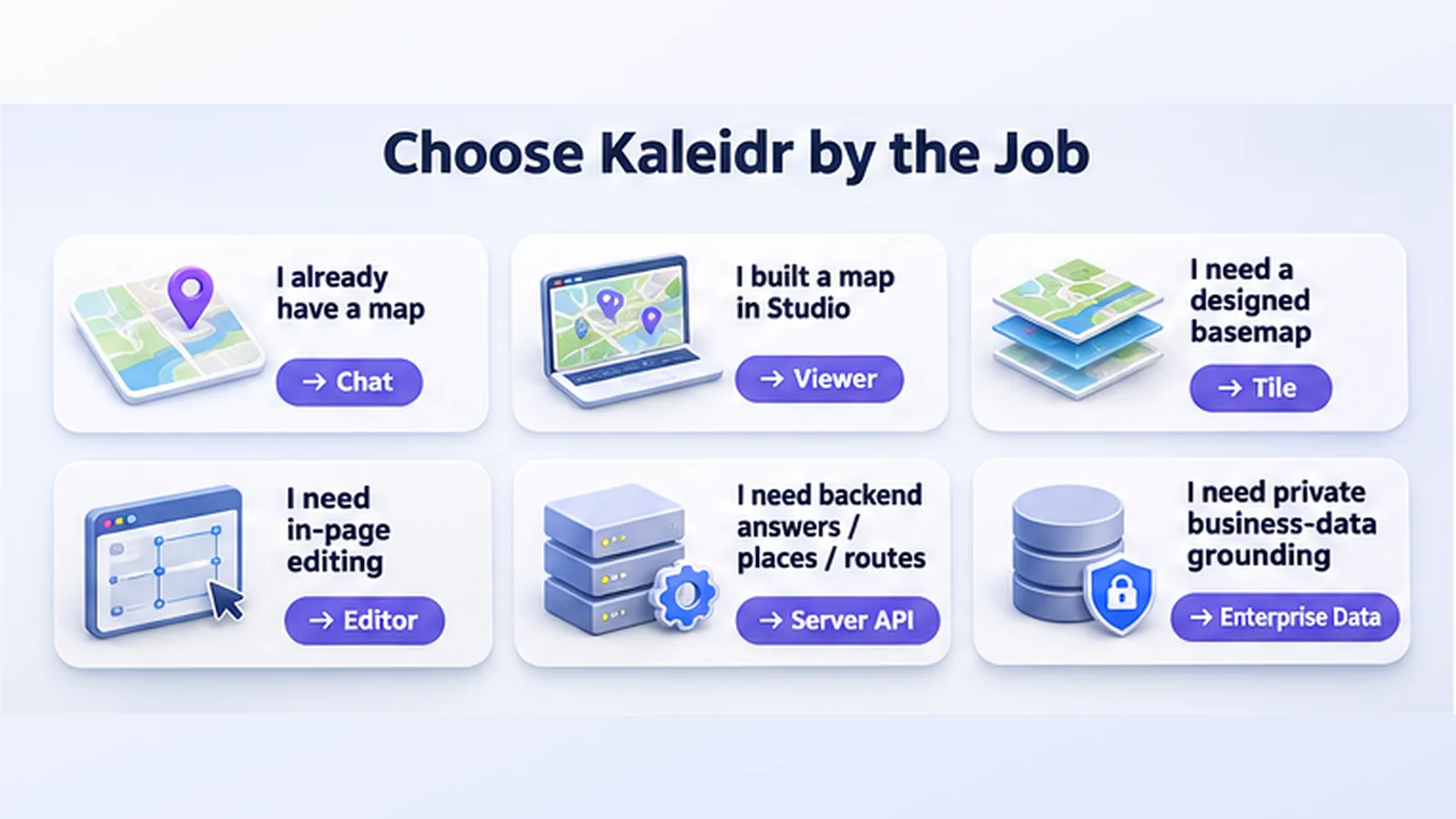
Each card is a job, then the product that does that job. Viewer is for a map already built in Studio. Enterprise data is the private grounding path, not a dataset on the map.
What are the four products in kaleidr.js?
One script loads every browser product. The loader defines window.Kaleidr and the kaleidr-map element, then fetches the bundle for the product you mount. Chat and Editor render in the host page, and Viewer and Tile render in a Kaleidr iframe. A publishable key in the page is exchanged for a short-lived session, while a server key calls the API from a backend, and that Server API has no JavaScript client and no npm package (Kaleidr, 2026).
There is no npm package for the browser loader, and the script tag is the only way to load it. A React, Next.js, or Vue app injects that script rather than importing a Kaleidr module. The loader URL is https://cdn.kaleidr.com/embed/v1/kaleidr.js. Mounting a product is what pulls in Chat, Viewer, Tile, or Editor (Kaleidr, 2026).
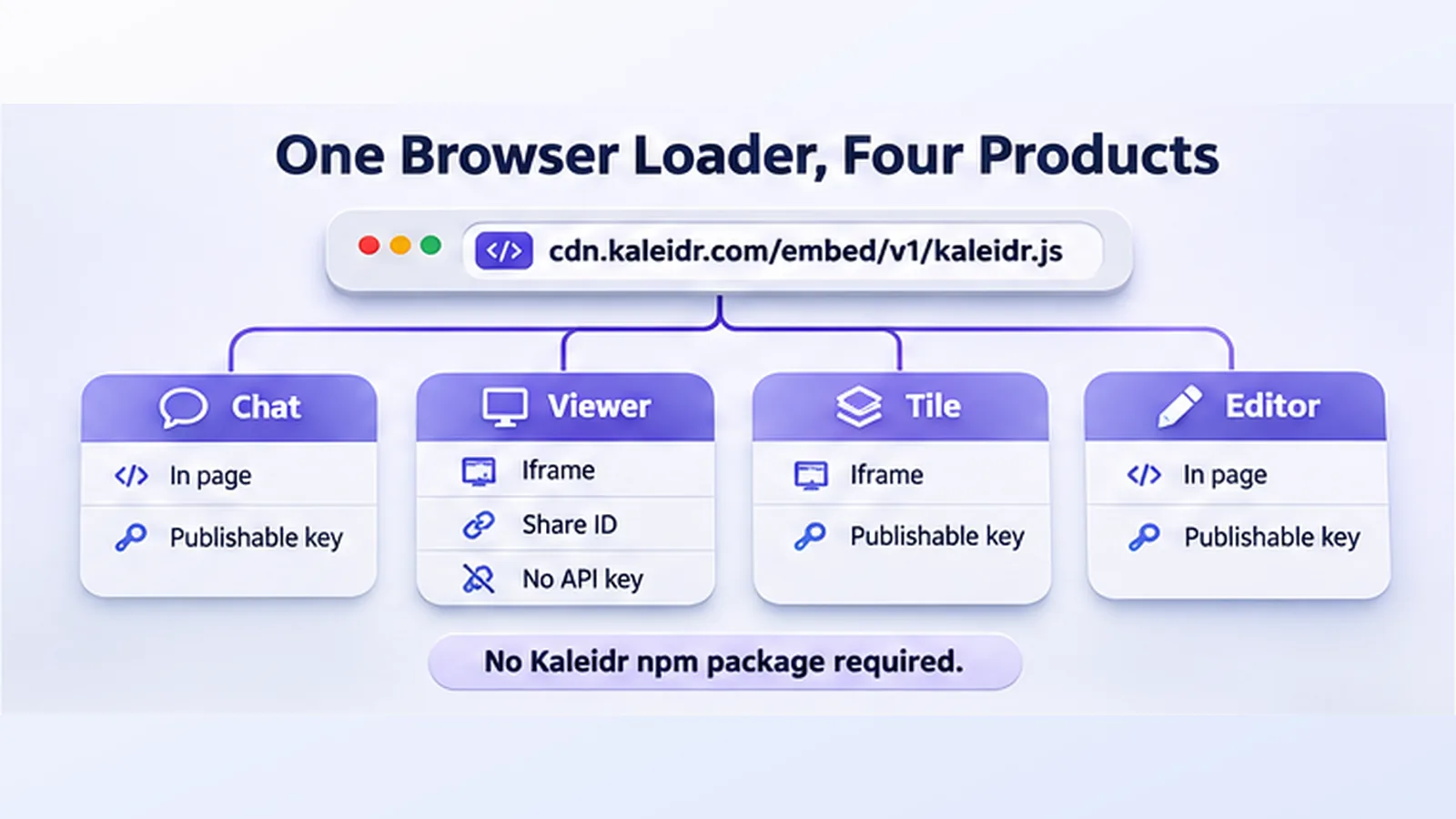
Chat and Editor run in the page. Viewer and Tile run in an iframe. Viewer is the product with no API key. The footer states that no Kaleidr npm package is required.
Which maps can Chat attach to?
Guides exist for Mapbox GL JS, MapLibre GL JS, the Google Maps JavaScript API, and Leaflet. The host keeps its renderer, its style, and its own layers. Chat adds a streamed answer, pins, a camera move, and a route when the question is about getting somewhere. Apple MapKit JS and Naver Maps are recognized, and neither has a dedicated guide (Kaleidr, 2026).
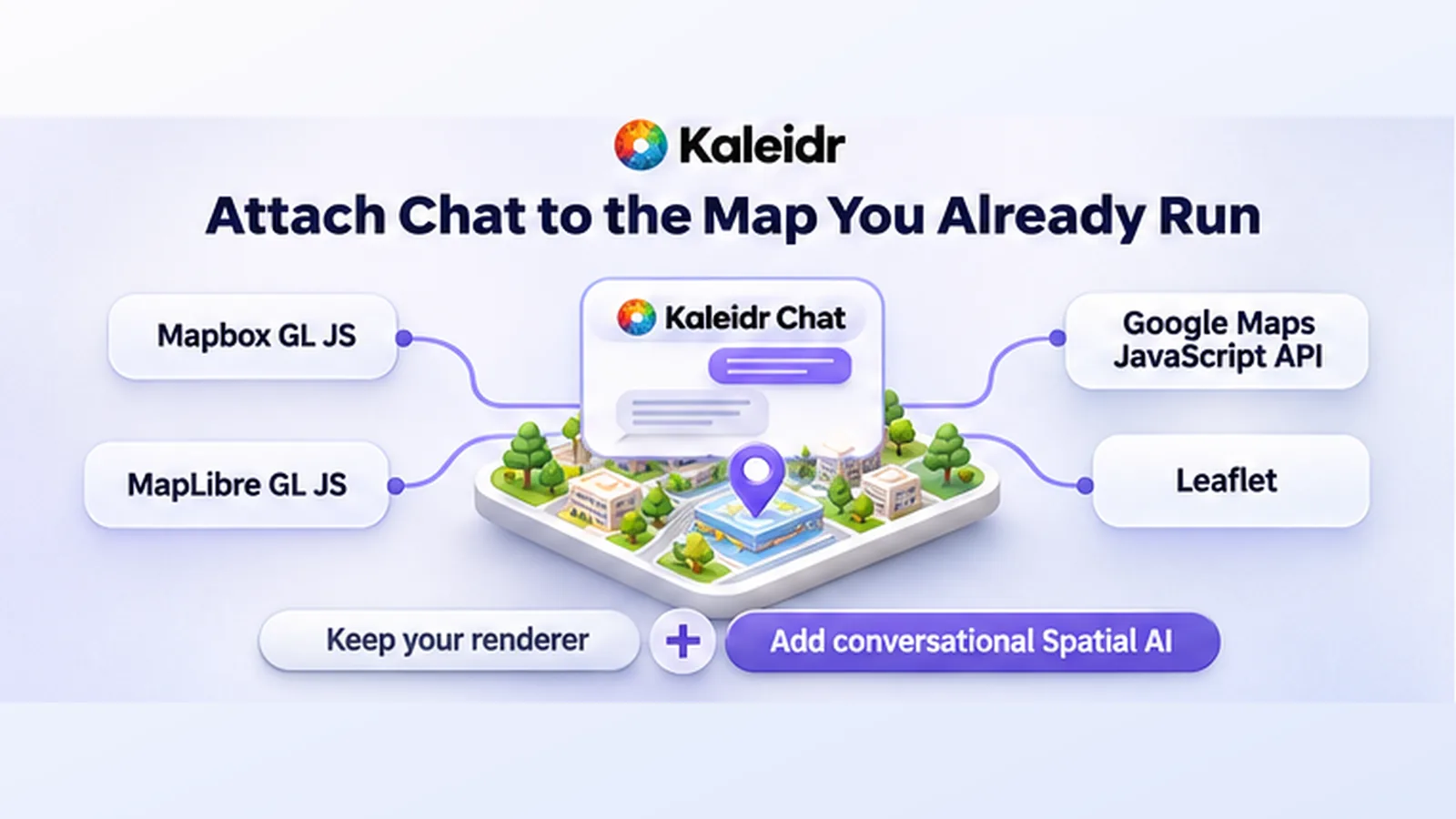
The four libraries with guides stay in place. Chat is added beside them. Apple MapKit JS and Naver Maps are recognized in the docs and are not on this figure.
Which key does each product use?
Chat on a host map, Chat without a map, Tile, and Editor use a publishable key. Viewer uses none. A publishable key can be limited to allowed origins, and the page exchanges it for a short-lived session bound to the product and the origin. A server key stays on the backend and is refused when a request looks like it came from a browser.
The chat panel sends the conversation, a random id for that conversation, the map's zoom level, and a language tag. The panel does not send the host map's layers, sources, or markers, or the area the map is showing. Of the camera, only the zoom level is sent. You cannot give browser Chat your own instructions or per-user permissions, Kaleidr does not know who the end user is, and there is no native SDK for iOS, Android, React Native, or Flutter (Kaleidr, 2026).
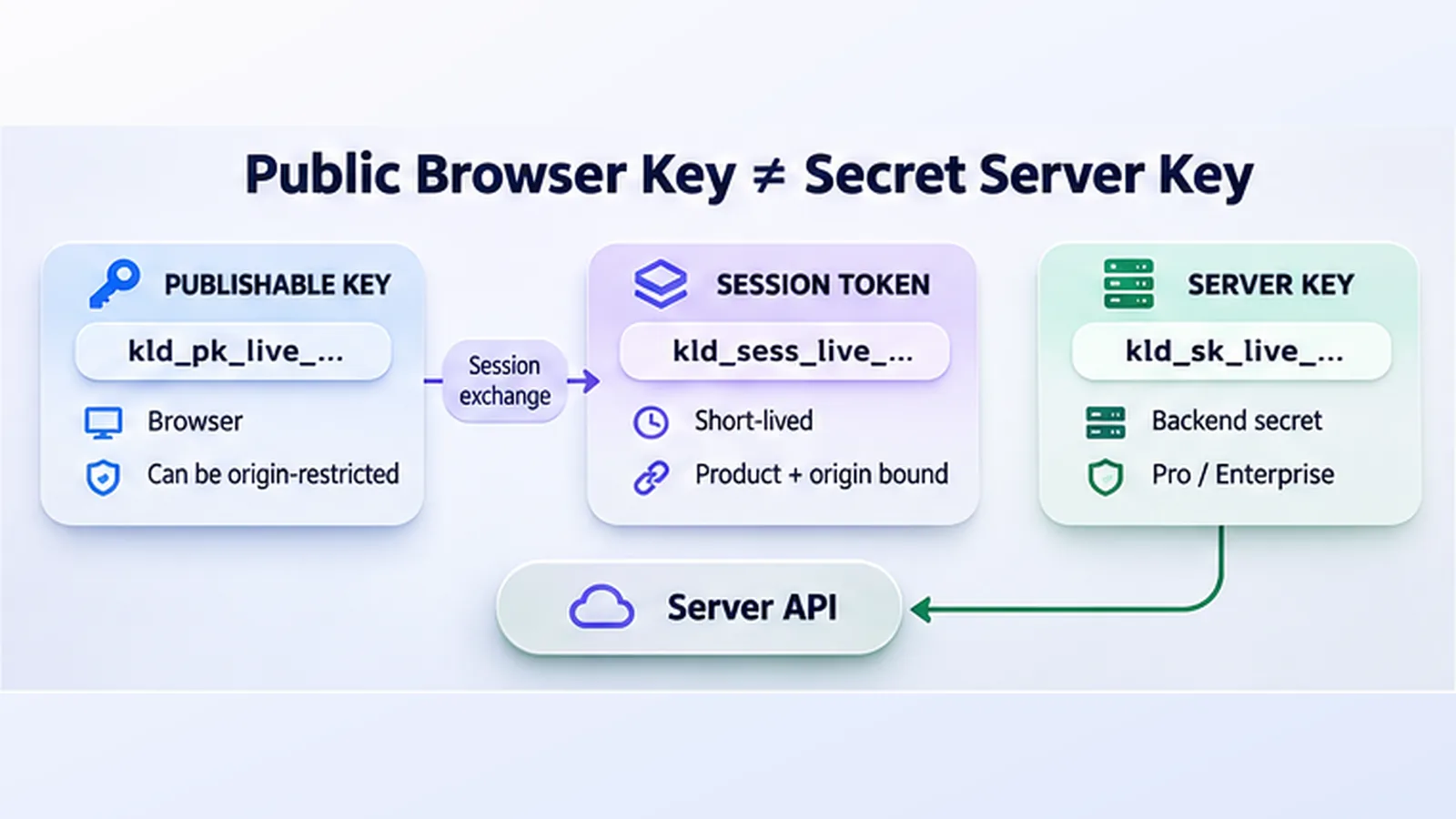
The left key is for the browser and can be limited by origin. The middle token is the short-lived session. The right key is a backend secret for Pro and Enterprise. The prefixes on the figure are formats, not live credentials.
How do your own data paths differ?
A dataset on a map is a file you add in Studio, on Free, Pro, or Enterprise. The file belongs to that map, you can draw it as a layer, and Studio's assistant can answer questions about its rows. That dataset is not read through an API key or the SDK. Business data for AI answers is a separate Enterprise upload, used to ground answers, and a published map still serves any dataset it draws, whole, with every column (Kaleidr, 2026).
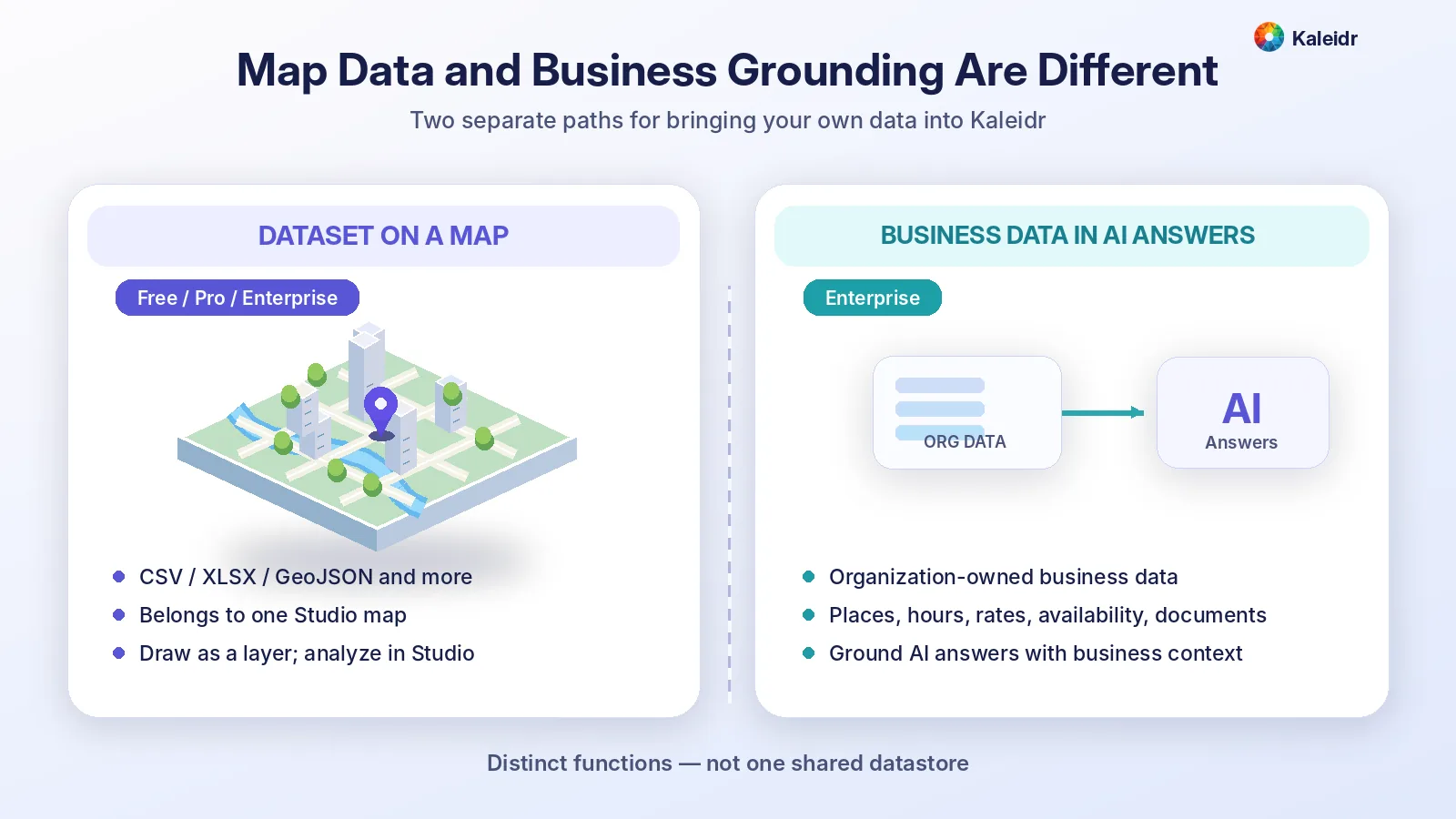
The left path is a file on one Studio map. The right path is organization business data for AI answers, and it is Enterprise only. The footer says the two are not one shared store.
What does Chat not see on a host map?
Attaching Chat does not hand Kaleidr the host application. Existing layers, markers, sources, the signed-in user, and private application state stay with the host. Chat can answer, return places, add pins, move the camera, and draw a route. Those actions are Kaleidr's own, and they are not a reading of everything already drawn on the map.
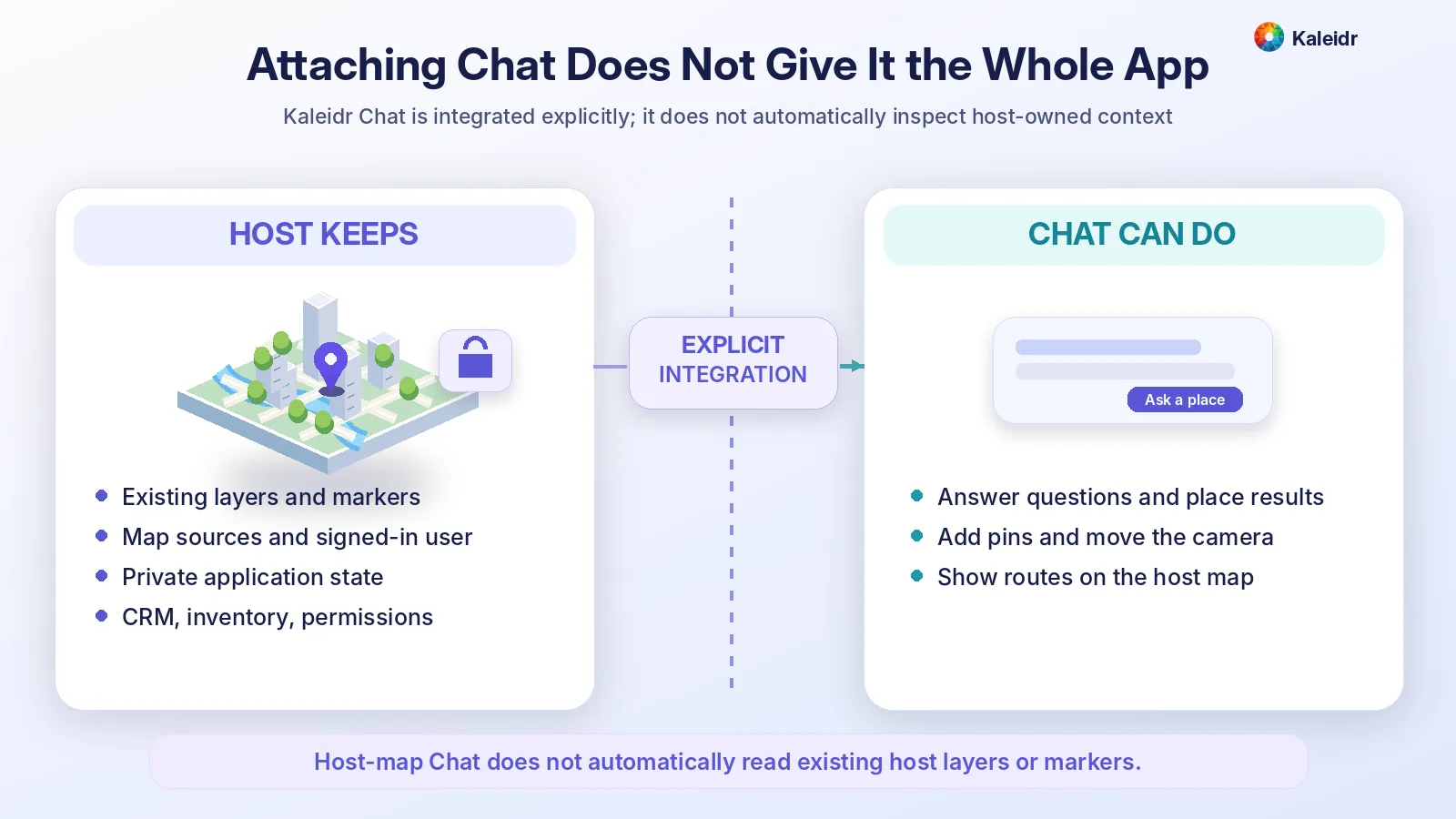
The left column is what the host keeps. The right column is what Chat can add. The footer says host-map Chat does not automatically read existing host layers or markers.
What does Kaleidr not do today?
The browser loader is not published as an npm package, and there is no native mobile SDK. Browser Chat does not automatically read host layers or markers, and it does not take a custom system prompt or per-user permissions. The embedded Editor does not save, export, or publish, and its work stays in the page's memory until the page reloads or the editor is destroyed. A map you need to keep is built in Studio (Kaleidr, 2026).
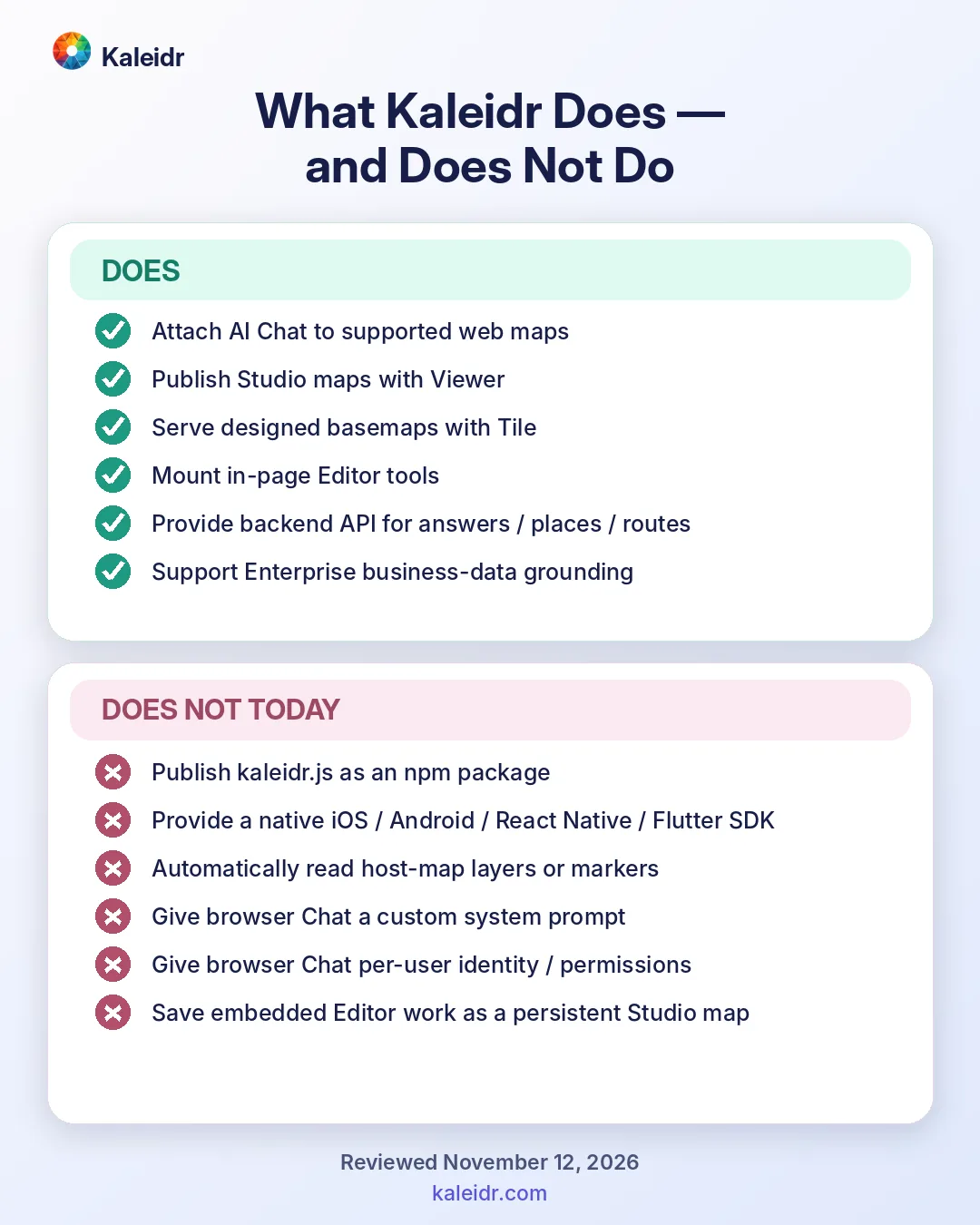
The does column matches the products in this guide. The does-not column matches the current limits: no npm package for kaleidr.js, no native mobile SDK, no automatic reading of host layers, no custom prompt, no per-user permissions, and no saved Editor map. The review date on the card is November 12, 2026.
What do the plans include?
Free is $0 a month, with 500,000 AI credits and 50,000 map loads. Pro is $29 a month, with 5,000,000 AI credits and the same 50,000 map loads. A map load is one shared-map open, one published or embedded map view, or one SDK basemap session, and tile requests are not a separate meter. Enterprise is priced by agreement, with custom usage, and Enterprise can serve tiles from an independent CDN (Kaleidr, 2026).
Start with the job, then the plan. A prototype can stay on Free, a backend moves to Pro for a server key, and private business data waits for Enterprise. Explore Kaleidr Studio when the map itself is the next piece of work.
Note: Kaleidr uses AI-assisted tools for image creation, content refinement, and research throughout its creative and development workflows.
FAQs
What is Kaleidr?
Kaleidr is a Spatial AI platform. Kaleidr AI, Studio, Analytics, and Enterprise are the platform areas. Chat, Viewer, Tile, and Editor are the four products loaded in the browser.
Is Studio the same as Editor?
No. Studio is where you author and publish a map. Editor mounts editing tools inside a host page, and that work stays in the page's memory.
Does Viewer need an API key?
No. Viewer embeds a published Studio map by its id. Chat, Tile, and Editor use a publishable key. The Server API uses a server key and starts on Pro.
Does Chat read the layers on my map?
No. Chat does not send the host map's layers, sources, or markers. Of the camera, only the zoom level is sent. Pins and routes that Chat draws are its own.
Is there a Kaleidr npm package?
No. kaleidr.js is loaded with a script tag. The Server API has no JavaScript client and no npm package.
What does Free include?
Free is $0 a month and includes 500,000 AI credits and 50,000 map loads. Pro is $29 a month, with 5,000,000 AI credits and 50,000 map loads. Enterprise usage is set by agreement.
Is there a native mobile SDK?
No. There is no SDK for iOS, Android, React Native, or Flutter. A mobile app can load a web page that uses kaleidr.js, or call Kaleidr from its own backend with a server key.
References
- Kaleidr Developer Docs. Choose your path. Which product, key, and minimum plan match each job, including Chat on Free, Viewer with no key, the Server API on Pro, and Enterprise business data. Accessed November 12, 2026. https://docs.kaleidr.com/concepts/choose-your-path
- Kaleidr Developer Docs. How Kaleidr works. One loader, four products, where each renders, publishable keys exchanged for sessions, and no npm package for the Server API. Accessed November 12, 2026. https://docs.kaleidr.com/concepts/how-kaleidr-works
- Kaleidr Developer Docs. kaleidr.js. The browser loader has no npm package, and the script tag is the only way to load it. Accessed November 12, 2026. https://docs.kaleidr.com/sdk/kaleidr-js
- Kaleidr Developer Docs. Supported maps. Guides for Mapbox GL JS, MapLibre GL JS, the Google Maps JavaScript API, and Leaflet. Apple MapKit JS and Naver Maps are recognized and have no guide. Accessed November 12, 2026. https://docs.kaleidr.com/chat/supported-maps
- Kaleidr Developer Docs. Security model. What the chat panel sends, including zoom and not the host layers, and the absence of a native mobile SDK. Accessed November 12, 2026. https://docs.kaleidr.com/security/security-model
- Kaleidr Developer Docs. Answers from your own data. Datasets on a map versus Enterprise business data for AI answers. Accessed November 12, 2026. https://docs.kaleidr.com/your-data/overview
- Kaleidr Developer Docs. Editor. In-page edits stay in the page's memory and are not saved, exported, or published. Accessed November 12, 2026. https://docs.kaleidr.com/editor
- Kaleidr. Choose Your Plan. Free at $0 with 500,000 AI credits and 50,000 map loads a month. Pro at $29 a month with 5,000,000 AI credits and 50,000 map loads. Enterprise by agreement. Accessed November 12, 2026. https://kaleidr.com/pricing
References in BibTeX
@misc{kaleidr_choose_your_path_2026,
  title  = {Choose your path},
  author = {{Kaleidr}},
  year   = {2026},
  url    = {https://docs.kaleidr.com/concepts/choose-your-path}
}

@misc{kaleidr_how_kaleidr_works_2026,
  title  = {How Kaleidr works},
  author = {{Kaleidr}},
  year   = {2026},
  url    = {https://docs.kaleidr.com/concepts/how-kaleidr-works}
}

@misc{kaleidr_js_2026,
  title  = {kaleidr.js},
  author = {{Kaleidr}},
  year   = {2026},
  url    = {https://docs.kaleidr.com/sdk/kaleidr-js}
}

@misc{kaleidr_supported_maps_2026,
  title  = {Supported maps},
  author = {{Kaleidr}},
  year   = {2026},
  url    = {https://docs.kaleidr.com/chat/supported-maps}
}

@misc{kaleidr_security_model_2026,
  title  = {Security model},
  author = {{Kaleidr}},
  year   = {2026},
  url    = {https://docs.kaleidr.com/security/security-model}
}

@misc{kaleidr_answers_from_your_own_data_2026,
  title  = {Answers from your own data},
  author = {{Kaleidr}},
  year   = {2026},
  url    = {https://docs.kaleidr.com/your-data/overview}
}

@misc{kaleidr_editor_2026,
  title  = {Editor},
  author = {{Kaleidr}},
  year   = {2026},
  url    = {https://docs.kaleidr.com/editor}
}

@misc{kaleidr_choose_your_plan_2026,
  title  = {Choose Your Plan},
  author = {{Kaleidr}},
  year   = {2026},
  url    = {https://kaleidr.com/pricing}
}