
Map load pricing is the published charge for starting one interactive web map session. At list prices checked on October 10, 2026, Kaleidr includes 50,000 map loads a month and then charges $2 per 1,000. MapTiler Flex costs $30 a month with 25,000 sessions and then $2.50 per 1,000. Mapbox charges from $5 per 1,000 after 50,000 free loads, and Google Dynamic Maps charges from $7 per 1,000 after 10,000 free loads.
The comparison covers basemap display, which is the unit the four platforms share. Kaleidr is a Spatial AI platform, and Kaleidr AI attaches to maps built on Mapbox, Google Maps, MapTiler, or MapLibre, so the platforms are often used together. At 120,000 monthly loads the published map-display cost is $140 on Kaleidr, $267.50 on MapTiler Flex, $330 on Mapbox, and $742 on Google pay-as-you-go. Google also sells subscription plans, the other vendors lower some rates as volume grows, and Kaleidr quotes volume pricing above 250,000 monthly loads. Search, routing, geocoding, place details, and conversational features sit outside this table.
Map load pricing essentials
- What is compared: Basemap display. Kaleidr's focus is Spatial AI, which can attach to maps on the other platforms.
- Comparable unit: One web map initialization or session, not one tile request.
- Included monthly volume: Kaleidr 50,000, Mapbox 50,000, MapTiler Flex 25,000 inside a $30 plan, and Google Dynamic Maps 10,000.
- First paid rate: $2.00 per 1,000 on Kaleidr, $2.50 on MapTiler Flex, $5.00 on Mapbox, and $7.00 on Google pay-as-you-go.
- At 120,000 monthly loads: $140 on Kaleidr, $267.50 on MapTiler Flex, $330 on Mapbox, and $742 on Google pay-as-you-go.
- Above 250,000 monthly loads: Kaleidr prices by quote. The other vendors keep publishing rates that fall with volume, so a buyer at that scale should compare quotes.
- Scope: A map load pays for map display. Search, routing, geocoding, place details, and conversational features are priced separately.
What Is a Map Load?
A map load is one initialization of an interactive web map, and each vendor states its own counting rule. Mapbox counts a load whenever a Mapbox GL JS Map object is initialized, states that interaction and style changes do not affect usage, and caps one session at 12 hours (Mapbox, 2026). MapTiler bills a Map Session, defined as a webpage or mobile-app load that contains a map initialization, with unlimited interaction inside the session (MapTiler, 2026). Google bills the Dynamic Maps SKU on each successful map load and states that panning, zooming, and switching map layers generate no additional loads (Google, 2026). Kaleidr counts one map load when a shared map opens, a published or embedded map is viewed, or an SDK basemap session starts (Kaleidr, 2026).
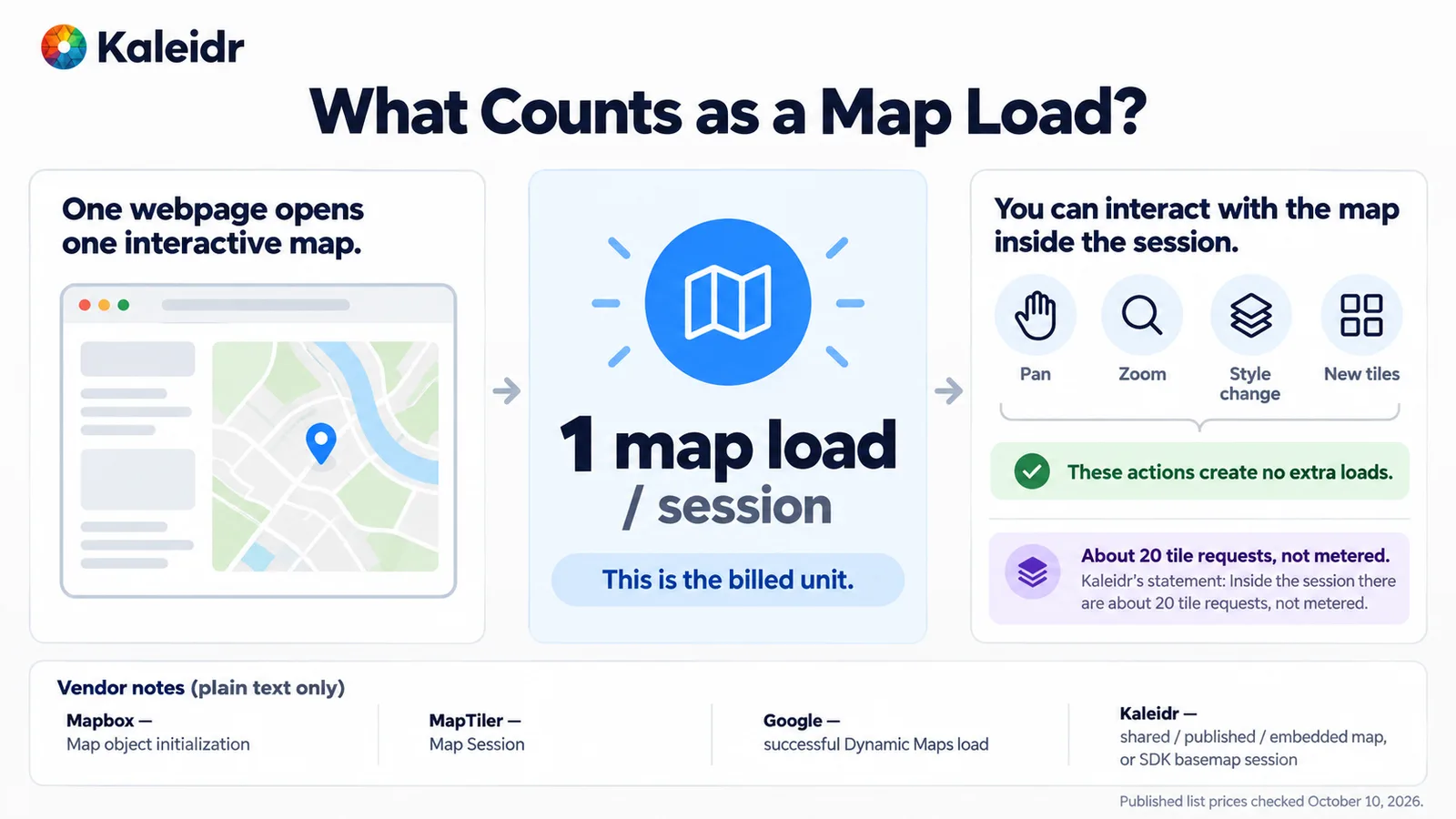
The figure separates one webpage opening one interactive map from the single billed map load, and then from pan, zoom, style changes, and new tiles inside the session. Vendor notes name Mapbox's Map object initialization, MapTiler's Map Session, Google's successful Dynamic Maps load, and Kaleidr's shared, published, embedded, or SDK session. The note of about 20 tile requests is Kaleidr's own statement, and Kaleidr does not meter those requests. The checked date on the figure is October 10, 2026.
The unit matters because billing per tile request would tie cost to how far a visitor pans and zooms. A visitor who explores a whole city would then cost more than a visitor who opens the same page and leaves. A per-load unit lets a team estimate cost from sessions that display a map. Kaleidr states that one map load covers roughly 20 tile requests and that the platform does not meter those requests separately.
The four definitions are close and still not interchangeable. Session length, mobile counting, and a second initialization on the same page differ by vendor. A migration forecast should use each vendor's billing definition together with the team's own traffic. One provider's usage export should not be multiplied across the other three without that check.
Which Platform Includes the Most Map Loads?
Kaleidr and Mapbox each include 50,000 map loads a month before usage pricing starts, which is the largest included volume in this comparison. Google Dynamic Maps includes 10,000 free loads a month on the pay-as-you-go schedule. MapTiler Flex includes 25,000 sessions inside a plan that costs $30 a month. MapTiler also offers a Free plan with 5,000 sessions a month, and the vendor describes that plan as suitable for testing, prototyping, and personal or non-commercial use.
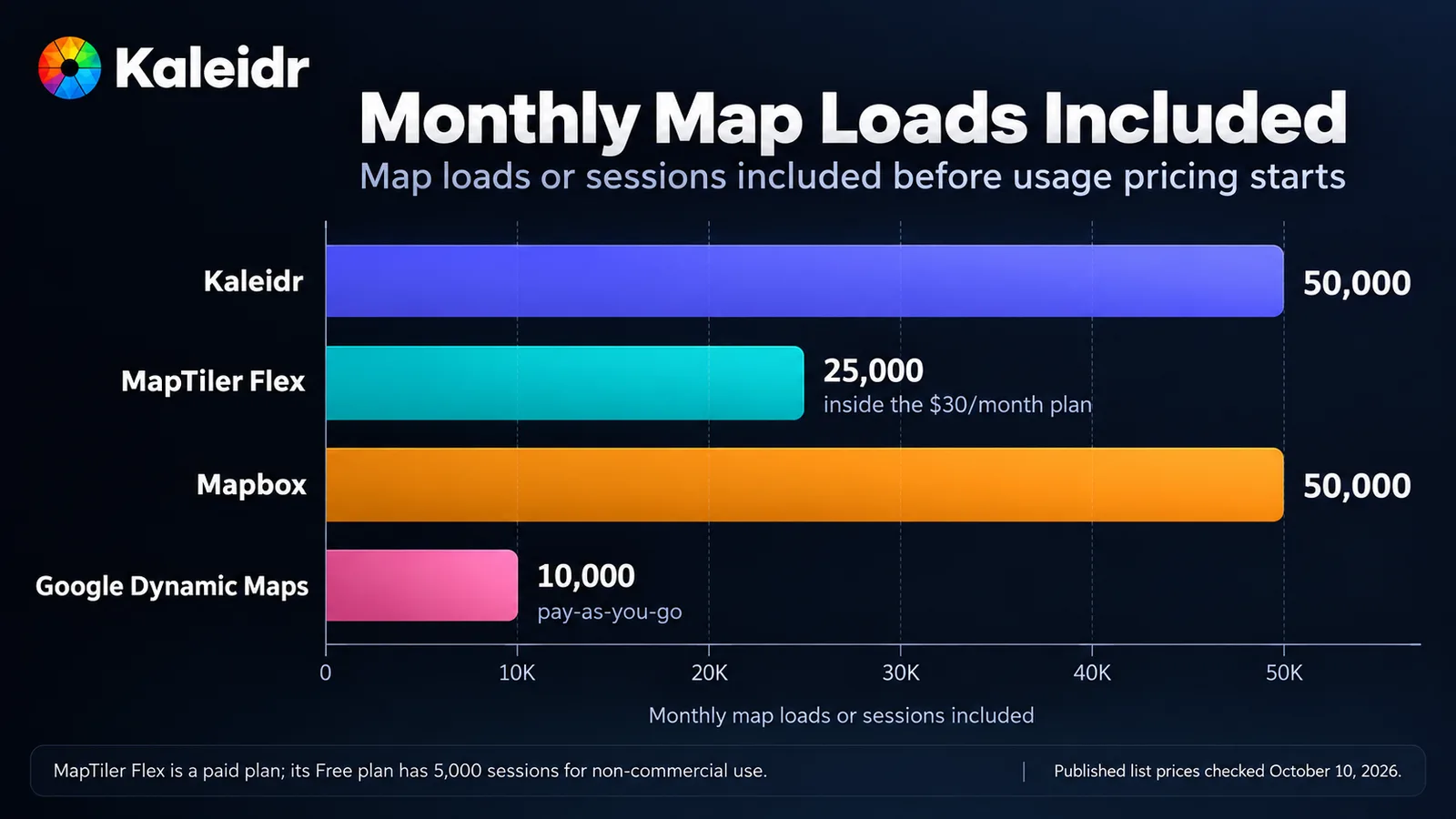
The bars show monthly map loads or sessions included before usage pricing starts. Kaleidr and Mapbox each include 50,000, MapTiler Flex includes 25,000 inside the $30 plan, and Google Dynamic Maps includes 10,000 on pay-as-you-go. The footer states that MapTiler Flex is a paid plan and that its Free plan has 5,000 sessions for non-commercial use. The prices were checked on October 10, 2026.
Included volume decides the bill for a small site. A commercial site below 10,000 monthly loads pays nothing for map display on Kaleidr, Mapbox, or Google, and pays the $30 plan fee on MapTiler Flex. Between 10,000 and 50,000 loads, Kaleidr and Mapbox remain at no map-load charge while Google bills at $7 per 1,000. Kaleidr allows commercial use on every plan within the allowance, and Free and Pro share the same monthly pool of 50,000 map loads.
The Pro plan is $29 a month and adds AI credits and developer API access. The map-display figures in this article do not add that $29, because the map-load pool is already included on the free plan. Plans differ on AI credits, API access, and features, not on the size of the map-load pool. A buyer who needs the Pro features should add that plan fee on top of any map-load packs.
How Does Map Load Pricing Compare at List Price?
The price lists differ most at the first paid tier, and the gap narrows as volume grows. The table reproduces each vendor's published price per 1,000 map loads for web maps. Mapbox prices come from the Map Loads for Web table (Mapbox, 2026). Google prices come from the Dynamic Maps row of the Maps loads list, which Google last updated on October 7, 2026 (Google, 2026). The table covers map display only and excludes search, geocoding, routing, place details, support packages, negotiated discounts, taxes, and regional price lists.
| Monthly map loads | Kaleidr (USD per 1,000) | MapTiler Flex (USD per 1,000) | Mapbox (USD per 1,000) | Google Dynamic Maps, pay-as-you-go (USD per 1,000) |
|---|---|---|---|---|
| Up to 10,000 | Included | In the $30 plan | Free | Free |
| 10,001 to 25,000 | Included | In the $30 plan | Free | 7.00 |
| 25,001 to 50,000 | Included | 2.50 | Free | 7.00 |
| 50,001 to 100,000 | 2.00 | 2.50 | 5.00 | 7.00 |
| 100,001 to 200,000 | 2.00 | 2.50 | 4.00 | 5.60 |
| 200,001 to 250,000 | 2.00 | 2.50 | 3.00 | 5.60 |
| 250,001 to 500,000 | Quote | 2.50 | 3.00 | 5.60 |
| 500,001 to 1,000,000 | Quote | 2.50 | 3.00 | 4.20 |
| 1,000,001 to 5,000,000 | Quote | 2.50 | 2.50 | 2.10 |
| Above 5,000,000 | Quote | 2.50 | Contact sales | 0.53 |
The billing models behind those rates differ in three ways. MapTiler charges a base plan fee, so a commercial site pays $30 before any overage. Mapbox and Google use graduated volume pricing, in which each rate applies only to the loads inside its band. Kaleidr sells extra capacity as prepaid Add-On packs at $2 per 1,000 loads: the account draws on a pack only after the month's allowance is spent, and unused pack loads roll over.
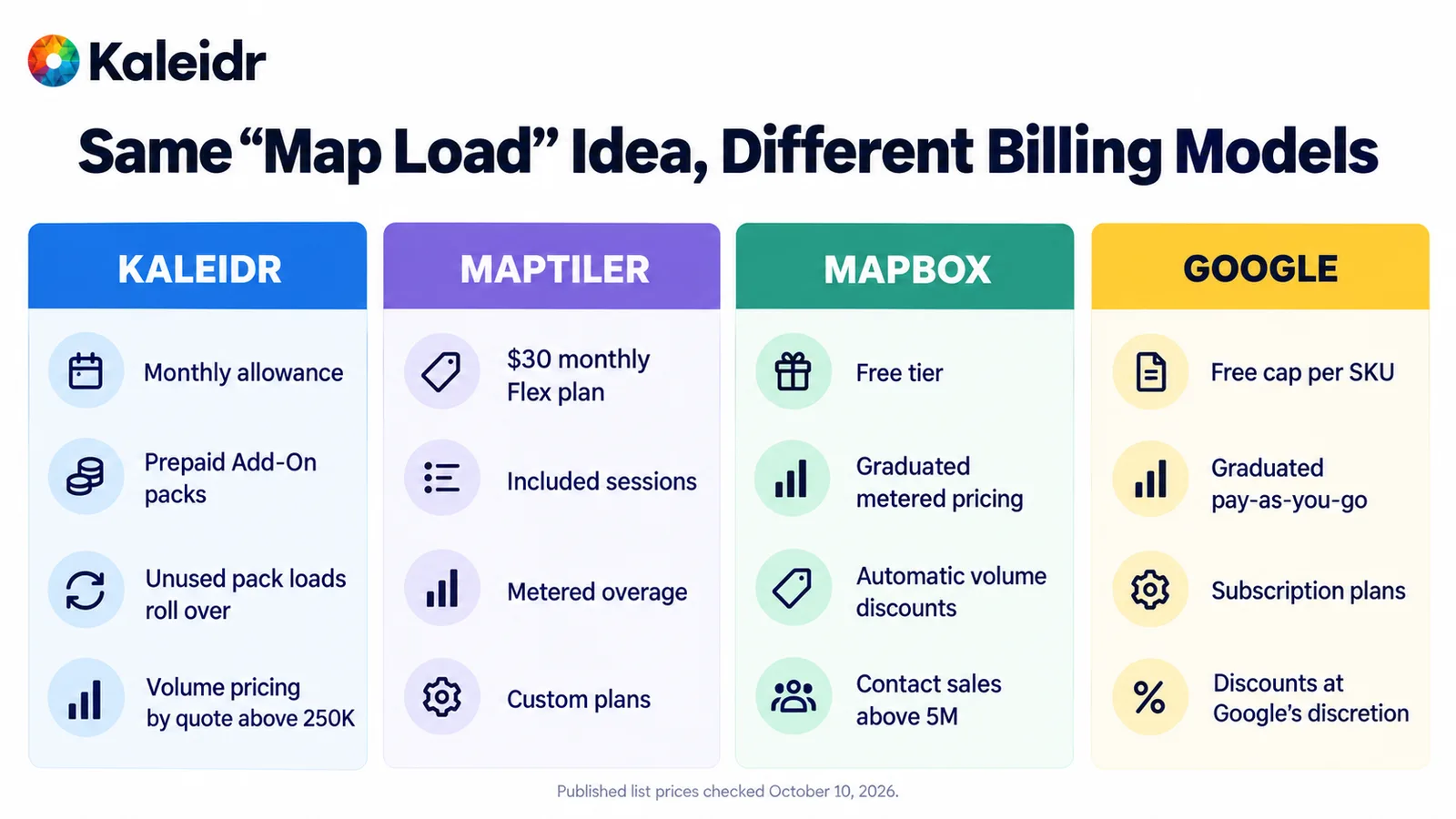
The four columns contrast a monthly allowance and prepaid Add-On packs on Kaleidr with a $30 Flex plan on MapTiler, a free tier and graduated metering on Mapbox, and a free cap plus pay-as-you-go and subscription plans on Google. Kaleidr prices by quote above 250,000 monthly loads, and Mapbox directs buyers to sales above five million. Google states that further discounts are available at its discretion. The figure was checked against published pages on October 10, 2026.
A Kaleidr account prepays for extra map-load capacity, while the other three platforms meter usage and charge after the fact. Unused Kaleidr plan loads reset each billing cycle, and unused pack loads roll over until they are used. Mapbox states that volume pricing applies automatically as usage grows and that annual commitments earn further discounts. Google states that additional discounts, when offered, are set in a signed order and are not part of the public rate card.
What Does a 120,000-Load Site Pay?
A commercial site with 120,000 interactive map loads in one month pays between $140 and $742 for map display at list price. The figures below are a calculation from the published prices, not a quote from any vendor. Each graduated rate applies only to the loads inside its band. Google's row uses pay-as-you-go pricing, not a subscription plan.
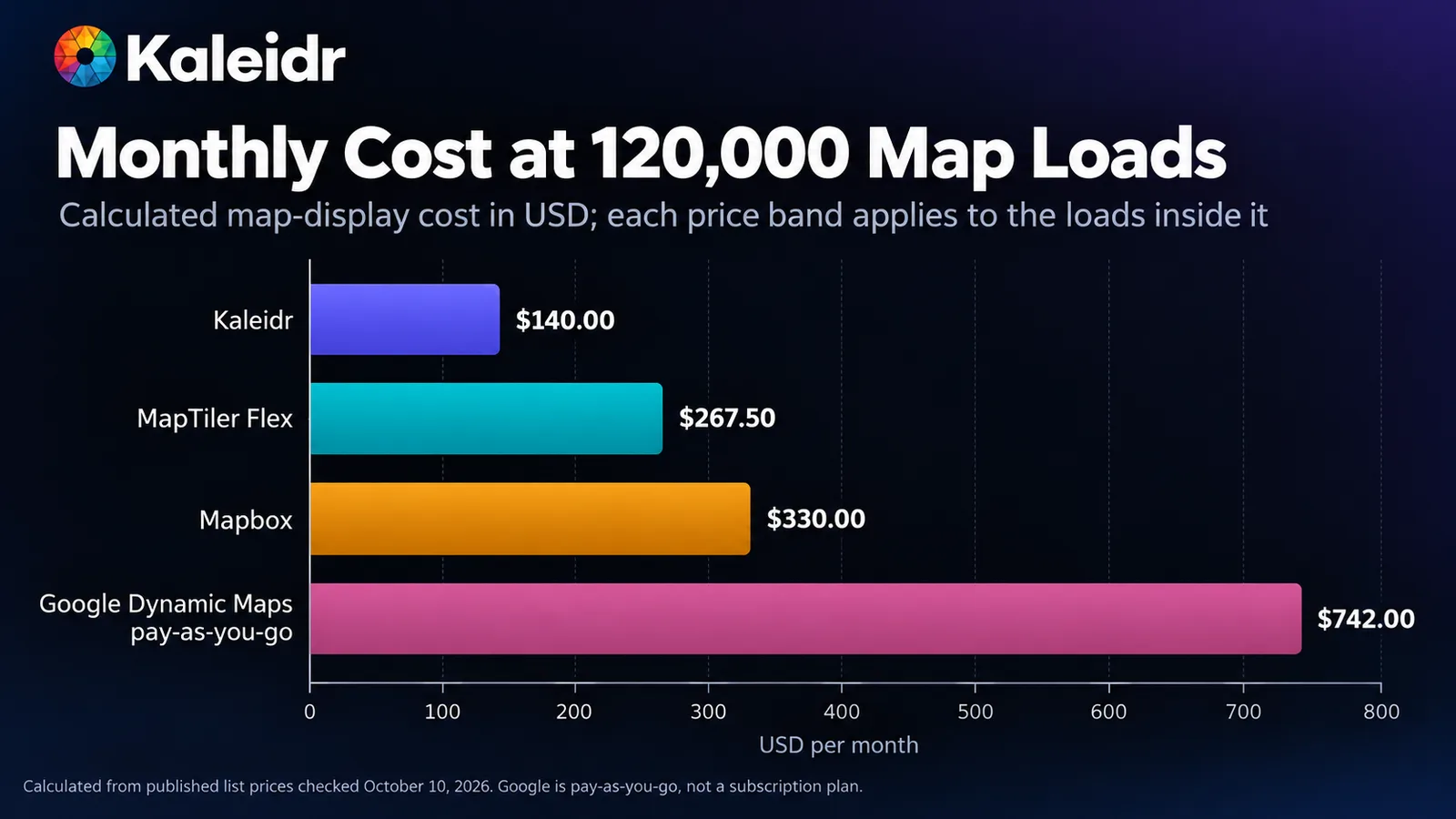
The bars show a calculated monthly map-display cost at 120,000 map loads. Kaleidr is $140, MapTiler Flex is $267.50, Mapbox is $330, and Google Dynamic Maps pay-as-you-go is $742. The axis starts at zero, and each price band applies only to the loads inside it. Google is shown on pay-as-you-go pricing, and the prices were checked on October 10, 2026.
| Platform | Included loads | Paid loads | Calculation (thousands × USD) | Monthly cost (USD) |
|---|---|---|---|---|
| Kaleidr | 50,000 | 70,000 | 70 × 2.00 | 140.00 |
| MapTiler Flex | 25,000 | 95,000 | 30.00 plan fee + 95 × 2.50 | 267.50 |
| Mapbox | 50,000 | 70,000 | 50 × 5.00 + 20 × 4.00 | 330.00 |
| Google Dynamic Maps, pay-as-you-go | 10,000 | 110,000 | 90 × 7.00 + 20 × 5.60 | 742.00 |
At that volume the Kaleidr map-display cost is about 52 percent of the MapTiler Flex cost, about 42 percent of the Mapbox cost, and about 19 percent of the Google pay-as-you-go cost. Those percentages describe one traffic level and should not be read as a general ratio, because the gap changes when traffic moves between price bands. Google's included volume explains much of its gap: Google bills 40,000 loads that Kaleidr and Mapbox include.
How Does Monthly Cost Change as Traffic Grows?
Across the range in which all four vendors publish a price, the Kaleidr basemap has the lowest calculated map-display cost at every listed volume above 50,000 monthly loads. Below that level Kaleidr and Mapbox both cost nothing for map loads. The table applies the same list prices at six traffic levels, and it stops at 250,000 monthly loads, where the Kaleidr pricing page stops quoting a pack price and shows a contact path for a discount.
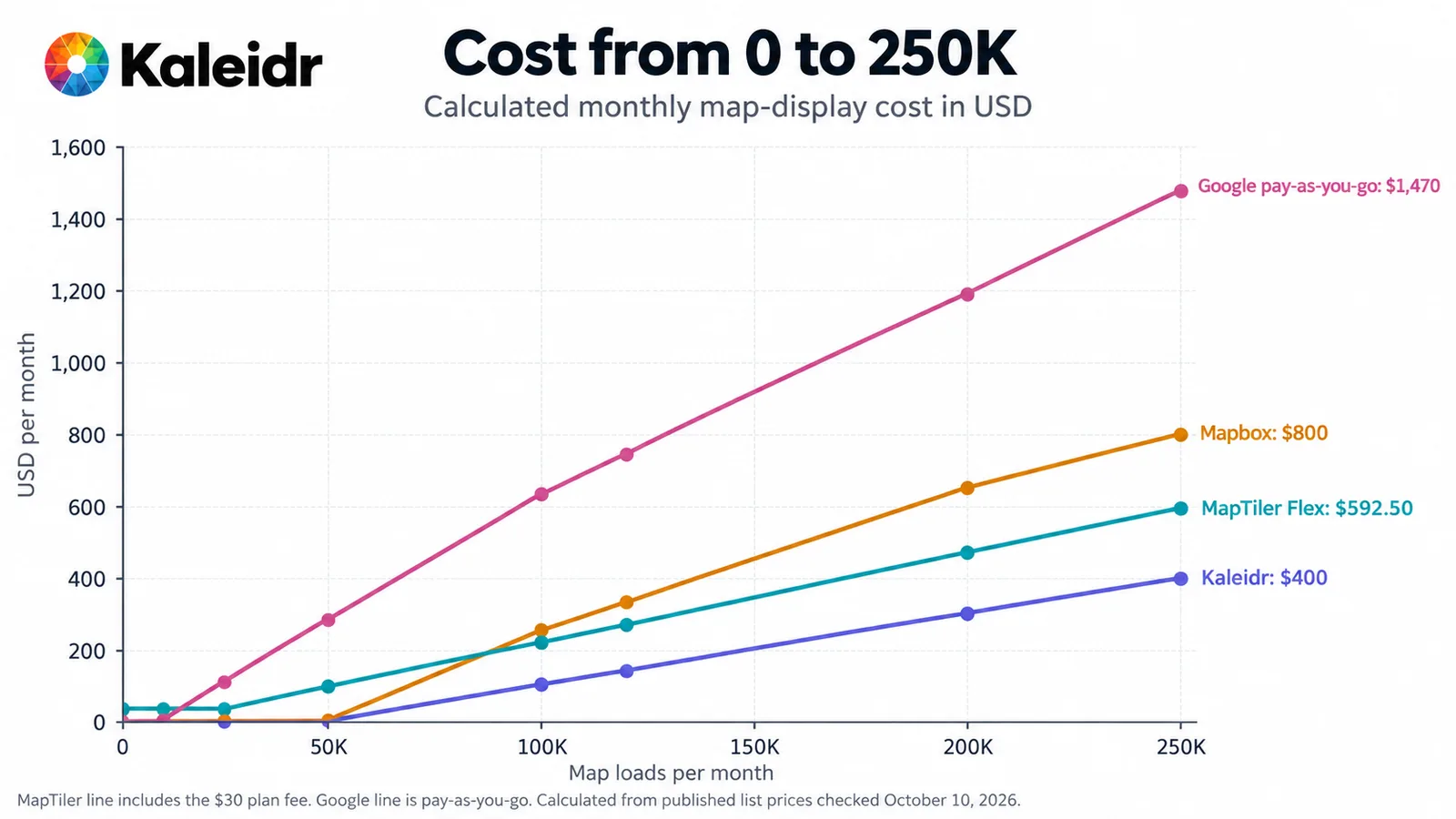
The lines show calculated monthly map-display cost from zero to 250,000 map loads. At 250,000 loads the cost is $400 on Kaleidr, $592.50 on MapTiler Flex, $800 on Mapbox, and $1,470 on Google pay-as-you-go. The MapTiler line includes the $30 plan fee, and the Google line uses pay-as-you-go pricing. No Kaleidr price is drawn past 250,000 monthly loads, and the prices were checked on October 10, 2026.
| Monthly map loads | Kaleidr (USD) | MapTiler Flex (USD) | Mapbox (USD) | Google Dynamic Maps, pay-as-you-go (USD) |
|---|---|---|---|---|
| 25,000 | 0.00 | 30.00 | 0.00 | 105.00 |
| 50,000 | 0.00 | 92.50 | 0.00 | 280.00 |
| 100,000 | 100.00 | 217.50 | 250.00 | 630.00 |
| 120,000 | 140.00 | 267.50 | 330.00 | 742.00 |
| 200,000 | 300.00 | 467.50 | 650.00 | 1,190.00 |
| 250,000 | 400.00 | 592.50 | 800.00 | 1,470.00 |
Two readings of a price table lead to different conclusions. The marginal rate is the price of the next 1,000 loads, and the cumulative cost is the whole monthly bill. A vendor can show a lower marginal rate in a high band and still produce a higher bill, because the earlier loads were charged at higher bands. Budget planning should use cumulative cost, and the marginal rate should inform only how the next block of traffic will be priced.
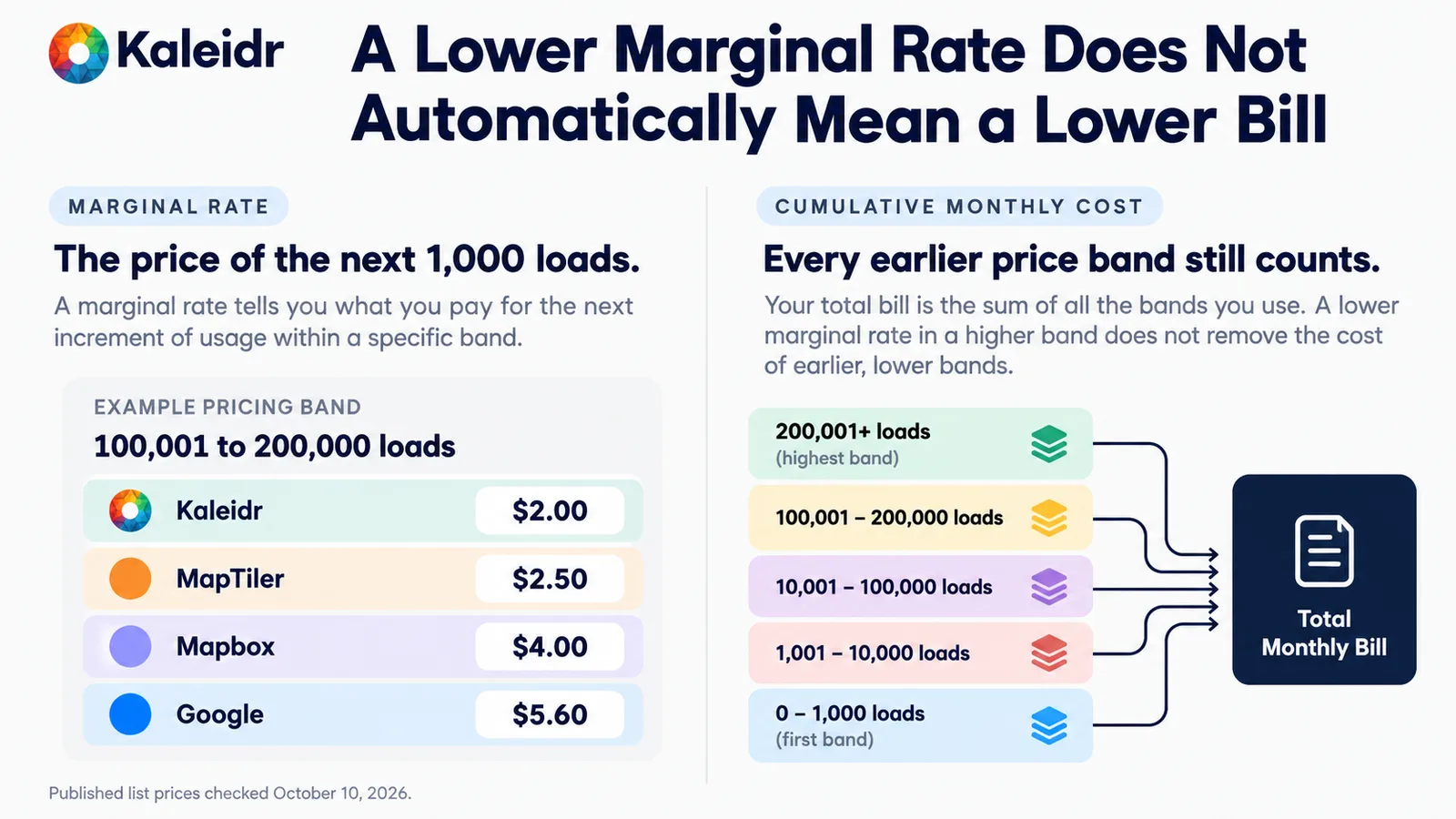
The left panel lists the published rate for the next 1,000 loads in the 100,001 to 200,000 band: $2.00 on Kaleidr, $2.50 on MapTiler, $4.00 on Mapbox, and $5.60 on Google pay-as-you-go. The right panel is a schematic of earlier bands adding into one bill, and those schematic edges are not a vendor price table. A lower rate in a later band does not erase the cost of the earlier bands. The published rates on the left were checked on October 10, 2026.
Does a Google Subscription Change the Comparison?
Google's pay-as-you-go schedule is not its only public price, and a Google buyer should calculate both paths. Google Maps Platform lists three subscription plans: Starter at $100 a month for 50,000 calls, Essentials at $275 for 100,000 calls, and Pro at $1,200 for 250,000 calls (Google, 2026). Each plan pools its calls across Maps, Routes, Places, and Environment products and includes Dynamic Maps. Calls beyond the plan's usage limit are charged at the pay-as-you-go rate for the tier that total monthly usage falls into. Google last updated that page on October 7, 2026.
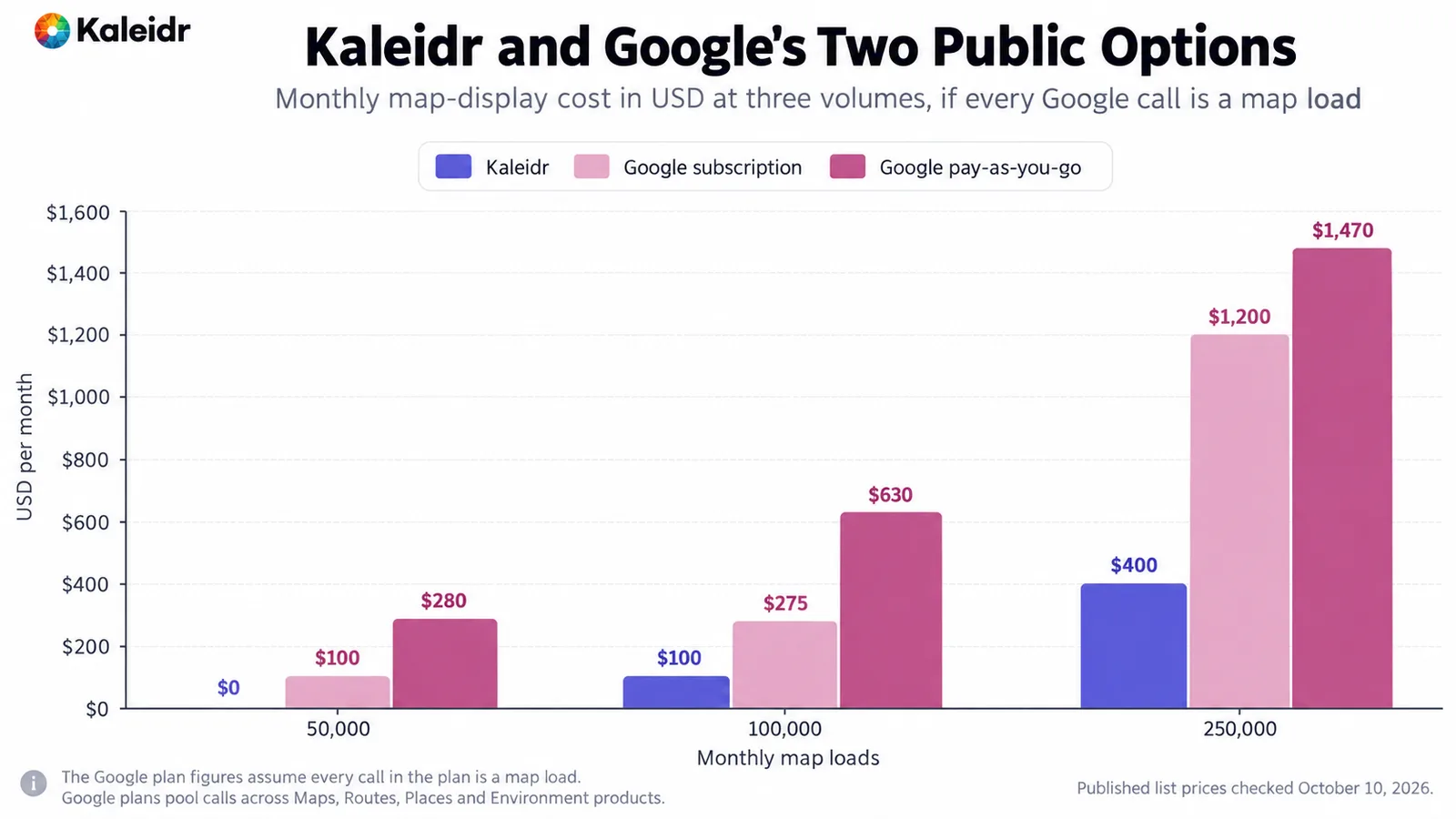
The grouped bars compare Kaleidr with a Google subscription and with Google pay-as-you-go at 50,000, 100,000, and 250,000 map loads. Kaleidr costs $0, $100, and $400. The Google plans cost $100, $275, and $1,200, and Google pay-as-you-go costs $280, $630, and $1,470. The Google plan figures assume every call in the plan is a map load, and the plans pool calls across Maps, Routes, Places, and Environment. The prices were checked on October 10, 2026.
| Monthly map loads | Kaleidr (USD) | Google subscription plan (USD) | Google pay-as-you-go (USD) |
|---|---|---|---|
| 50,000 | 0.00 | 100.00 (Starter) | 280.00 |
| 100,000 | 100.00 | 275.00 (Essentials) | 630.00 |
| 250,000 | 400.00 | 1,200.00 (Pro) | 1,470.00 |
The rows assume that every call in the Google plan is a map load. A subscription then lowers Google's map-display cost at each of those volumes, and the Kaleidr map-display cost remains lower in all three rows. The comparison is still incomplete for a buyer who needs routing, places, or other bundled services, because that buyer receives more from the plan than a map-load table can show. A unit-price comparison is most useful when the commercial models are comparable, and a bundle should be compared against the full workload.
What Happens Above 250,000 Monthly Loads?
Above 250,000 monthly loads the Kaleidr pricing page stops quoting a pack price and directs the buyer to sales for volume pricing, so the public tables no longer describe every vendor. The other three vendors continue to publish rates. Mapbox lists $3.00 per 1,000 from 200,001 through 1,000,000 loads and $2.50 from 1,000,001 through 5,000,000, and then contact sales. MapTiler keeps the Flex rate of $2.50 and offers Custom plans with volume discounts through sales. Google's published Dynamic Maps rate is $4.20 per 1,000 from 500,001 through 1,000,000, $2.10 from 1,000,001 through 5,000,000, and $0.53 above 5,000,000.
A buyer at that scale should request quotes rather than extend any public rate past the page that publishes it. Google's published rate above five million loads is well below Kaleidr's $2 pack rate, and that lower rate applies only to loads above the threshold while the earlier bands still count toward the bill. Kaleidr Enterprise prices custom volumes and can run those volumes on an independent CDN. The larger the deployment, the more the quote matters relative to the public table.
Where Does the Comparison Stop Being Fair?
A map-load table normalizes one visible unit, and two limits remain after volume. The first limit is scope, because a map load covers display and not the whole location product. A location experience can also use place search, autocomplete, geocoding, routing, place details, imagery, conversational answers, and analytics, and each service can carry its own unit and price. Google lists other Maps, Routes, and Places SKUs separately from Dynamic Maps, MapTiler prices search sessions beyond the plan allowance, and Mapbox prices its search products on their own tables.
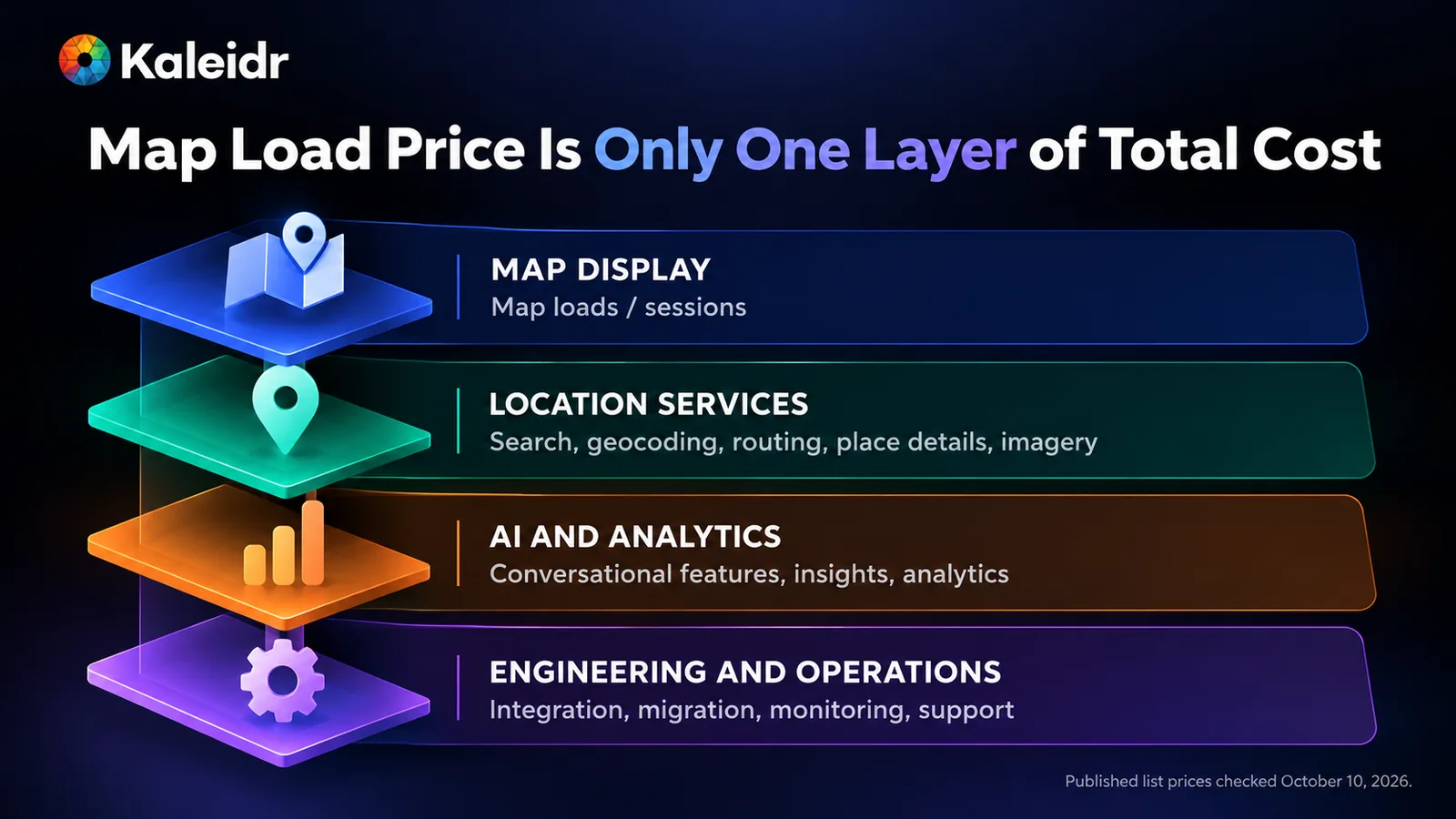
The stack places map display, measured in map loads or sessions, as the first of four cost layers. Location services cover search, geocoding, routing, place details, and imagery. AI and analytics cover conversational features, insights, and engagement analytics. Engineering and operations cover integration, migration, monitoring, and support, and the figure carries no prices.
The second limit is fit. Mapbox and Google Maps Platform offer location-service catalogs, including routing, geocoding, and mobile SDKs, that a map-load table cannot measure. MapTiler combines map hosting, styles, data processing, and search. Kaleidr combines designed maps with Spatial AI, Studio, Analytics, embedding, and developer APIs. A provider that costs more per 1,000 map loads can still be the right platform when the product depends on a capability that provider supplies.
A production estimate should therefore cover four cost layers, and the map bill is only the first.
| Cost layer | What to estimate |
|---|---|
| Map display | Map loads or sessions |
| Location services | Search, geocoding, routing, place details, imagery |
| AI and analytics | Conversational features, insights, engagement analytics |
| Engineering and operations | Integration, migration, style conversion, monitoring, support, security review |
Kaleidr bills conversational features against AI credits, while basemap loads draw on the map-load pool. The two pools are separate on the pricing page. A forecast that puts search calls, route calls, and map loads into one unlabeled total will not match any vendor's invoice.
Why Is CARTO Not in the Price Table?
CARTO publishes no price per 1,000 map loads, so the four-way table cannot include the platform. The CARTO pricing page describes a Pay As You Go option and committed enterprise tiers, and each one directs the buyer to the sales team for a price (CARTO, 2026). CARTO tracks consumption in usage units that cover map loads alongside workflow runs and analytics API calls. The product category also differs, because CARTO describes its tiers in terms of spatial analytics for business units and enterprises. A buyer whose primary job is analytical should request a CARTO quote and compare the complete workload.
How Does Kaleidr Work With These Platforms?
Kaleidr and the other three platforms are complementary more often than they are substitutes, because Kaleidr's focus is Spatial AI and Kaleidr AI is designed to attach to location tools a team already runs. A basemap price comparison therefore applies only to teams that also want Kaleidr to serve the basemap. A team can use Kaleidr basemaps and draw on the Kaleidr map-load pool. A team can instead keep an existing Mapbox, Google Maps, or MapLibre renderer and attach the conversational layer to that map. In the second architecture the existing provider continues to bill its own map usage, and the Kaleidr conversational layer spends AI credits.
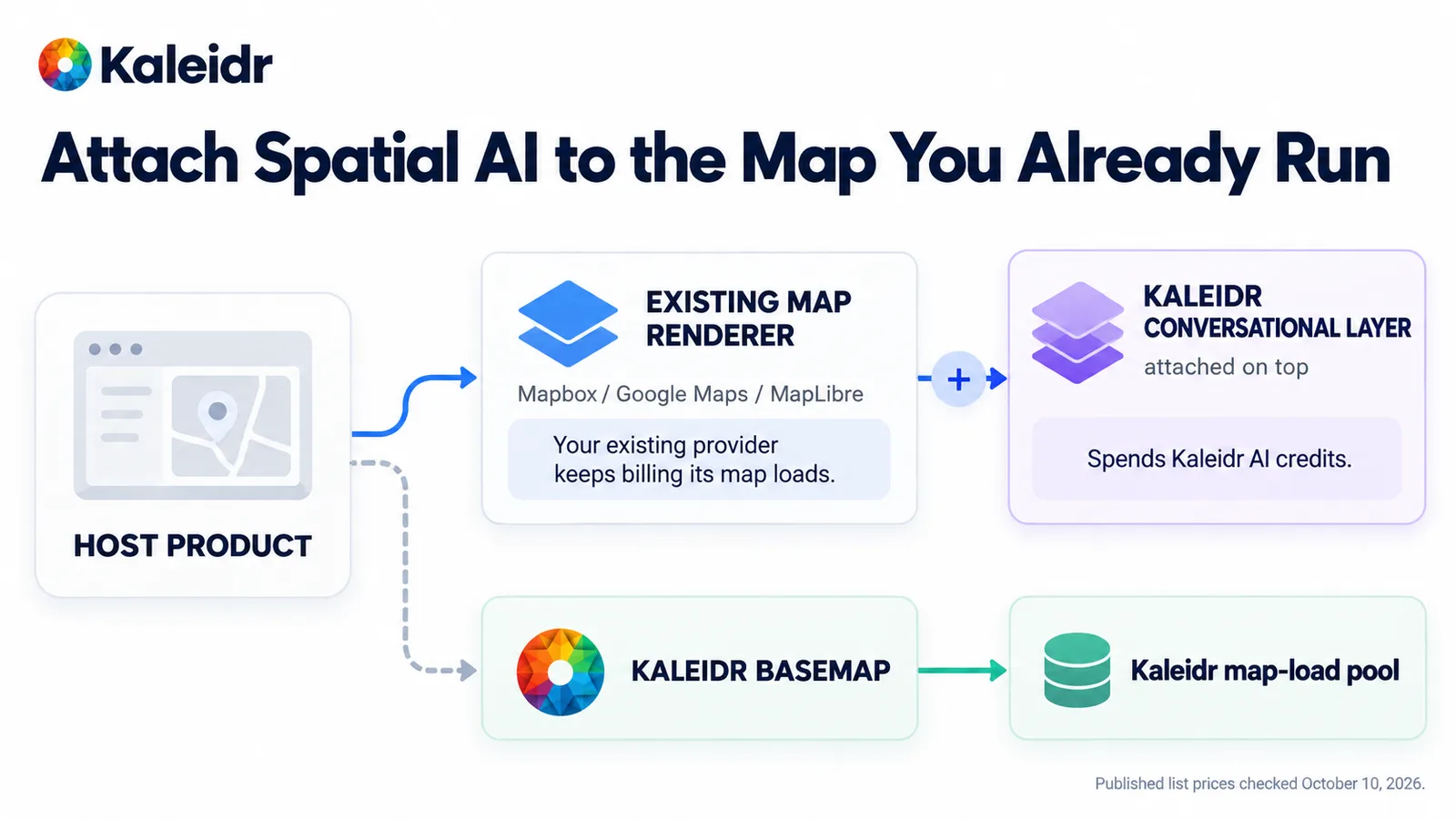
The main path keeps the host product on an existing Mapbox, Google Maps, or MapLibre renderer, and that provider keeps billing its own map loads. A Kaleidr conversational layer sits on top of that map and spends Kaleidr AI credits. A smaller path uses a Kaleidr basemap and draws on the Kaleidr map-load pool. Attaching the conversational layer does not remove the existing provider's map bill.
The useful question is which platform should perform each part of the location experience, not which platform should replace the others. The map SDK, map API, and map platform comparison covers the criteria that precede price, including authentication, data ownership, and support. Price should decide the question only after those criteria are met.
What Should a Buyer Check Before Choosing a Basemap?
A pricing table should start the analysis, and six questions complete a first pass.
- Usage: How many billable map loads does the product generate each month, and is the traffic steady or spiky?
- Map experience: Does the product need only a basemap, or also custom styles, proprietary data layers, mobile SDKs, or imagery?
- Location services: How much place search, routing, geocoding, or conversational interaction does the product perform?
- Architecture: Can the current renderer stay, and can the map, search, and analytics providers be separated?
- Commercial terms: Which usage is included, are paid tiers graduated, is overage metered or prepaid, and do unused units roll over?
- Risk: What happens when usage spikes, and can the team set a spending limit or quota?
The safest input is the current provider's billing dashboard, not a page-view count from web analytics. A single page can initialize a map more than once, and the session definition varies by vendor. One month of real traffic, priced against the tables above and against a quote, gives a better answer than any published comparison.
How Was This Comparison Made?
The comparison uses published vendor pricing and documentation checked on October 10, 2026, and the main table is intentionally narrow. The table compares the closest public unit from each vendor: Kaleidr map loads, MapTiler sessions, Mapbox GL JS map loads, and Google Dynamic Maps billable map loads. The worked examples use USD list prices and apply graduated tiers only inside each band. The examples exclude tax, negotiated discounts, regional price lists, and separately priced services, and the Google subscription plans stay in their own section.
Kaleidr figures use the public Add-On rate of $2 per 1,000 and stop at 250,000 monthly loads, where the public pack price ends. Prices change, so the current vendor page should be checked before a contract or a migration. See the current Kaleidr pricing page, and confirm MapTiler, Mapbox, and Google on the pages named in the references, before production traffic moves.
Note: Kaleidr uses AI-assisted tools for image creation, content refinement, and research throughout its creative and development workflows.
FAQs
What is a map load?
A map load is one initialization of an interactive map on a webpage or web application. Mapbox states that interaction and style changes do not add a further load and caps a session at 12 hours. MapTiler allows unlimited interaction inside a Map Session. Google states that panning, zooming, and switching map layers add no further Dynamic Maps loads, and Kaleidr does not meter individual tile requests inside a map load.
Which map platform includes the most free map loads?
Kaleidr and Mapbox each include 50,000 web map loads a month. MapTiler Flex includes 25,000 sessions inside a $30 monthly plan, and Google Dynamic Maps includes 10,000 free loads a month on pay-as-you-go pricing. MapTiler's Free plan includes 5,000 sessions and is described for testing, personal, or non-commercial use.
How does Kaleidr's map-load price compare with Mapbox's?
At list prices checked on October 10, 2026, both platforms include 50,000 monthly loads. Beyond that, Kaleidr charges $2 per 1,000, and Mapbox publishes $5, $4, and $3 per 1,000 across the volumes at which Kaleidr publishes a pack price. Above 250,000 monthly loads Kaleidr prices by quote, so the public comparison ends there. A team can also keep a Mapbox map and attach Kaleidr AI to it.
How does Kaleidr's map-load price compare with Google Maps Platform's?
At list prices up to 250,000 monthly loads, the Kaleidr basemap costs less than Google pay-as-you-go and less than the Google subscription plan that covers the same volume, if every call in that plan is a map load. Google's published pay-as-you-go rate falls to $0.53 per 1,000 above five million monthly loads, and Kaleidr prices by quote above 250,000, so a large deployment should compare quotes. A team can also keep a Google map and attach Kaleidr AI to it.
How does Kaleidr's map-load price compare with MapTiler's?
MapTiler Flex costs $30 a month, includes 25,000 sessions, and charges $2.50 per 1,000 beyond that. Kaleidr includes 50,000 map loads a month and charges $2 per 1,000 beyond that. The comparison applies to map display for a commercial site, and MapTiler's Free plan is not the commercial comparison.
Does Google Maps Platform have subscription pricing?
Yes. Google lists Starter, Essentials, and Pro plans at $100, $275, and $1,200 a month for 50,000, 100,000, and 250,000 combined calls. The plans pool calls across Maps, Routes, Places, and Environment. Calls beyond the usage limit are charged at the pay-as-you-go rate for the tier that total monthly usage falls into.
Do unused Kaleidr map loads roll over?
The monthly plan allowance resets each billing cycle. Loads bought as Add-On packs roll over until used, and the account draws on a pack only after the month's allowance is spent. Add-On packs do not change the plan.
Does a map load include place search?
No. A map load covers map display, including the labels drawn on the basemap. Search, autocomplete, place details, geocoding, and routing use separate pricing units on MapTiler, Mapbox, and Google Maps Platform. Conversational features spend AI credits on Kaleidr, and those credits are a separate pool from map loads.
Does Kaleidr replace Mapbox, Google Maps, or MapTiler?
Not necessarily. Kaleidr is a Spatial AI platform, and Kaleidr AI attaches to a map built on any of those platforms. The price comparison in this article applies only to a team that also chooses Kaleidr for the basemap.
Should a team change basemap providers to reduce map-load price?
Not on price alone. The saving should be weighed against migration cost, required SDKs, search and routing usage, styling, and engineering effort. A team whose renderer already works can keep the renderer and add another platform for a specialized capability.
References
- Mapbox. Map loads. Mapbox Help glossary. Defines a map load as the initialization of a Mapbox GL JS Map object, states that interaction and style changes do not affect usage, and sets a 12-hour maximum session. Accessed October 10, 2026. https://docs.mapbox.com/help/glossary/map-loads/
- MapTiler. Flexible pricing for maps, data processing & storage. Free, Flex, and Custom plans; included sessions, extra-usage rates, and the Map Session definition. Accessed October 10, 2026. https://www.maptiler.com/cloud/pricing/
- Google. Google Maps Platform API usage details. Dynamic Maps billable event and the statement that panning, zooming, and switching map layers add no loads. Accessed October 10, 2026. https://developers.google.com/maps/billing-and-pricing/sku-details
- Kaleidr. Pricing and Plans. Map-load allowance and definition, Add-On packs, and Enterprise options. Accessed October 10, 2026. https://kaleidr.com/pricing
- Mapbox. Mapbox pricing. Map Loads for Web volume pricing, automatic volume pricing, and commitment savings. Accessed October 10, 2026. https://www.mapbox.com/pricing
- Google. Google Maps Platform core services pricing list. Dynamic Maps free usage and graduated pay-as-you-go pricing; last updated October 7, 2026. Accessed October 10, 2026. https://developers.google.com/maps/billing-and-pricing/pricing
- Google. Google Maps Platform Subscriptions. Starter, Essentials, and Pro monthly plans, included calls, and overage terms; last updated October 7, 2026. Accessed October 10, 2026. https://developers.google.com/maps/billing-and-pricing/subscriptions
- CARTO. Pricing. Pay As You Go and committed tiers, each priced on request, and the usage-unit model. Accessed October 10, 2026. https://carto.com/pricing/
- Kaleidr. How to Add AI Chat to a Map. Attaching a conversational layer to a Mapbox, Google Maps, or MapLibre map without replacing the renderer. Accessed October 10, 2026. https://kaleidr.com/blog/add-ai-chat-mapbox-google-maps-maplibre
- Kaleidr. Map SDK vs. Map API vs. Map Platform. Architecture and buying criteria beyond price. Accessed October 10, 2026. https://kaleidr.com/blog/map-sdk-vs-map-api-vs-map-platform
@misc{mapbox_map_loads_2026,
  title  = {Map loads},
  author = {{Mapbox}},
  year   = {2026},
  url    = {https://docs.mapbox.com/help/glossary/map-loads/}
}

@misc{maptiler_pricing_2026,
  title  = {Flexible pricing for maps, data processing \& storage},
  author = {{MapTiler}},
  year   = {2026},
  url    = {https://www.maptiler.com/cloud/pricing/}
}

@misc{google_maps_sku_details_2026,
  title  = {Google Maps Platform API usage details},
  author = {{Google}},
  year   = {2026},
  url    = {https://developers.google.com/maps/billing-and-pricing/sku-details}
}

@misc{kaleidr_pricing_2026,
  title  = {Pricing and Plans},
  author = {{Kaleidr}},
  year   = {2026},
  url    = {https://kaleidr.com/pricing}
}

@misc{mapbox_pricing_2026,
  title  = {Mapbox pricing},
  author = {{Mapbox}},
  year   = {2026},
  url    = {https://www.mapbox.com/pricing}
}

@misc{google_maps_pricing_2026,
  title  = {Google Maps Platform core services pricing list},
  author = {{Google}},
  year   = {2026},
  url    = {https://developers.google.com/maps/billing-and-pricing/pricing}
}

@misc{google_maps_subscriptions_2026,
  title  = {Google Maps Platform Subscriptions},
  author = {{Google}},
  year   = {2026},
  url    = {https://developers.google.com/maps/billing-and-pricing/subscriptions}
}

@misc{carto_pricing_2026,
  title  = {Pricing},
  author = {{CARTO}},
  year   = {2026},
  url    = {https://carto.com/pricing/}
}

@misc{kaleidr_add_ai_chat_2026,
  title  = {How to Add AI Chat to a Map},
  author = {{Kaleidr}},
  year   = {2026},
  url    = {https://kaleidr.com/blog/add-ai-chat-mapbox-google-maps-maplibre}
}

@misc{kaleidr_map_sdk_vs_api_2026,
  title  = {Map SDK vs. Map API vs. Map Platform},
  author = {{Kaleidr}},
  year   = {2026},
  url    = {https://kaleidr.com/blog/map-sdk-vs-map-api-vs-map-platform}
}