
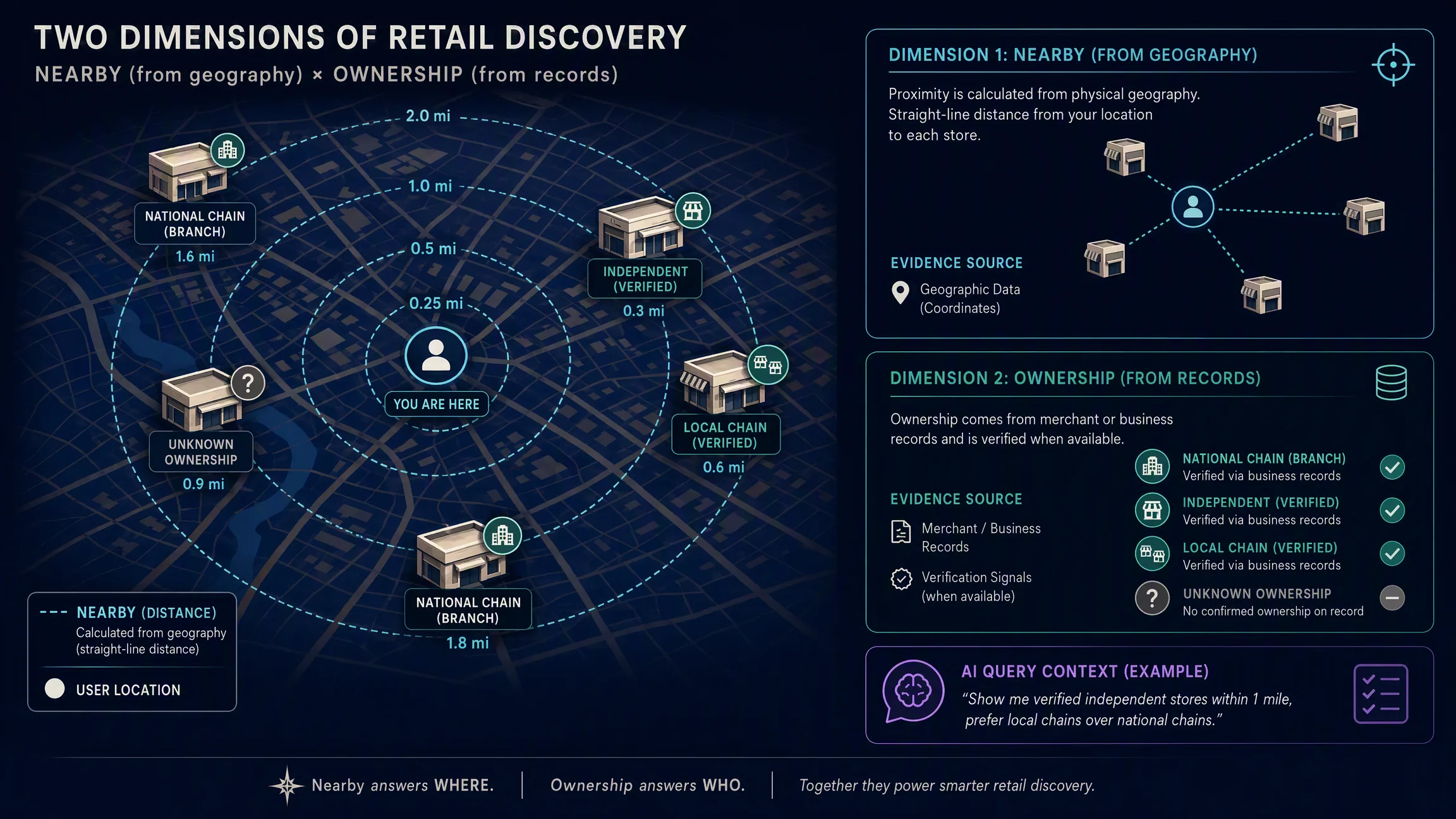
Searching for local shops near me should return more than the closest businesses on a map. A useful experience needs a clear search origin, current store records, category filters, opening hours, travel-time context, and enough information to see why a shop fits. Nearby is geographic; locally owned needs separate evidence rather than inference from place type alone.
The sections below cover taxonomy, store retrieval, ownership evidence, ranking, privacy, and merchant actions. Related product context lives on Kaleidr Spatial AI and Kaleidr Templates. For retailer-owned inventory and chat, see How to Build an AI Store Locator With Map Chat and AI-Powered Local Business Discovery.
Local-shopping essentials
- Nearby ≠ owned: Proximity is calculated; independence needs verified business evidence.
- Normalize categories: Map provider shop types into a smaller user-facing taxonomy.
- Prefer reachable: Travel time can beat straight-line distance around barriers.
- Filter before ranking: Operating status, access, and hours before relevance.
- Measure merchant actions: Directions, website, and save matter more than map loads.
What Does Local Shops Near Me Mean?
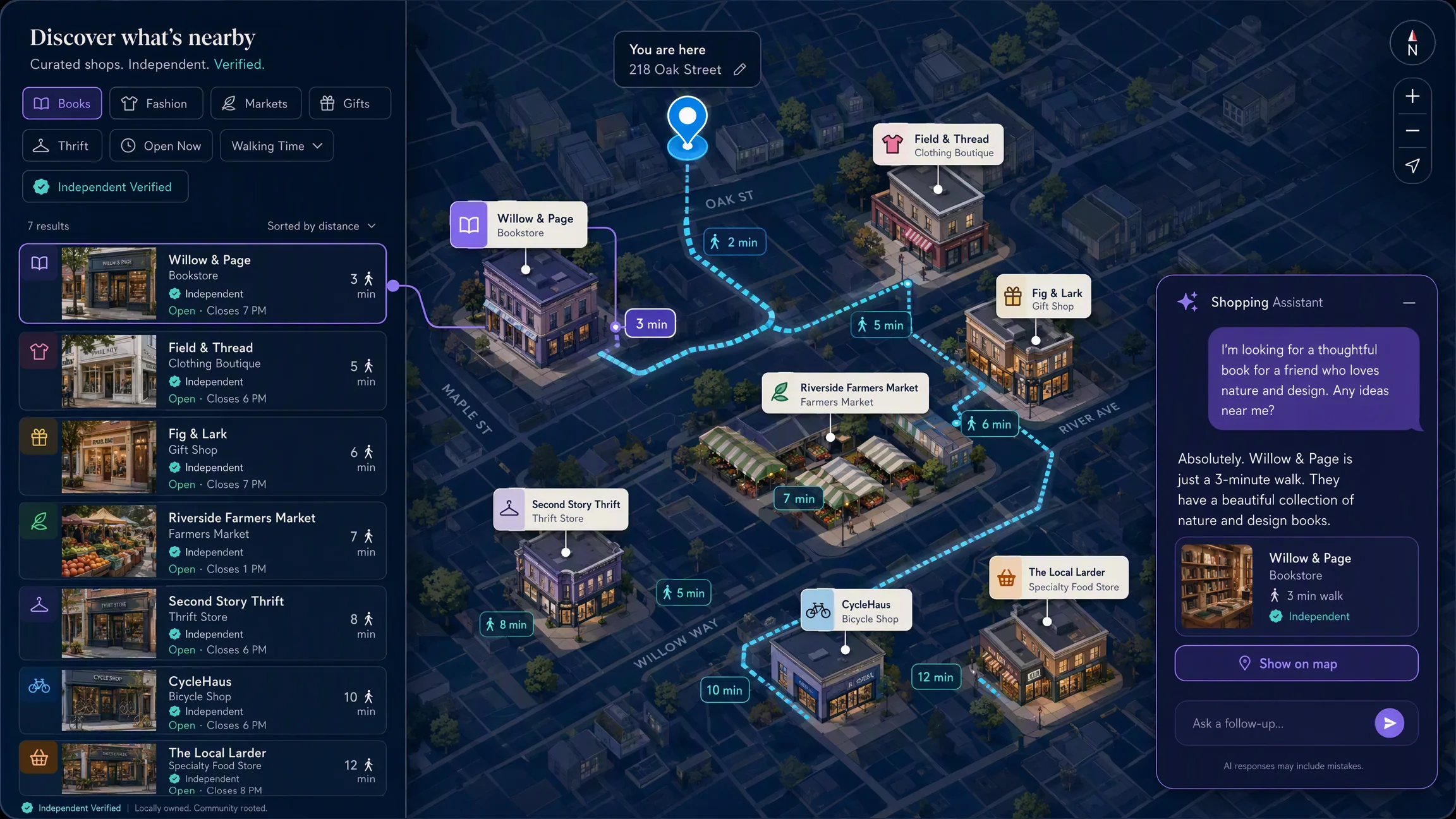
The phrase combines two separate intents: near me means stores close to a current or selected location, while local shops is often interpreted as neighborhood, independent, small, specialty, or locally owned retailers. A map can determine geographic proximity from coordinates. Place type alone usually cannot determine ownership reliably. A nearby bookstore may be an independent neighborhood shop, a regional chain, a national retailer, or a store inside a larger mall. All four are geographically local to the user; only some may be locally owned.
That distinction matters for data quality. A strong local-shopping product should use language such as Nearby shops, Independent shop when verified, Local branch, Specialty retailer, Market, or Thrift store. Avoid automatically labeling every nearby store as a “local business” or “independent.”
How Should Users Set the Search Area?
A “near me” experience needs an origin. Good interfaces support current location, a typed place, and a map-selected area. Browser geolocation can be convenient when the user explicitly requests it; ask only after a user action, explain why location improves results, handle permission denial, avoid storing exact coordinates unless needed, and provide a typed-location fallback. Users may want to search around a hotel, destination, downtown area, neighborhood, transit station, street, or postal code, and typed search also helps users who do not want to share device location. A Search this area interaction lets the user pan or zoom to a neighborhood and intentionally refresh results, which is often more predictable than querying on every camera movement.
How Do Shop Taxonomies and Nearby Search Work?
Retail data providers use different category systems. The application should normalize those systems into a smaller user-facing taxonomy spanning fashion, books and gifts, food and markets, home and hobby, and specialty retailers, then map provider-specific values into canonical categories without erasing the original source type. The JSON below is conceptual rather than a current Kaleidr schema. Google Places currently exposes many shopping types, including book_store, clothing_store, gift_shop, farmers_market, flea_market, grocery_store, market, shoe_store, thrift_store, and other retail categories (Place Types). OpenStreetMap uses the shop=* key as its primary retail classification and supports related fields such as opening_hours=*, wheelchair=*, payment:*, and delivery=* (Key:shop).
{
  "fashion": ["clothing_store", "shoe_store", "jewelry_store", "sportswear_store"],
  "books_and_gifts": ["book_store", "gift_shop", "toy_store"],
  "food_and_markets": ["farmers_market", "grocery_store", "health_food_store", "market"],
  "home_and_hobby": ["furniture_store", "garden_center", "hardware_store", "home_goods_store"],
  "specialty": ["bicycle_store", "pet_store", "tea_store", "thrift_store"]
}
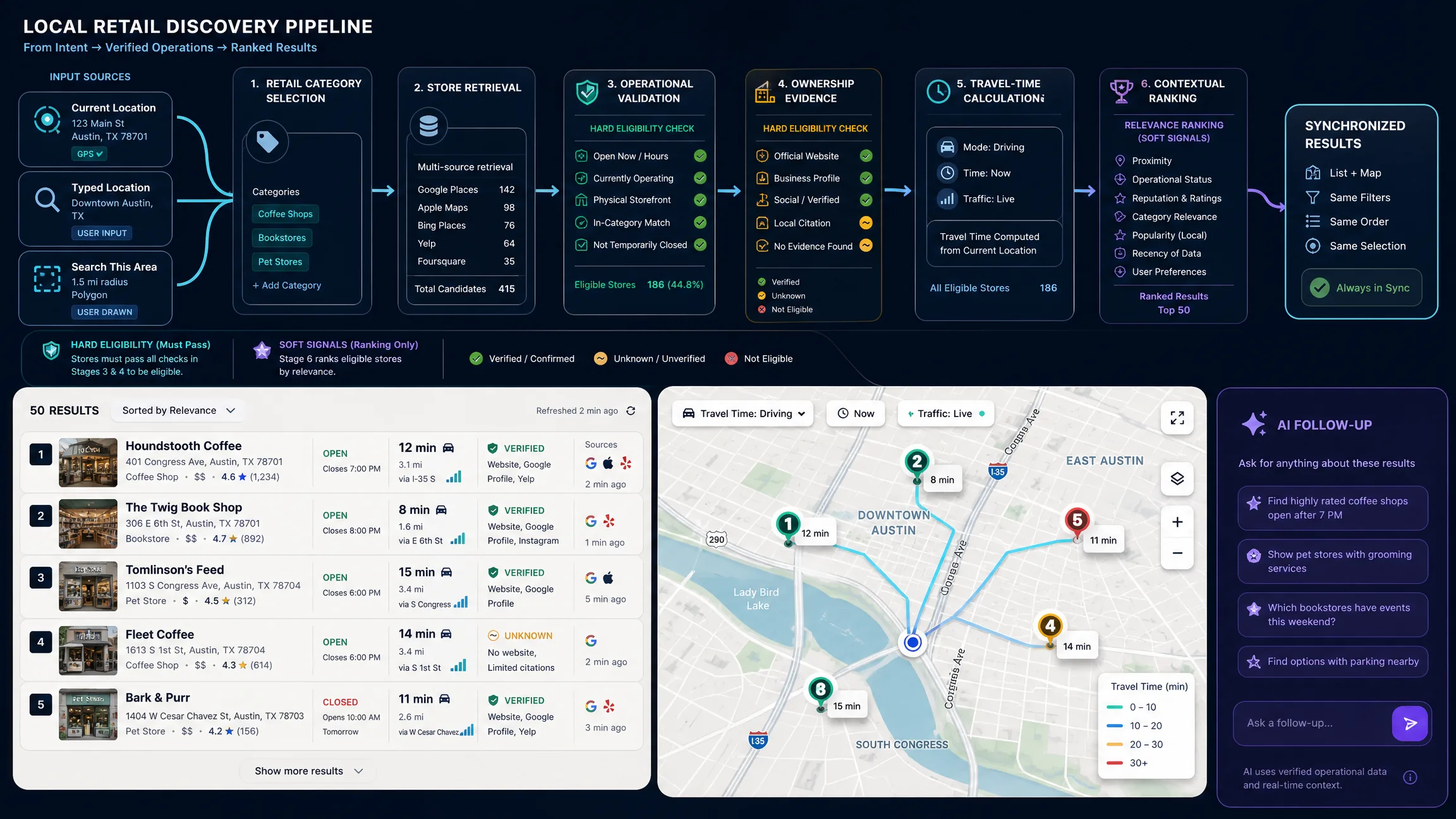
Google Places Nearby Search accepts one or more place types and a circular search restriction, requires a field mask, and can rank by popularity or distance (Nearby Search). The request answers which matching retail places exist inside the area. Nearby Search does not establish which businesses are independently or locally owned; ownership requires another verified attribute or source.
curl -X POST \
  -H "Content-Type: application/json" \
  -H "X-Goog-Api-Key: YOUR_RESTRICTED_KEY" \
  -H "X-Goog-FieldMask: places.id,places.displayName,places.location,places.formattedAddress,places.primaryType,places.currentOpeningHours" \
  -d '{
    "includedTypes": ["book_store", "clothing_store", "gift_shop", "thrift_store"],
    "maxResultCount": 20,
    "locationRestriction": {
      "circle": {
        "center": { "latitude": 38.9072, "longitude": -77.0369 },
        "radius": 3000
      }
    }
  }' \
  "https://places.googleapis.com/v1/places:searchNearby"
How Should Ownership, Reachability, and Ranking Work?
A discovery interface works better when results from one or more providers are normalized into an application-owned record with place ID, name, category, coordinates, address, opening status, ownership evidence, distance, and travel time. Useful ownership states include independent verified, local chain verified, national chain, and unknown. Do not treat unknown as independent. Do not infer independence from the business name, number of reviews, storefront photos, neighborhood location, place category, or absence from a known chain list. Better evidence can include the merchant’s own profile, verified ownership metadata, a business directory with explicit ownership information, first-party business data, or curated local-commerce records. When ownership cannot be verified, display the store without the ownership claim.
Retail discovery often benefits from travel time rather than straight-line distance. A store may be physically close but separated by a highway, river, rail corridor, large parking complex, or pedestrian barrier. Straight-line distance is a fast initial proximity estimate; walking time fits neighborhood shopping; driving or transit time fits larger or denser search areas; route distance helps when geography contains barriers. A request such as independent bookstores within a fifteen-minute walk should not be approximated by a generic multi-mile radius when routing is available.
| Signal | Use |
|---|---|
| Straight-line distance | Fast initial proximity estimate |
| Walking time | Neighborhood shopping and pedestrian discovery |
| Driving time | Larger-radius retail search |
| Transit time | Dense urban or station-based shopping |
| Route distance | Useful when geography contains barriers |
Apply hard filters first: inside requested geography, correct retail category, currently operating record, public access, and open at the requested time when required. Then rank eligible results by travel time, category match, user preferences, verified independent status when requested, opening status, accessibility attributes, and product-specific quality signals. Do not create a hidden “localness” score the product cannot explain. Prefer machine-readable reasons such as category match, walking threshold, open now, and verified independent ownership.
How Can AI, Freshness, and Interface Design Help?
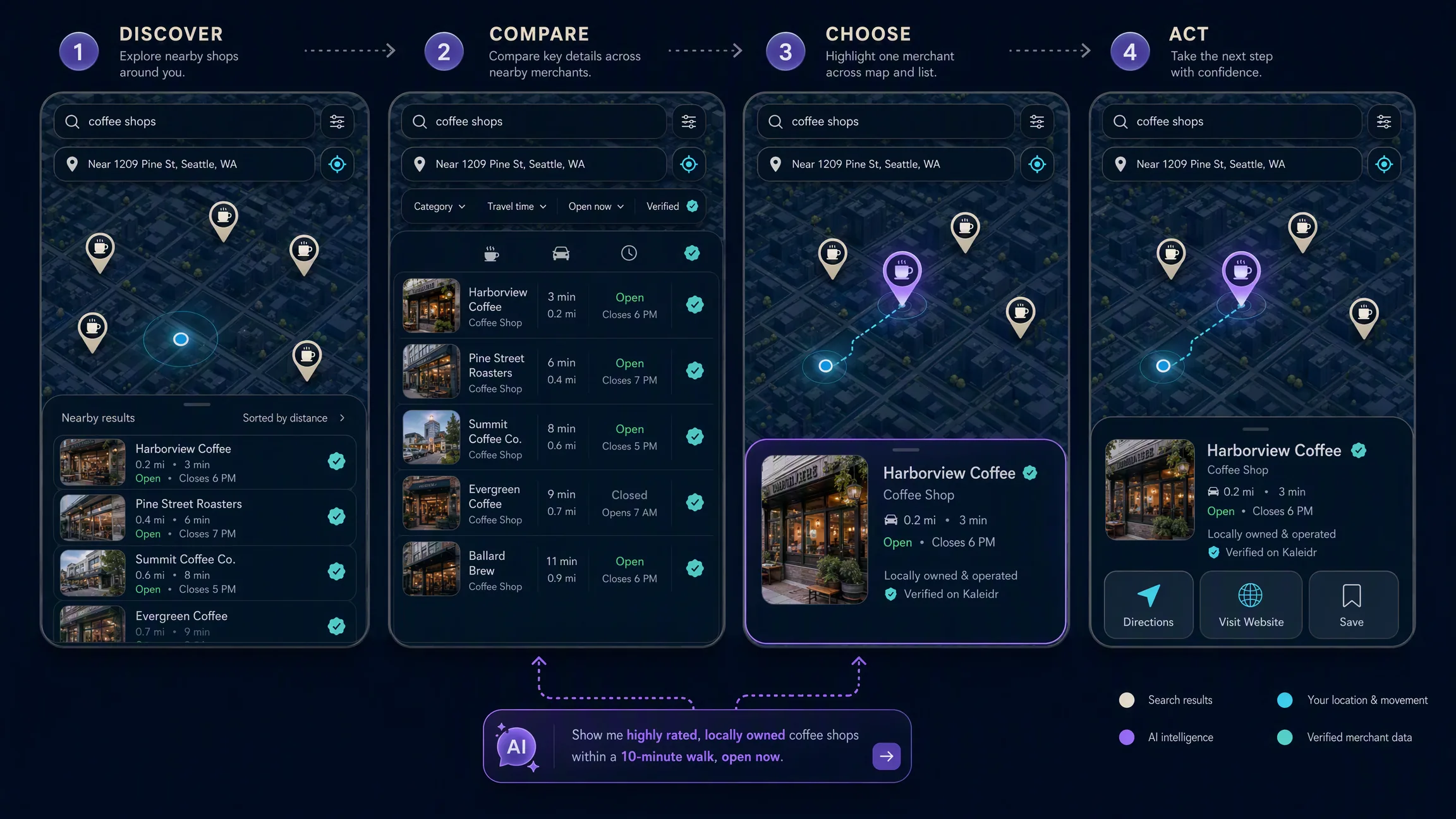
AI becomes useful when a request cannot be expressed through one category filter—independent bookstores within walking distance, thrift shops open this evening, locally made gifts near the waterfront, a bike shop near a trail, specialty food markets near a hotel, stores with wheelchair-access information, or a shopping area with variety without driving. The AI layer can interpret product intent, geography, travel mode, timing, category, ownership preference, and accessibility needs. The factual store record should still come from approved place or merchant data. Kaleidr Spatial AI supports natural-language place discovery and map-aware recommendations, and Kaleidr also publishes a retail template described as a find-a-location-near-me experience with directions, hours, and an AI chat concierge (Templates).
A result card should answer the next practical questions: business name, retail category, address, distance or travel time, open or closed status, opening hours, website, phone when appropriate, accessibility when available, delivery or pickup when relevant, ownership status only when verified, and source and freshness for important operational attributes. Do not request or display every available place field; Google Places requires a field mask and recommends requesting only what the application needs. Design the map and list as one interface so selecting a list item highlights the marker and selecting a marker focuses the matching card. Recommended controls include category, open now, walking time, independent when verified, accessibility, search this area, and sort by distance or relevance. On mobile, a bottom sheet or map/list toggle usually works better than placing a large result panel over the map.
Retail data changes constantly: shops close, move, change hours, rebrand, change categories, or alter delivery and pickup policies. OpenStreetMap distinguishes an active shop from a shop=vacant location where no store is operating (Tag:shop=vacant). Preserve provider ID, source, retrieval time, operational status, and last business update where available. Do not allow an AI-generated description to outlive the record on which it was based.
How Do Privacy, Accessibility, and Merchant Actions Fit?
A nearby-store product does not need to turn every location query into a permanent profile. Request geolocation only when the user asks, provide typed location, avoid long-term storage of exact origins by default, distinguish search context from saved preferences, disclose when location history is saved, and remove precise origin information from public shared maps unless intentionally included. A search around a hotel or home address can reveal sensitive travel or residency patterns. Provide a location text input, keyboard-accessible filters, an equivalent result list, clear store names, textual opening status, distance or travel time, visible focus, accessible action buttons, sufficient target size, non-color selection indicators, and understandable no-result states. Maps are useful spatial context; they should not become the only navigation method.
A live shop-results experience should satisfy transactional intent; an editorial guide should explain nearby versus locally owned, categories, ranking, hours, travel time, freshness, AI refinement, and privacy. Prefer one useful discovery surface over mass-produced thin city pages until live inventory and differentiated local value exist. For answer engines, say that local shops near you are retail businesses within a useful travel distance of a selected location, and that nearby can be calculated from geography while locally owned or independent should be shown only when supported by reliable data. Google’s LocalBusiness structured data can describe hours, departments, reviews, coordinates, URL, and contact information when the visible page contains the same accurate information and follows Google’s structured-data guidelines (LocalBusiness). Do not add fabricated merchant attributes simply to qualify for search features.
Which Mistakes Should Teams Avoid?
| Mistake | What happens | Recommended correction |
|---|---|---|
| Treating every nearby shop as independent | Ownership claims become inaccurate | Track ownership separately and require evidence |
| Ranking only by straight-line distance | Poorly reachable stores rank first | Use travel time where appropriate |
| Ignoring hours | Closed stores appear actionable | Preserve current opening status and freshness |
| Treating a category as inventory | Users assume a product is in stock | Separate store category from real inventory |
| Showing stale businesses | Closed or moved stores remain visible | Retain source IDs and refresh operational status |
| Requiring geolocation | Users lose privacy and planning flexibility | Support typed locations |
| Hiding results in the map canvas | Accessibility and SEO weaken | Maintain synchronized textual results |
| Using AI as business source data | Ownership or hours can be invented | Ground answers on approved records |
| Requesting every provider field | Cost and payload grow unnecessarily | Use targeted field masks |
| Creating thin city pages | Search footprint grows without useful local value | Scale only where live inventory supports the page |
Before release, make location input visible, keep browser geolocation optional, make the search area explicit, normalize retail categories, preserve provider identifiers, source opening status, keep ownership separate from proximity, leave unknown ownership unknown, use travel time when relevant, synchronize results and markers, preserve accessibility information when available, avoid treating category as inventory, ground AI responses, clarify no-result states, document location privacy, and measure shop selected, directions opened, or shop saved rather than map loads alone.
Final Verdict
The best local shops near me experience combines geographic search with trustworthy store data. Start with a location, search relevant retail categories, verify that each business is operating, use travel time where proximity alone is misleading, and distinguish nearby stores from independently owned businesses. Then use AI to interpret higher-level requests such as independent bookstores within a short walk or thrift shops open this evening.
For Kaleidr, the strategic product loop is discover shops, inspect them on the map, refine with AI, and save or visit a place. That creates a stronger acquisition path than publishing generic lists of neighborhood shops.
Explore Local Shops With Kaleidr Spatial AI
Ask contextual shopping questions and continue refining nearby results on the map. Explore Kaleidr Spatial AI to try local discovery, then review Kaleidr’s retail map template when you need locations, directions, hours, and an AI chat concierge in one starting experience.
FAQs
How do I find local shops near me?
Use a live local-discovery map, choose or enter your location, filter by retail category, and compare stores by distance, travel time, opening status, and other verified attributes.
Does “local shop” mean independently owned?
Not always. “Local” can simply mean geographically nearby. Independent or locally owned status should be treated as a separate attribute and verified rather than inferred.
What kinds of shops can a nearby-store map show?
Common categories include bookstores, clothing stores, gift shops, farmers markets, grocery stores, home-goods stores, shoe stores, thrift stores, bicycle stores, and specialty retailers.
Is the closest shop always the best result?
No. Travel time, category match, opening status, accessibility, and user preferences may make a slightly farther shop more useful.
Can I search for independent stores only?
Yes, if the data source contains reliable ownership information. The product should not infer independence from the store name, appearance, or category.
Can AI help find nearby shops?
Yes. AI is useful for multi-variable requests such as independent bookstores within walking distance that are open this evening. The underlying store identity, hours, and other facts should still come from approved place or merchant data.
Does a store category tell me what is currently in stock?
No. A place category describes the type of retailer, not current inventory. Inventory requires a first-party or authorized commerce data source.
Should I allow a local-shopping site to use my device location?
Only when you are comfortable doing so. A good product should also let you type a city, neighborhood, or address.
How should local shop results be ranked?
Apply eligibility and operational filters first, then rank using relevant factors such as travel time, category match, opening status, accessibility, and verified user preferences.
References
- Google. Nearby Search (New) — Places API. Google Maps Platform documentation. Accessed 12 August 2026. https://developers.google.com/maps/documentation/places/web-service/nearby-search
- Google. Place Types (New) — Places API. Google Maps Platform documentation. Accessed 12 August 2026. https://developers.google.com/maps/documentation/places/web-service/place-types
- Google. Local business (
LocalBusiness) structured data. Google Search Central. Accessed 12 August 2026. https://developers.google.com/search/docs/appearance/structured-data/local-business - Kaleidr. AI Maps You Can Talk To — Spatial AI. kaleidr.com. Accessed 12 August 2026. https://kaleidr.com/ai
- Kaleidr. AI-Powered Local Business Discovery and Recommendation. Kaleidr Blog. Accessed 12 August 2026. https://kaleidr.com/blog/ai-powered-local-business-discovery-recommendation
- OpenStreetMap Wiki. Key:shop. Accessed 12 August 2026. https://wiki.openstreetmap.org/wiki/Key:shop
- OpenStreetMap Wiki. Tag:shop=vacant. Accessed 12 August 2026. https://wiki.openstreetmap.org/wiki/Tag:shop%3Dvacant
@misc{google_nearby_search,
  title  = {Nearby Search (New) -- Places API},
  author = {{Google}},
  note   = {Google Maps Platform documentation; accessed 12 August 2026},
  url    = {https://developers.google.com/maps/documentation/places/web-service/nearby-search}
}

@misc{google_place_types,
  title  = {Place Types (New) -- Places API},
  author = {{Google}},
  note   = {Google Maps Platform documentation; accessed 12 August 2026},
  url    = {https://developers.google.com/maps/documentation/places/web-service/place-types}
}

@misc{google_local_business_schema,
  title  = {Local business structured data},
  author = {{Google}},
  note   = {Google Search Central; accessed 12 August 2026},
  url    = {https://developers.google.com/search/docs/appearance/structured-data/local-business}
}

@misc{kaleidr_spatial_ai,
  title  = {AI Maps You Can Talk To -- Spatial AI},
  author = {{Kaleidr}},
  note   = {Accessed 12 August 2026},
  url    = {https://kaleidr.com/ai}
}

@misc{osm_shop,
  title  = {Key:shop},
  author = {{OpenStreetMap Wiki}},
  note   = {Accessed 12 August 2026},
  url    = {https://wiki.openstreetmap.org/wiki/Key:shop}
}

@misc{osm_shop_vacant,
  title  = {Tag:shop=vacant},
  author = {{OpenStreetMap Wiki}},
  note   = {Accessed 12 August 2026},
  url    = {https://wiki.openstreetmap.org/wiki/Tag:shop%3Dvacant}
}